The inconspicuous Stringy Stonecrop by the roadside, when hung up and grown, is more beautiful than a waterfall.
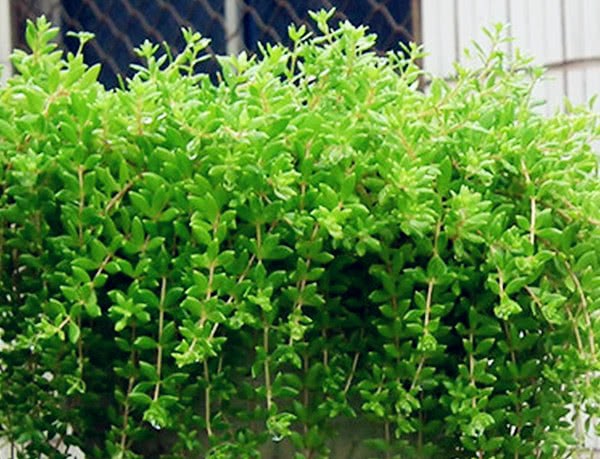
Stringy Stonecrop is also called Kuijingtian, Snake Grass, Dog's Tooth Grass and Stone Vegetable. It is a succulent plant of the genus Sedum in the Crassulaceae family, with creeping stems that root easily; the sterile branches and flowering stems are slender, creeping and rooting at the nodes, extending up to just below the inflorescence, 10-25 cm long. Leaves in whorls of 3, leaves oblanceolate to oblong, 15-28 mm long, 3-7 mm wide.
The flowering stems of Stringy Stonecrop are slender, creeping, and root at the nodes; the leaves are whorled, oblanceolate to oblong; the cyme is few-flowered, and the flowers are sessile; the sepals are lanceolate to oblong, the petals yellow, lanceolate to oblong, the nectar scales wedge-shaped and square, the seeds ovate; it flowers from May to July and fruits in August.
Stringy Stonecrop generally grows on rocky crevices on mountain slopes, along mountain gullies, and in moist places by riversides. It is extremely easy to cultivate and is not demanding about its environment; it can be planted in front of or behind the house, and can also be grown in pots. It is usually propagated by division. Stringy Stonecrop looks superb when hung up and grown!
Medicinal lore:
It is said that at the foot of Weifeng in the Qing Dynasty, there was a farmer surnamed Zeng, 40 years old, with one son and one daughter; the man farmed and the woman wove, and they lived very well. One day the man suddenly had abdominal pain, tenesmus, and bloody mucous stools, more than twenty times a day. A local doctor was urgently called; he diagnosed dysentery, but the medicine was ineffective. One day, the daughter pulled up a basket of pigweed and brought it back, and among it there was a lot of Stringy Stonecrop. Zeng remembered that this grass could treat diarrhea in pigs, so he asked his wife to boil a bowl of it for him to eat with congee. After just two bowls, his stomach stopped hurting; after taking it for 3 days in a row, the bloody mucus stopped completely and the dysentery was cured. When neighbors suffered from the same dysentery, they also ate this grass with congee, and all of them recovered. Word spread from one to ten and from ten to a hundred, and many people came to know that Stringy Stonecrop had a miraculous effect in treating dysentery. Afterward, folk tradition also held that Stringy Stonecrop could treat jaundice and other diseases.
The effects and functions of Stringy Stonecrop:
1. It has the effects of clearing heat and draining dampness, removing toxins and reducing swelling, and cooling the blood and stopping bleeding.
2. For scalds from boiling water and fire, fresh Stringy Stonecrop can be washed, pounded into juice and applied externally.
3. For incipient carbuncles and swellings, besides being decocted and taken orally, fresh grass can also be washed, pounded and applied externally, which can also reduce the carbuncle and swelling.
4. It is good at neutralizing snake venom and is a commonly used folk medicine for treating venomous snake bites. Half a jin of fresh grass can be used alone, washed with cold boiled water, pounded and squeezed for juice to take orally, once or twice a day; it can also be decocted and taken orally together with Scutellaria barbata, wild chrysanthemum, Bidens bipinnata, plantain, raw rhubarb and other medicines, and fresh grass can be washed, pounded and applied externally.
5. Stringy Stonecrop used alone to treat infectious hepatitis (including acute icteric hepatitis, acute anicteric hepatitis, as well as persistent hepatitis and the active phase of chronic hepatitis) can also reduce or eliminate the patient's damp-heat symptoms such as a bitter taste in the mouth, poor appetite, and dark yellow urine.