7 succulent ground cover plants that easily fill a pot and are simply beautiful
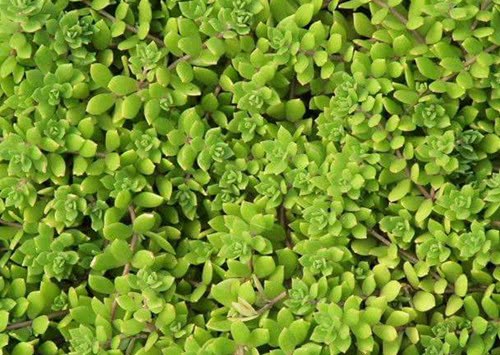
Ground cover plants refer to the low, dense layer of small plants on the soil surface of flower and tree bonsai pots. The presence of these small, delicate ground cover plants not only enhances the ornamental value, but also maintains the permeability of the potting soil after watering. The growth of ground cover plants is not to be underestimated - if you are not careful, they may take over as the main role and steal nutrients from the star of the bonsai!
However, no one says we cannot grow a big pot full of ground cover plants, right? Even if you plant just one variety of succulent ground cover, a full pot is a visual treat!
1. Stringy Stonecrop (Sedum sarmentosum)
Stringy Stonecrop is a perennial succulent herb in the Crassulaceae family, Sedum genus. The flowering stems are slender and creeping, rooting at the nodes; leaves are whorled, oblanceolate to oblong; the inflorescence is a cyme with few flowers, and the flowers are sessile; sepals are lanceolate to oblong; petals are yellow, lanceolate to oblong; scales are wedge-shaped and square; seeds are ovate. It flowers from May to July and fruits in August.
Stringy Stonecrop generally grows in rock crevices on mountain slopes, along mountain gullies, and in moist areas by rivers. It is extremely easy to cultivate and has no strict environmental requirements. It can be planted in front of or behind the house, and can also be grown in pots. It is usually propagated by division.
2. Japanese Stonecrop (Sedum lineare)
A very common ground cover plant that is very easy to keep alive! Extremely adaptable! Cold-resistant, drought-resistant, salt-alkali resistant, barren-tolerant, and resistant to pests and diseases. It can be enjoyed as a potted plant or planted as an outdoor ornamental ground cover. Japanese Stonecrop likes light, its leaves tolerate shade, and it is not particularly strict about soil. It will not die even in frosty conditions with temperatures of minus 5 degrees Celsius in winter. It basically does not need watering, making it very easy to care for. Evergreen in all four seasons, it is suitable for succulent lovers who do not want to do much maintenance!
3. Little Ball Rose (Sedum spurium 'Dragon's Blood')
The Little Ball Rose has a very appealing appearance and likes full-sun conditions. Although it can also grow in partial-sun conditions, its ornamental quality will be greatly reduced. It can adapt to higher-temperature environments and can tolerate a certain degree of low temperature, but it needs to be kept above zero degrees.
4. Sedum dasyphyllum
Sedum dasyphyllum is a full-sun plant and is suitable for growing in an environment with ample sunlight, but strong direct sunlight should be avoided. It can also grow in partial shade. It is cold-resistant, and the most suitable temperature for growth is 18-25°C.
5. Sedum hispanicum
Sedum hispanicum has a white waxy powder covering its surface and blooms in summer, which is quite attractive. As a member of the Crassulaceae family, Sedum genus, Sedum hispanicum actually has its most vigorous growth period in winter. At other times, it likes a warm, dry environment with ample sunlight, and strong direct sunlight should be avoided.
6. Golden Japanese Stonecrop (Sedum japonicum 'Tokyo Sun')
Golden Japanese Stonecrop, as a member of the Crassulaceae family, Sedum genus, is truly succulent as its name suggests, with a bright and charming appearance, and its golden hue is especially appealing! Rather than saying succulent lovers use it as a ground cover plant, it would be more accurate to say they are inclined to admire it on its own when it fills a pot!
7. Sedum makinoi
Sedum makinoi has very small leaves in a jade-green color. Almost every leaf looks small and delicate, crystal clear. It likes a full-sun environment and can also grow in partial sun, though in partial sun the leaf arrangement will be relatively loose! Generally speaking, it is drought-tolerant. You can wait until the medium is slightly dry before watering, and no special fertilizing is needed.