Bougainvillea glabra: A Unique Flower with Triangular Blooms
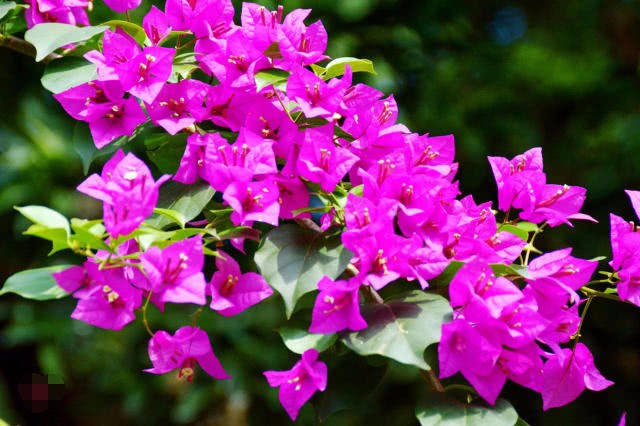
Bougainvillea glabra, also known as paper flower, lesser bougainvillea, and bougainvillea, Latin scientific name: Bougainvillea glabra Choisy. A vine-like shrub of the Nyctaginaceae family and the Bougainvillea genus. Stems thick and sturdy, branches drooping, hairless or sparsely pubescent; thorns axillary, 5-15 mm long. Leaves papery, ovate or ovate-lanceolate. It prefers a warm, humid climate, is not cold-tolerant, and loves full sunlight. It has many varieties and strong adaptability; it is not only widely distributed in southern regions, but can also be cultivated in the cold north. Native to Brazil. In southern China it is planted in courtyards and parks, while in the north it is cultivated in greenhouses; it is a beautiful ornamental plant. The flowers are used medicinally to harmonize qi and blood, treat leukorrhea, and regulate menstruation.
Bougainvillea glabra
Growth habits:
Comparative analysis was conducted under different temperatures, different light conditions, and different moisture conditions. The results showed that potted Bougainvillea glabra enters a forced dormant state when the temperature drops to a certain level; during the non-dormant period, Bougainvillea glabra experiences abnormal flower drop due to insufficient light, and with ample moisture the flowers fade early; in the dormant state, bougainvillea is insensitive to light intensity, but due to low temperature it shows a longer lifespan, and due to low moisture it also shows a longer lifespan.
It prefers a warm, humid climate, is not cold-tolerant, and loves full sunlight. It has many varieties and strong adaptability; it is not only widely distributed in southern regions, but can also be cultivated in the cold north. However, in the north the flower colors tend to be more uniform. Or there may be regional variation; this is not a general statement.
Bougainvillea glabra
Ornamental value:
Bougainvillea glabra has large bracts with vivid colors like flowers, and they last a long time, making it suitable for garden planting or potted ornamental display. It can also be used for bonsai, hedges, and pruning into shapes. Its ornamental value is very high. In Brazil, women often wear it in their hair as decoration, which is quite unique. In Europe and America it is commonly used as a cut flower. In southern China it is planted in courtyards and parks, while in the north it is cultivated in greenhouses; it is a beautiful ornamental plant.
Bougainvillea glabra
Medicinal value:
The leaves can be used medicinally; pounded and applied to the affected area, they have the effect of dissipating blood stasis and reducing swelling. The flowers of Bougainvillea glabra can serve as the medicinal source, activating blood and regulating menstruation, and resolving dampness to stop leukorrhea. They treat blood stasis amenorrhea, irregular menstruation, and red and white leukorrhea. The stems and leaves of Bougainvillea glabra are toxic; eating 12-20 pieces can cause diarrhea, bloody stool, and so on. The flowers are used medicinally to harmonize qi and blood, treat leukorrhea, and regulate menstruation.
Other applications:
Bougainvillea glabra is suitable for people whose Five Elements belong to Fire to plant in the living room. If the house door faces south (Five Elements belonging to Fire): a Fire-element Bougainvillea glabra should be planted in the living room, which is beneficial for regulating the health of a person's heart and intestines and stomach, and for people who are introverted, timid, melancholic, and lack courage and confidence in life, it also has the effect of warding off evil and protecting the body.