What kind of succulent plant is Orostachys spinosa?
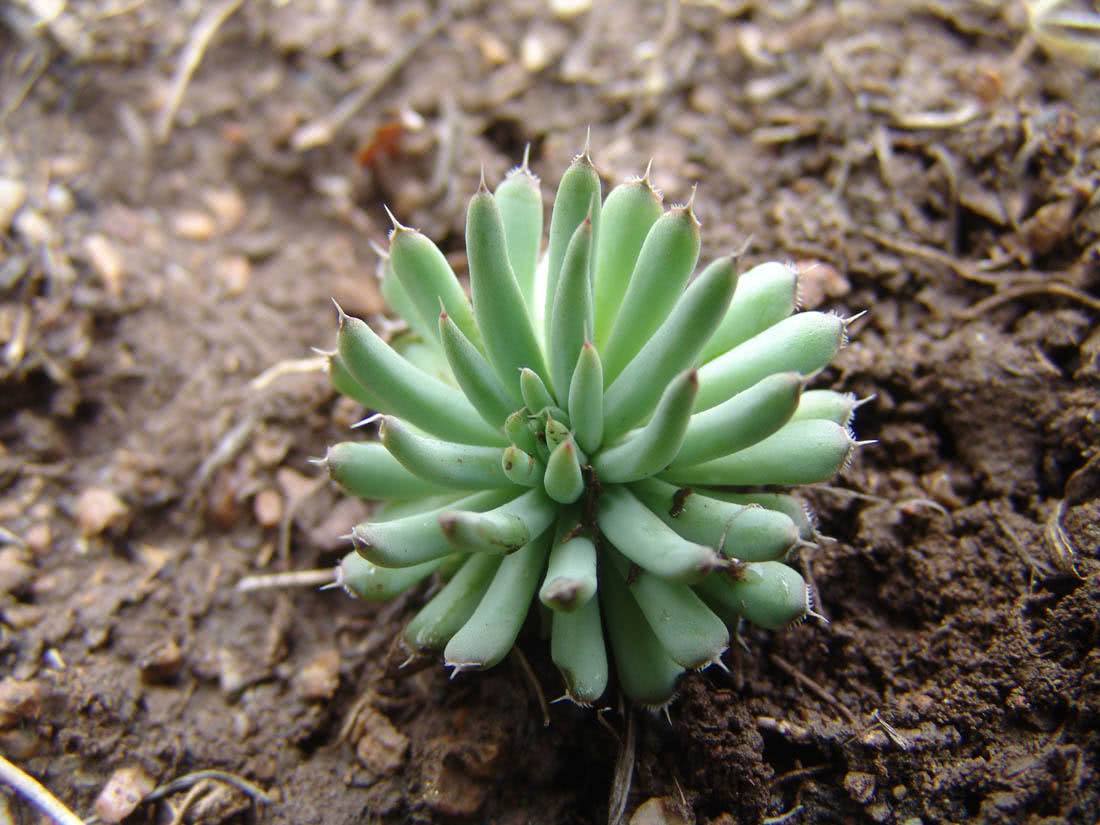
Orostachys spinosa: A biennial herbaceous plant in the genus Orostachys of the Crassulaceae family. Densely covered with leaves, white, cartilaginous appendages; flowering stems can reach up to 30 cm tall; leaves alternate, broadly linear to oblanceolate; inflorescence terminal, bracts lanceolate to oblong; sepals ovate-oblong with red spots; petals yellow-green, ovate-lanceolate; anthers yellow; scales nearly square; follicles elliptic-lanceolate; flowers in July-August, fruits in September.
Distributed in northern and northeastern China. Also found in Korea, Mongolia, Russia and other places. Grows at altitudes of 600-2900 m in crevices of dry mountain slopes. This species has excellent ornamental value and can be used as a flower bed plant on hillsides, rock gardens or rooftops; it is a wild flower with development potential.
Orostachys
Morphological characteristics:
Biennial herb. In the first year it forms a rosette, densely covered with leaves; rosette leaves oblong, apex with a semicircular, white, cartilaginous appendage, center with a white, cartilaginous spine 2-4 mm long. Flowering stems 10-30 cm tall; leaves alternate, broadly linear to oblanceolate, 1-3 cm long, 2-5 mm wide, apex acuminate, with a cartilaginous spine, base sessile.
Inflorescence terminal, narrow and elongated, spicate or racemose, 5-20 cm long; pedicels 1 mm long, or sessile; bracts lanceolate to oblong, up to 4 mm long, with a spiny tip; sepals 5, ovate-oblong, 2-3 mm long, apex acuminate, with a spiny tip, with red spots; petals 5, yellow-green, ovate-lanceolate, 5-7 mm long, 1.5 mm wide, connate at 1 mm from the base, apex acuminate; stamens 10, slightly longer than the petals, anthers yellow; scales 5, nearly square, 0.7 mm long, apex slightly emarginate. Follicles 5, elliptic-lanceolate, 5-6 mm long, erect, base narrow, beak 1.5 mm long; seeds oblong-ovate, 0.8-1 mm long. Flowering period July-August, fruiting period September.
Orostachys
Pest and disease control:
Few pests and diseases. When air humidity is too high during the rainy season, spray once with carbendazim or thiophanate etc. to prevent powdery mildew. When used as ground cover or in flower borders, because the density is high after forming a turf and the plants are closed together with poor ventilation, silverleaf whitefly damage is prone to occur; use 10% imidacloprid wettable powder at 1000 times dilution or 25% buprofezin wettable powder at 1500 times dilution, spray once every 5-7 days, spraying twice in succession, to control it.
Ornamental:
Around the Dragon Boat Festival, the bulbs grow to the size of a thumb; harvest them with roots and plant them in clusters in small pots, placing them on a balcony is very charming. Especially when tied with string and hung bare indoors, they grow into a U shape and decorate the interior, very unique. The epidermal layer of the scales contains wax, which protects against water evaporation. In dry and water-scarce seasons, the water stored in the scales supplies the normal growth of stems and leaves until the water is used up, and the bulb withers, completing its growth cycle.
Medicinal:
Korean medicine: The whole plant treats stubborn skin ulcers and hemorrhoids, "Illustrated Korean Medicine".
The whole plant of Orostachys spinosa. Nature and flavor: sour and bitter, cool, toxic. "Bencao Zaixin": "Enters the liver and lung meridians."
Precautions: "Quanzhou Bencao": "Contraindicated for those with deficiency-cold of the spleen and stomach."
Orostachys
Plant culture:
In traditional Chinese culture, it is mostly a symbol of residing in a high position. The Tang dynasty poet Li Ye wrote in "Orostachys on the Wall of the Shangshu Hall" praising Orostachys: "The secret immortal traces in the splendid ministry, the tall hall reveals Orostachys. Leaves grow after spring, flowers are dense for the rain. Shadows blend with mandarin duck colors, light contains jadeite appearance. Naturally this is where it resides, the terrain is too without reason. Connecting the ridge and facing the double towers, continuous eaves near the nine layers. How would one know at the bottom of a deep ravine, frost and snow seal it year after year." Expressing his wish to rely on authority and reside in a high position in the court. Yet Zheng Gu's "Chrysanthemum" says: "Do not compare the prince's descendant to weeds, on the ninth day each branch approaches the hair on the temples. Dew moistens autumn fragrance full of the pond bank, never envying the height of Orostachys" showing disdain and no envy toward Orostachys. Some ancients believed that although Orostachys can bloom and put forth leaves, it is "less than a chi tall, only as small as a cun below," with no practical use, so "the physician does not appreciate it, the carpenter finds it hard to select." Zheng Gu contrasts the chrysanthemum on the pond bank with the Orostachys on the high roof, intending to show that although the chrysanthemum grows in marshy lowlands, it is noble and serene, sparing no effort to offer its fragrance to people; while Orostachys, though occupying a high position, is in fact "useless to people, achieving nothing among things." Here, the utterly useless Orostachys serves as a foil to the chrysanthemum's noble sentiment of not seeking power or fame, which in fact reflects a lack of understanding of Orostachys's value; it is a writing technique of the ancients to praise one and suppress another, and also a reflection of the narrow-minded thinking of traditional literati lacking magnanimous and inclusive thought.
In the hearts of ordinary Chinese people, it is an ordinary yet great little grass, embodying the humanistic spirit of the Chinese people's willingness to be ordinary, tenacious resistance, endless vitality, and independent character. The modern folk poet Chen Cunwan wrote a "Seven-Character Quatrain - Orostachys": "Standing in the cracks of tiles, why fear hardship? A jade body dares to defy frost and cold. Do not sigh that it cannot match the greatness of the green pine, its style has never been second to any," and also praised: "The jade branches seem as if they cannot withstand wind, why should a loyal heart not help the poor world. The sharp axe and proud sun baptize it twice, a single spiritual medicine is offered to Shennong," both writing of the great spiritual charm contained in the ordinariness of Orostachys.