The spring grass is a succulent plant with a unique form and quaint bulbs
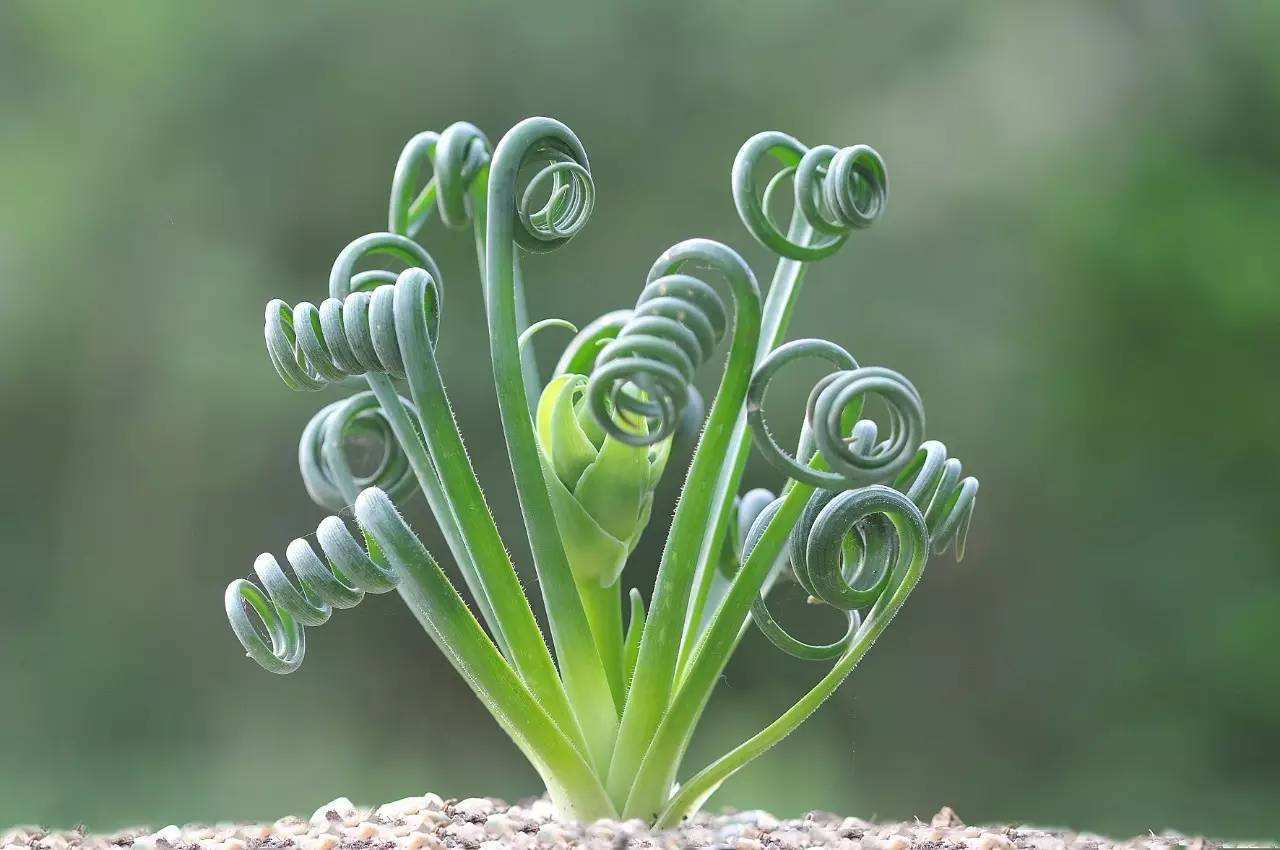
Spring grass is a perennial bulbous succulent plant in the family Asparagaceae, genus Albuca. The plant has round or irregular bulbs; the skin of the underground portion is yellowish-white, while the part exposed above the soil is yellow-green. Its linear leaves emerge from the top of the bulb, initially growing upright and later gradually twisting and curling. The flower stalks emerge from the leaf cluster, bearing racemes; the small flowers hang downward, with petals pale yellow on the front and yellow-green on the back, blooming from March to April.
It is distributed in the Cape Province of southern Africa and Namibia. It prefers a cool, moist environment with plenty of sunlight, fears damp heat, tolerates partial shade, is also tolerant of drought, and has a certain degree of cold hardiness. It goes dormant in summer and grows from autumn to spring.
Spring grass has a unique form and quaint bulbs; its lines are smooth and graceful, full of variation, and its flowers are elegant and fresh. It is suitable for growing in small pots and placing as an accent on windowsills, desks, and other spots, where it is unusual and interesting.
Spring grass
Sowing:
After spring grass blooms, different plants should be selected for artificial pollination so that the plants set seed. Once the seeds mature, take care to harvest them and do not let them scatter; if no seed is to be kept, promptly cut off the remaining flower stalks after blooming to avoid consuming too many nutrients. For mass propagation, sowing can be done in autumn. After sowing, cover with a thin layer of soil and place a piece of glass over it to keep the soil and air moist, which gives a fairly high germination rate. After sowing and during the seedling stage, to avoid washing the seeds or young seedlings out of the soil when watering, use the "seep irrigation" method.
Spring grass
Division:
Break off the small bulbs that sprout around the large bulb and plant them separately in potting soil; they readily survive.
Pest and disease control:
Spring grass has few pests and diseases. The main pests are snails and nematodes in the soil that damage the bulbs. When planting, the soil can be treated at high temperature to kill pests and eggs in the soil, or insecticides such as carbofuran can be mixed into the potting soil. However, because "carbofuran" is a highly toxic pesticide with very poor degradability, improper use can harm the environment, so it must be used with great caution.
Spring grass