Succulents suffer damage from moths no less than from scale insects, especially severe in summer
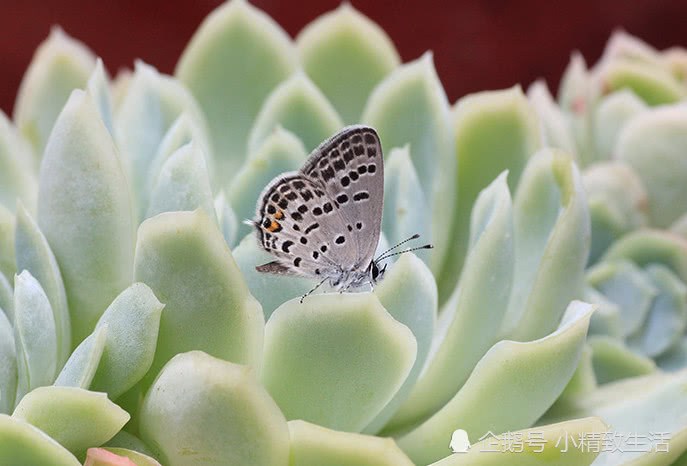
Friends who grow succulents outdoors may have more or less experienced attacks by the lycaenid butterfly (Tongeia filicaudis). Summer is the outbreak period for this butterfly. Most succulents already struggle enough in summer, and then suffering raids by the lycaenid butterfly, the poor succulents may very well end up with not even a trace left. So, what is the modus operandi of the lycaenid butterfly? How do you deal with it? Below, Little Exquisite Life will discuss this with everyone one by one.
The lycaenid butterfly's favorite is Crassulaceae Sedum genus grasses; the entire Sedum genus is its favorite. Its reproductive capacity is super strong. It usually lays eggs on the back of leaves, very small, only about 0.4 mm. Its eggs cannot be killed with chemicals. Once found, you can only use the toothpick-pricking method to puncture them, but what drives people crazy is that this thing lays eggs every night. Often you just finished pricking them clean one day and the next day there are more, driving people to mental breakdown... But it is still recommended to spray some conventional chemicals when you find the eggs, because although the eggs cannot be killed, the newly hatched larvae can still be killed.
But if you let these worms on the succulents, they will directly bore into the interior of the leaves, and then chemicals are basically useless again. It will hide inside the leaf slowly enjoying a feast, until the entire leaf is eaten hollow and then it bores into another leaf.
And even if the larva has eaten its fill and comes out to wander around and bask in the sun, because it has protective coloration that can change its own color according to the plant's color, it is still very hard to find...
If your succulent shows the road-colored feces in the picture below, then there is basically no escaping the presence of worms...
If your succulent turns out like this, then it is one hundred percent the work of this thing.
If you do not find the larvae and let them grow large enough to spin cocoons, then congratulations, your succulents will soon become the strike targets of a new fighter group, and they will carry out the next round of egg-laying bombardment...
So, how do you deal with these "troublesome moths"?
First, if manually killing the eggs, it is generally done by pricking them to death with a toothpick. There is also a more labor-saving method: wrap clear tape in reverse around a small wooden stick and then use it to stick the eggs.
In addition, as mentioned above, the lycaenid butterfly generally takes within one week from laying eggs to hatching larvae. During this period, you can try spraying some conventional chemicals such as carbofuran, Tudanling, DX Xiaobaiyao, abamectin, Huhuashen, etc., so that the newly hatched larvae can be killed by the chemicals before they have time to bore into the interior of the leaves.
Then, the most effective method is still prevention. Put up insect-proof netting; it both prevents insects and can also provide shade.
The above are the growth habits of the lycaenid butterfly and the methods to deal with it. I hope it can be of some help to everyone.
Compiled and published by Little Exquisite Life.