Monstera deliciosa is suitable for growing at home and thrives in a warm, humid environment.
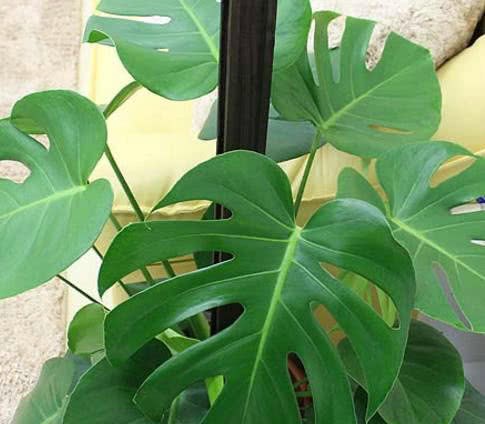
Monstera deliciosa has an elegant posture, a distinctive form, a fresh and graceful appearance, large leaves, and stays green through all four seasons, never withering all year round. It is suitable for the family living room, bedroom, study, and doorway. It is an elegant foliage plant that makes people feel spring is always present, with a distinctive charm. In particular, its broad, thick, and glossy leaves play a certain role in absorbing indoor carbon dioxide, purifying the indoor air, and benefiting people's physical and mental health.
Monstera deliciosa likes warmth and is suitable for growing in a warm, humid environment; it is not cold-tolerant. The suitable growing temperature is 20-25°C. Monstera deliciosa grows relatively fast and needs repotting once a year. The best time for repotting is March-April in spring or September-October in autumn. When repotting, remove part of the old soil, cut off dead roots, and move it into a purple clay pot or earthen pot one size larger. The bottom of the pot should be given sufficient fully rotted cake fertilizer powder or fully rotted dried chicken and duck manure powder; depending on the size of the pot and the plant, generally 100-150 g of fertilizer per pot is suitable. The powder fertilizer should be mixed evenly with the soil and placed in the bottom layer as base fertilizer. Then add loose, well-aerated, well-drained, humus-rich
Monstera deliciosa has large leaves and thick stems and needs a lot of fertilizer. Therefore, during the growing season, apply fully rotted cake fertilizer water 2-3 times a month. When applying fertilizer in the evening, first move the flower pot outdoors, scrape the soil around the pot toward the center, then apply the liquid fertilizer around the edge of the pot, immediately cover it with soil, and water moderately to avoid a foul odor from the liquid fertilizer.
For home potted propagation of Monstera deliciosa, the cutting method is mainly used. Cuttings should preferably be taken in spring and autumn. For the cutting medium, river sand held in a large pot is best; the river sand should first be rinsed with clean water to wash out impurities in the sand. For cuttings, cut stem sections with nodes from the mother plant. For cuttings, choose side branches of the current year that are firm in tissue and free of pests and diseases. For each cutting, it is best to use the two stem nodes from the middle and upper parts, as they have strong sprouting ability, while the stem nodes at the base have poor sprouting ability.