The complete process of making and shaping an elm forest-style bonsai
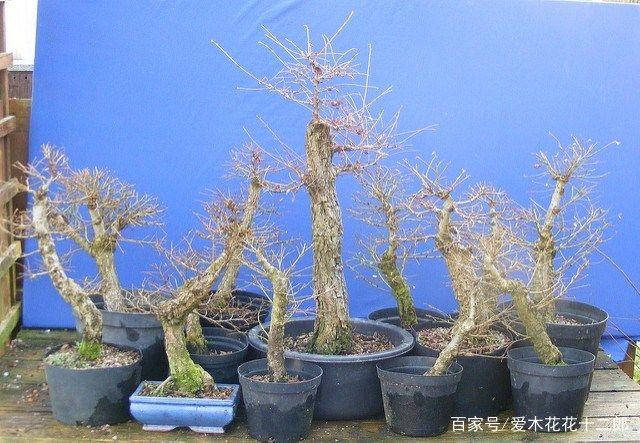
This bonsai artist and his good buddy had been planning to make a forest-style bonsai for many years. 8 years ago (2001), they took a batch of elm cuttings, and over those 8 years they kept shaping them. Now these 10-plus elms have taken shape and are ready to be worked on. Forest-style bonsai does not demand much of any single tree, but it is best if there is variation in height and thickness. Judging by the curves of their trunks, these 10-plus elms would also make very good bonsai individually. I do not understand the world of the wealthy; I am just here to watch the fun.
A few buddies spent 10 pounds on a plastic tray, drilled holes in the bottom, and propped it up with wooden strips to serve as a pot.
Wire is threaded through from below to secure the elms; first a layer of coarse granules is laid down underneath.
Preparing the material, 9 trees were selected. There is an unwritten rule in bonsai, though it is not absolute: forest-style or multi-trunk styles generally use an odd number, except for double-trunk. Before potting, the roots and branches are combed through, and whatever needs cutting is cut.
Then, according to each tree's form, a suitable position is found for each one, and they are fixed in the pot.
Generally speaking, the main tree, that is, the tallest one, is not placed in the middle; it is best placed at the golden ratio position. The positions of the remaining smaller trees should have both spacing and density.
Then fill in the soil
Viewed from the two sides, there also needs to be distribution from front to back.
The effect seen from the back
After two years of free growth, all 9 trees have survived, and there is too much foliage and too many branches, so pruning is needed.
After a simple combing through, it looks pretty good too.
After another half year of growth, the branches have become much denser again.
So it is pruned once more. Elms have strong sprouting ability, and the branches tend to grow long, so they can be pruned two to three times a year.
After more than another year of building up branches and pruning, it has basically taken shape. Once the roots of the 9 trees are completely tangled together, switching to another pot can be considered. This plastic tray is really too ordinary; if it were switched to a cloud pot, with some rockery stones and green moss added, the effect should be decent. I have to say the bark of this elm is really quite nice.