How to grow marigolds? A flower care guide that can monitor ozone
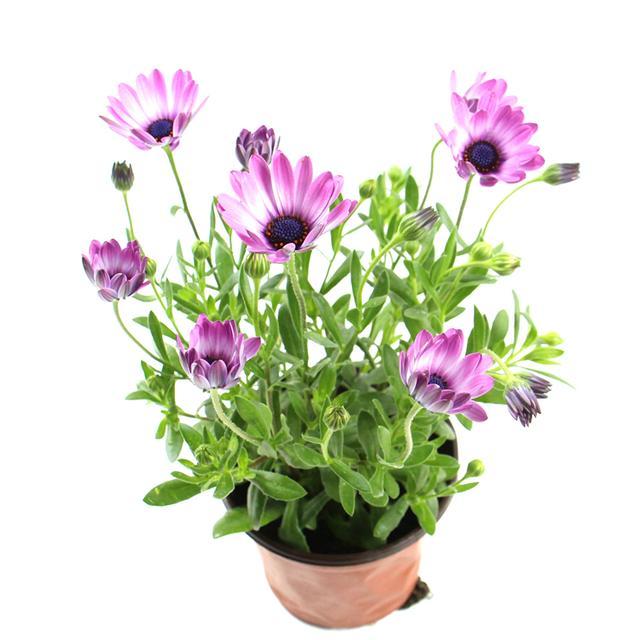
A marigold flower care guide for "monitoring ozone"
Marigold, also known as stinking marigold, belongs to the genus Tagetes in the Asteraceae family. It is an annual herbaceous plant with an upright, sturdy stem, fine longitudinal ridges, and branches spreading upward. Marigolds are usually sown in spring. Because their flowers are large and the blooming period is long, they are often used for flowerbed landscaping. The picture shows a potted marigold.
1. Monitoring effect
Marigolds are able to monitor sulfur dioxide and ozone. Their reaction to both gases is very sensitive. When attacked by sulfur dioxide, their leaves turn grayish white, irregular spots appear between the veins, and the leaves gradually lose green color and turn yellow; when attacked by ozone, the leaf surface becomes waxy, necrotic spots appear, and after drying they become white or brown, while the leaves turn red, purple, black, brown, and other colors, and drop early.
2. Care guide
(1) Pot selection. For planting marigolds, it is best to use unglazed earthenware pots; plastic pots are also acceptable, and porous pots are preferable.
(2) Soil selection. Marigolds do not have strict soil requirements, but they grow best in loose, fertile, well-drained sandy loam, and the soil is best when fine and powdery.
(3) Cultivation. Cut young branches into 10cm-long cuttings, keep 2 leaves at the top, and make the cut smooth. Mix 5g of rooting powder with l-2kg of water, add 800-fold dilution of 50% carbendazim wettable powder to make a seedling soaking solution, dip 1/2 of the cutting into the solution, and immediately insert it into the pot soil to a depth of about 1/2 the pot height. Gently firm the pot soil, then water thoroughly.
(4) Light. Marigolds like sunlight, and sufficient sunlight can significantly improve flower quality.
(5) Temperature. The suitable growth temperature for marigolds is 15-25°C, and in winter the temperature must not be lower than 5°C. When the summer temperature is higher than 30°C, the plant will grow excessively, making the stems and leaves less compact and reducing flowering; when the temperature is lower than 10°C, the plant can still grow, but the growth rate will slow down,
(6) Watering. Both the watering time and amount for marigolds must be appropriate. Do not let too much water accumulate; keeping the soil slightly moist is enough. For newly planted young marigolds, in hot weather, spray 2-3 times a day to keep the pot soil moist. Watering marigolds should follow the principle of "water when dry, stop when wet."
(7) Fertilizing. Marigolds bloom for a long time and therefore need relatively more nutrients. They like potassium fertilizer, and the application ratio of nitrogen, phosphorus, and potassium fertilizer should be 15:8:25. During the growth period, topdressing is needed about every 15d. At the peak blooming stage, 0.5% monopotassium phosphate can be used for foliar topdressing.
(8) Propagation. Marigolds can be propagated by sowing or cuttings. When using sowing propagation, it can be done throughout the year. When using cutting propagation, it is best to do it in May-June, when the plants are easy to keep alive.
(9) Pruning. Marigolds bloom for a long time. In the later stage, the branches and leaves of the plant dry up and age, and it is easy for the plant to topple over, which is not good for viewing. Therefore, remove the remaining flowers on the plant as soon as possible, and apply fertilizer as soon as possible to encourage the plant to bloom again.
(10) Placement. The flowering period of marigolds is relatively long. They can be placed in pots on windowsills, desks, and tables, or single stems can be made into cut flowers for vases.