Succulent Sun Protection Methods and Aftercare Tips for Sunburn
Succulent Sun Protection and Aftercare for Sunburn
Every spring, some tragic stories about succulents happen, and sunburn is one of them. What? Sunburn in spring too?
Red Grape severely sunburned after being exposed to blazing sun following watering
Condition after sunburn
The succulents spend the cold winter in cozy indoor conditions, and after months in an environment with insufficient sunlight, spring suddenly arrives. Everyone joyfully carries them outdoors to receive the baptism of sunlight, and then tragedy strikes. Spring sunlight is very intense, and this sudden change in environment is lethal to plants. So not only should you pay attention to sun protection in spring, but you should also take appropriate sun protection measures in summer and autumn.
Surely someone will ask: why don't greenhouses need shade cloth? Home cultivation and greenhouse cultivation are completely different. Greenhouses provide an almost full-sun environment, and succulents that have long been in such an environment have already adapted to high-intensity sunlight, so even without shading there is no problem. The home environment is very comfortable, and sunlight is not very abundant. Due to the sudden change to strong sunlight caused by climatic conditions, the leaves are very easily scorched.
There are many ways to prevent sunburn. In a home environment, you can refer to the following points:
1. Avoid suddenly moving plants from a position with weaker sunlight to blazing sun exposure.
2. Glass blocks part of the ultraviolet rays, so there is no need to move plants placed behind a glass window; there is also no need to move them behind a screen window or mosquito net;
3. In some areas with strong sunlight, you need to pull up a shade net, and the density can be determined according to the light intensity.
4. While protecting from sun, you also need to pay attention to two other situations: clear skies after a rainstorm, or blazing sun after watering. Both situations can cause sudden death of succulents. After moist soil receives strong sunlight, the inside of the pot begins to heat up, and water evaporates to create a sauna effect. The succulent's root system is quickly steamed to death, and then the whole plant rots. So after entering summer, watering must be done at night or on cloudy, overcast days, avoiding watering under the blazing sun on clear days.
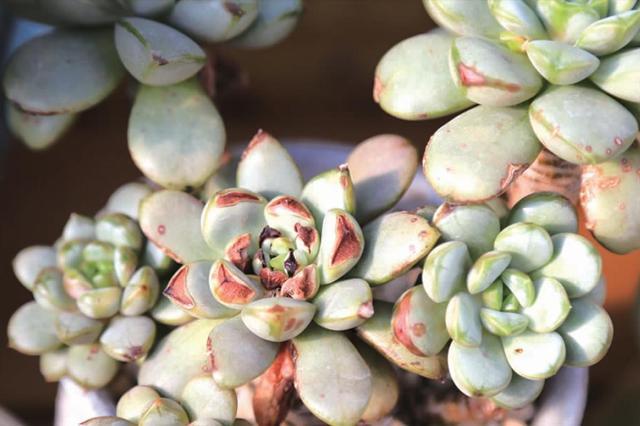
Pachyphytum 'Moonstone' sunburn
Aftercare for sunburn
After sunburn, it cannot be shown on the plant leaves the same day; various scars may appear over the following week, so it is not very easy to detect. When sunlight suddenly becomes intense, succulent leaves soften under direct sunlight and may even collapse. Such situations require attention. Once a situation resembling possible sunburn appears, we need to handle it in the following ways.
1. Move it to a position with relatively weaker sunlight (a bright, indirect light spot), or pull up a layer of shade net.
2. Appropriately increase ventilation to avoid a stuffy, hot environment.
3. If the soil is especially dry, you can water once 2 to 3 days after moving it to a bright, indirect light spot, ensuring the plant can normally absorb water to recover its health.
4. Do not pull off scorched leaves just because they look unsightly. The leaves still store nutrients, and during the recovery period the succulent will prioritize consuming the nutrients from these damaged leaves.
5. For some plants with especially severe scorching, they need to be dug out, have their roots cleaned, be dried, and then be repotted in fresh soil. The soil during the recovery period is best kept as soft and water-retentive as the soil used for raising seedlings.
Succulent steamed to death
Sunburned Red Rolled Leaf
6. If you like outdoor cultivation, even if sunburn occurs you do not have to move it. Keep the current environment, and the plant will gradually train itself to adapt to this sunlight intensity. For routine care, adopt a watering method of small amounts and frequent watering, to avoid rot caused by excessive water evaporation. Increase ventilation to cool down the plant and soil. (This outdoor cultivation method is not suitable for small seedlings, and there is a certain possibility of sunburn death.)
7. After sunburn, all succulent plants' leaves themselves will not recover. You can only wait for the plant's center to grow new leaves, consume the sunburned leaves, and restore its beauty.
Sunburned Pachyphytum compactum f. cristatum
Sunburned Echeveria
Sunburned Echeveria
Sunburned Echeveria
Depending on the succulent variety, the damage caused by sunburn and the recovery speed both differ.
I. Crassulaceae, Aeonium genus
This type has very thin leaves. If it has not been trained by strong sunlight and is suddenly moved from a position with relatively weak sunlight to strong sunlight, the situation in the picture below will appear. Doesn't it look kind of like it just woke up... In the first two days after sunburn, the leaves do not change much, but after 3 to 5 days, scars on the leaves appear one after another. Fortunately, Aeonium-type leaves renew quickly, and after normal care they can recover in about two weeks. The sunburned leaves slowly dry up and fall off, and then new leaves grow from the center. Jishan Huayao
II. Crassulaceae, Sedum genus
This type very easily produces multiple heads and clusters, so the leaf center is often sunburned. Unlike the handling methods for other varieties, once the leaf center is sunburned, recovery is very troublesome. So the sunburned leaves at the leaf center need to be removed with tweezers, which can create new growth points. The recovery speed is relatively slow. During the recovery period, be sure to replenish water to speed up recovery. It is also okay if it becomes a bit leggy after being placed in bright, indirect light.
III. Crassulaceae, Echeveria genus
For rosette-type succulents, the leaf edges are generally the parts prone to sunburn, and after sunburn they actually look quite nice... For these, you only need to provide normal care and slowly wait for recovery! In later care, pay attention to using a watering method of frequent small amounts, to avoid stuffy, damp conditions and rot. If flower stalks extend out, they can all be cut off, allowing the plant to preserve more nutrients to recover its body.