What are the domestication methods for hydroponic plants?
Domestication methods for hydroponic plants
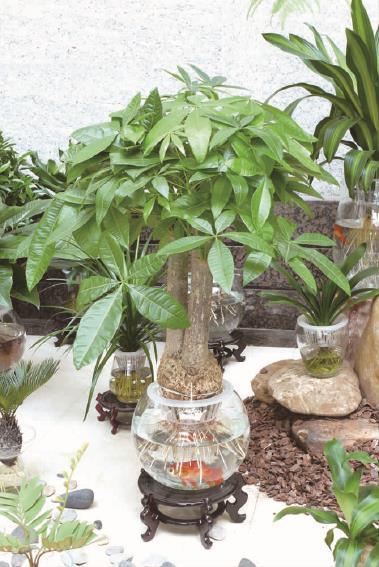
Hydroponic money tree
Hydroponic gold-heart Yemen iron tree
Hydroponics is a new type of soilless cultivation method for plants, also known as nutrient solution culture. Its core is to fix the plant roots and stems in a planting basket and let the root system hang naturally into the plant nutrient solution. This nutrient solution can replace natural soil in providing the plant with water, nutrients, oxygen, temperature and other growth factors, enabling the plant to grow normally and complete its entire life cycle. Hydroponic flowers are a new type of flower product that allows you to observe the growth process of the flower's root system while also achieving the co-cultivation of flowers and fish. Because of its advantages of being clean, environmentally friendly and elegant, it is gradually welcomed by the domestic and international flower industry and by flower enthusiasts.
I. General domestication process for hydroponic plants
1. Removing soil and washing roots: The soil and organic matter on the root system of soil-cultured plants must all be cleaned off, otherwise it will affect the normal growth of the hydroponic flower later or increase the probability of infection by pests and diseases.
2. Root pruning: For plants that adapt relatively easily to an aquatic environment, only simple pruning of the soil-grown roots is needed, cutting off old roots and diseased roots to prevent contamination of the water environment. Some plants are relatively difficult to adapt to an aquatic environment. In order to promote the plant's adaptability to the aquatic environment, all of their soil-grown roots need to be cut off, and then a rooting agent is used to stimulate root growth.
3. Disinfection: The aquatic environment is a relatively clean environment. If the roots carry harmful substances such as bacteria, they will contaminate the plant's water environment. Generally, potassium permanganate is used to disinfect the plants. For ordinary herbaceous plants, a disinfection time of a few dozen seconds is enough. For woody plants such as the money tree and banyan, the plants need to be soaked and disinfected for a long time to completely kill the bacteria.
4. Root stimulation: For many plants whose roots have been cut, root stimulation is a very important step, as it can accelerate the growth of water roots. A rooting agent is mostly used for treatment.
5. Domestication: The domestication process is to place the plant fixed in a planting basket or substrate. The substrate is generally perlite. Necessary nutrients are added to the substrate to ensure the plant's growth needs. In order to promote the plant's absorption of nutrients, a magnet treatment can be carried out to accelerate ion movement and increase the plant's absorption of the nutrient solution.
6. Adaptation to the water environment: Generally, through biological domestication, within one week to half a month, the plant can grow beautiful water roots. When the water roots have grown to a certain extent, take the plant out, place it into a hydroponic plant container, fix it well with a planting basket, and immerse 1/3 to 2/3 of the water roots in water to absorb nutrients from the water, with the remaining part of the roots exposed to the air to absorb oxygen. Generally after one week, if the growth is good, a finished pot of hydroponic plant is complete.
Hydroponic golden barrel cactus
Hydroponic golden-edged snake plant
II. Targeted domestication of common hydroponic plants
1. Spider plant
Cut off the young plantlets on the spider plant's stolons. At this time, the young plantlets have already begun to grow tender green aerial roots. Aerial roots that have not been contaminated by soil can very easily be hydroponically cultivated successfully. Place the cut young plants into a suitable hydroponic container, ensuring that the bottom of the aerial roots can touch the water surface while the tips of the aerial roots and the base of the leaves are exposed to the air. Place it in a shaded spot indoors and give it appropriate light during the day. In one week, water roots will grow, and in two weeks it can completely adapt to the hydroponic environment, fully achieving hydroponics.
Spring and autumn are the most suitable seasons for hydroponic domestication of spider plants. During domestication, change the water for the spider plant every two to three days. It is best to use tap water that has been left standing for two days or purified water. Avoid direct sunlight, maintain ventilation, and keep about 1/5 of the roots above the water surface, which is beneficial both for the sprouting of water roots and for the plant's growth and respiration.
2. Guangdong evergreen
Select a disease-free Guangdong evergreen, use a high-pressure spray gun to wash off the soil, remove all rotten roots and old roots, use a 0.5% potassium permanganate solution to disinfect for 15 minutes, then directly pot the Guangdong evergreen, leaving 1/2 of the main roots above the water surface. No auxin is needed to stimulate rooting. After one week, new roots can grow, and after three weeks it can completely adapt to the hydroponic environment.
Guangdong evergreen is a plant that is relatively easy to grow hydroponically. Its roots are similar to those of the traditional hydroponic plant lucky bamboo. During the hydroponic domestication of Guangdong evergreen, change the water once every 5 to 7 days. It is best to use tap water that has been left standing for two days or purified water. It is more suitable for hydroponic domestication indoors in a dark place in summer.
3. Dieffenbachia
The soil washing and disinfection methods are the same as for Guangdong evergreen. Due to the unique root system of dieffenbachia, the soil-grown roots are white, tender and clean, and adapt very easily to the aquatic environment, so they can be directly potted. During hydroponic domestication, pay attention to ventilation and change the water once every 3 to 5 days. It is more suitable for hydroponic domestication in spring and autumn. During growth, new roots will emerge from the main stem, and old roots are not easy to rot. If the root color darkens, it indicates that the roots are rotting, and they should be cleaned up and the water changed promptly.
Hydroponic anthurium
Hydroponic dracaena
4. Malabar chestnut
Take a Malabar chestnut (money tree) with good roots and no pest damage, clean the root system and cut off all soil-grown roots. After disinfection, soak the stem base in a 200 mg/L NAA (naphthaleneacetic acid) solution for 10 to 30 minutes, which is beneficial for rooting. After drying, the induction of the hydroponic root system can begin. The growth of the root system can be controlled according to different treatment methods, because the cross-section of the roots is generally not parallel to the water surface, so we use two treatment methods. First, keep the bottom of the Malabar chestnut stem level with the water surface at about 2 mm, so that it looks as if it is almost touching the water surface but is not touching it. Water roots generally grow from this part, which has more moisture. Second, directly bury the bottom of the Malabar chestnut in perlite. Perlite has no nutrients and plays a moisture-retaining role, allowing the bottom to evenly contact moisture, so the water roots that grow will be more uniform and more luxuriant.
Rooting is fastest indoors in a ventilated place in summer. Never let the stem of the Malabar chestnut touch the water, because the Malabar chestnut is a woody plant, and the woody part is very prone to root rot if kept in water for a long time. Change the water once every 3 to 5 days.
5. Alocasia
When washing the roots of Alocasia (dumb cane), be careful not to damage the tuber. All of its fibrous roots can be pruned. Alocasia roots very quickly and has high ornamental value. After washing the roots, disinfect them, and place the disinfected dumb cane in a cool place for 3 to 5 days until its wounds heal. Then the tuber of the dumb cane can be directly suspended above the water surface, with 1/3 placed in the water. In 5 days, water roots can grow.
Water root induction can be carried out in spring, summer and autumn. After the roots are washed, the wounds must be dried, otherwise root rot is very likely to occur. Dumb cane has a well-developed root system and very high requirements for water quality. It must be pure tap water or purified water.
6. Cactus types
When cactus-type plants undergo hydroponic domestication, the original root system needs to be completely cut off. They can grow new roots without disinfection or root stimulation treatment, but the trimmed cactus must be dried in the sun for 2 to 3 days to ensure the cactus wounds are dry. Place the cactus 2 mm above the water surface to ensure that the original roots do not touch the water surface. Place it in a relatively high-temperature, ventilated place. When the water evaporates to the roots, new roots will grow within one week.
Summer is the most suitable time for hydroponic domestication. Just ensure ventilation. The requirements for water quality are not high, as long as it is transparent and clean. The fleshy part of the cactus must never touch the water. Once it does, it needs to be air-dried immediately or exposed to strong sunlight. During hydroponics, if the water quality is transparent, the water does not need to be changed; just add more promptly when the water volume decreases.