Detailed Explanation of Dendrobium officinale Seedling Breeding Methods and Cultivation Techniques
Seedling Breeding and Cultivation Techniques of Dendrobium officinale
Dendrobium officinale is the finest among Dendrobium species, praised by physicians and medical classics through the ages, commonly known among the people as the "life-saving immortal herb," a national second-class protected plant, and one of China's important forest medicinal resources [Jishan Huayao]. The seedling breeding and cultivation techniques of Dendrobium officinale were developed and researched by the Dendrobium officinale planting base of the Three Gorges Natural Medicine Science and Technology Park (Science and Technology Park). The Science and Technology Park receives technical support from Wuhan University, Guangdong Pharmaceutical University and other universities and research institutions. It is currently the largest-scale, best-equipped and most standardized Dendrobium officinale seedling tissue culture, planting, deep processing and product research and development base in the Three Gorges region, and is also a leisure agriculture sightseeing and tourism park focused on medicinal plant culture. Through technical research and testing, it has been shown that the Dendrobium officinale cultivation techniques of the Three Gorges Natural Medicine Science and Technology Park are mature, highly operable, have mature supporting facilities, and offer advantages such as low cost [3], safety and environmental friendliness, playing an important role in promoting and applying Dendrobium officinale seedling breeding and cultivation techniques across the entire district and town.
1 Overview of Physical Geography
Yaque Ling Town is located at the eastern gateway of Yiling District, in the transitional zone from the mountainous area of western Hubei to the Jianghan Plain, at east longitude 111°27'8" to 111°39'30", north latitude 30°32'33" to 30°47'35". It borders Dangyang City to the east, Jin Yingang Forestry Science Institute and Wujia District to the west, Zhijiang City and Xiaoting District to the south, and Dangyang City and Longquan Town of Yiling District to the north. The terrain gradually slopes from northwest to southeast, with altitude descending from the highest point at Tianfeng Phoenix View at 313 m to 68 m at Wenfan Houlong Cave. The area contains low mountains, hills and plains, forming a typical landscape of interlocking hills and plains.
Yaque Ling has a subtropical monsoon climate, with abundant rainfall, sufficient sunlight, mild climate, cold winters and hot summers, and four distinct seasons. Annual rainfall is 1,200-1,400 mm, with extremely uneven distribution of rainy seasons and rainfall amounts. From May to September, rainfall is concentrated, at around 800 mm, accounting for 74% of the annual rainfall; from October to December, rainfall accounts for 14%; from January to April, rainfall accounts for only 12%. The average annual temperature is 16.6°C, the frost-free period is 245-290 d, the extreme maximum temperature is 41.4°C, the minimum temperature is -12°C, and the average annual sunshine duration is 1,669.2 h.
2 Basic Information of the Implementation Area
The Science and Technology Park was invested in and built by Hubei Zhujialouzi Leisure Development Co., Ltd. It is a medicinal herb planting and leisure sightseeing tourism project integrating Dendrobium officinale cultivation, medicinal plant science popularization and ecological agriculture sightseeing tourism. The Science and Technology Park is located in Wulong Village, Yaque Ling Town, Yiling District, Yichang City, Hubei Province, an area with clear mountains and waters and a beautiful environment. Wulong Village is one of the villages with relatively little forest land in Yaque Ling Town, Yiling District. "More people and less land" has always been a difficult problem facing the Wulong Village Committee and farmers. At present, the first phase of the Dendrobium officinale base has completed an investment of 8 million yuan, covering an area of 2 ha, and has built more than 90 Dendrobium officinale electrically controlled film greenhouses, automatic sprinkler irrigation elevated sheds and large sheds. The advancement of the Wulong Village Dendrobium officinale demonstration base can achieve the best demonstration effect of using one point to drive an area and then spreading across the board. After the Science and Technology Park project achieves substantive benefits, it will play a driving role in guiding and directing the establishment of characteristic traditional Chinese medicine planting, production and development across the entire town and even the entire city. The formation of the pharmaceutical factory + company + farmer industrial chain will certainly increase the income of the broad masses of farmers in the project area.
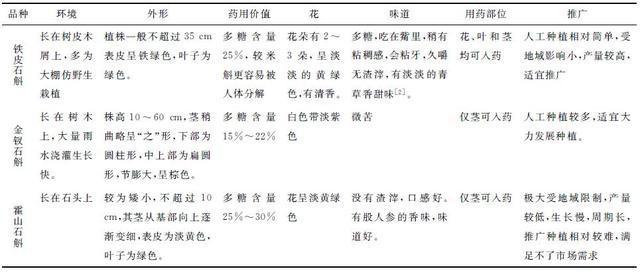
Table 1 Comparison Table of Main Dendrobium Varieties
3 Comparison Table of Main Dendrobium Varieties
From Table 1, it can be seen that Dendrobium officinale has characteristics such as strong environmental adaptability, easy identification by appearance, easily absorbed medicinal value, good taste, many edible parts and simple promotion, showing obvious advantages in comparison with other Dendrobium varieties.
4 Benefit Analysis
All planting adopts connected large sheds (elevated sheds). The specifications of the connected sheds are 30 m × 6 m, the span between sheds is 8 m, and the gap left between sheds (for convenient personnel operations) is 1.2 m. Calculated according to 3 sheds equivalent to 667 sq m, that is, large sheds 540 sq m (30 m × 6 m × 3 sheds), gaps 108 sq m (30 m × 1.2 m × 3 sheds), and radiation area such as artificial walking paths 19 sq m. Because the yield of Dendrobium officinale is unstable in the first and second years after planting, the harvested yield varies. However, after the third year (that is, the second harvest), the yield rises steadily. This data is analyzed based on the third year of "Zhujialou" Dendrobium officinale planting:
Number of planting stocks 1 sq m × 70-100 plants/sq m = 80 plants (there are distinctions between large seedlings and new seedlings)
Number surviving 80 plants × survival rate 90% (technical indicator) = 72 plants
Number of harvestable plants the following year 72 (planting stocks) × 3-5 stems (fresh stems)/plant = 216 stems (calculated at 3 stems)
Weight per fresh stem 216 stems (fresh stems) × 4-8 g/stem = 864 g (calculated at 4 g)
Yield of large shed (540 sq m calculated as effective area 350 sq m) 350 sq m × 864 g = 302,400 g = 302.4 kg. Annual related expenses for raw materials, water and electricity, medicines and labor wages, etc., total approximately 18,000 yuan. Annual profit (if no disease occurs) is estimated at 220,000 yuan, and output value per mu is 240,000 yuan (300 kg × 800 yuan/kg) or more.
5 Seedling Breeding of Dendrobium officinale
All Dendrobium officinale seedlings come from the Three Gorges Natural Medicine Science and Technology Park. Hubei Zhujialouzi Leisure Development Co., Ltd. and the Three Gorges Natural Medicine Science and Technology Park established a Dendrobium officinale tissue culture room in the Wujiagang High-tech Zone Biological Industrial Park in 2012. Through processes such as "tissue culture - bottle seedlings - screening - hardening - washing - acclimatization cultivation," qualified strong Dendrobium officinale seedlings can be transplanted to greenhouse planting beds. The company's Dendrobium officinale tissue-cultured acclimatized container seedlings have fully achieved self-sufficiency, laying a solid seedling foundation for the company to expand and strengthen the Dendrobium officinale industry, and also providing important seedling guarantees for the development [4] and promotion of the Dendrobium officinale industry.
6 Cultivation Techniques of Dendrobium officinale
In combination with the gregarious habit of Dendrobium officinale, when planting by division, it must be done in clumps, with 3 plants as one clump, and spacing of 8-10 cm as the standard. When planting, place equally robust young seedlings together in clumps of 3 plants. Note that the root system must not be heavily pressed during planting; simply lightly cover organic matter over the young seedlings' fibrous roots. During planting, pay attention to reasonable close planting, neat arrangement, and alignment in straight rows both lengthwise and crosswise, to facilitate ventilation and light transmission for the young seedlings. For the specifications and site selection of sunlight greenhouses, first select the project site according to the growth habits of Dendrobium officinale, and the selected project area must fully take into account that it is free from industrial environmental pollution. When building sunlight sheds, planning must be done well, with the shed opening facing north-south, the ground relatively flat, and drainage ditches dug around the sunlight shed. If funds are sufficient, install high-power air conditioners to adjust in a timely manner according to temperature changes to suit Dendrobium officinale growth, with temperature, humidity and spraying all automatically controlled by computer. The sunlight shed must be a large connected steel-frame structure with an internal height of 5-6 m or more, and each shed area of 2,000 sq m or more. Under the sunlight shed, imitation wild cultivation can be divided according to different cultivation carriers into trunk-binding cultivation, hanging pot cultivation and planting bed cultivation.
(1) Key technical points for planting beds under large sheds. The width of the bed must be convenient for operation; for example, in a sunlight shed 8 m wide, it is suitable to set up 4 beds each 1.3 m wide. The thickness of the organic substrate is about 10 cm, and a mixed substrate is prepared. Lay stone slab seedling beds more than 30 cm above the ground inside the shed to ensure ventilation and water permeability of the planting substrate, then spread organic granular material on top before planting Dendrobium seedlings. Transplanting is carried out in seasons with an average temperature of 15-30°C. Transplanting out of bottles is not suitable when the temperature is too low or too high. Generally speaking, cultivation can be done except in the coldest January-February and the hottest July-August. During transplanting, dig small holes of 3-5 cm in the substrate, gently place the roots of Dendrobium officinale into the small holes, and be careful not to break the roots of Dendrobium officinale. The planting spacing is 12 cm × 15 cm, with 1 clump of seedlings as 3-5 standard plants. Planting density and the number of small plants directly affect yield. It is appropriate to completely cover the roots. If planted too deeply, the leaves are prone to rot and cause disease; if planted too shallowly, the base is exposed to the air, which is not conducive to the growth of new roots and new buds. Water management for newly transplanted tissue-cultured seedlings is crucial. Lack of water leads to slow growth, drying out and low survival rate, but excessive watering causes root rot. When the temperature is high and humidity is high, soft rot may occur. Therefore, within 1 week after transplanting, the air humidity should be maintained at around 80%; after 1 week, when the plants begin to grow new roots, the air humidity can be maintained at around 70%, and keeping the substrate alternately dry and wet is beneficial for root and bud development.
(2) Key technical points for tree trunk binding cultivation under large sheds. Select sweetgum, camphor, oak and masson pine trees with a diameter at breast height of more than 10 cm, many branches, dense crowns, moist understory, ventilation, moderate trunks, loose bark, longitudinal fissure grooves and easy management as host trees, and carry out understory trunk-binding imitation wild cultivation of Dendrobium officinale. For every 666.7 sq m, select 80 tree trunks for binding. According to trunk size, bind 50 clumps per trunk, with 2-3 plants per clump, and 8,000-12,000 plants per mu. The seedling bed can be bound to the trunk with ropes, sufficient organic particles applied, and then the acclimatized Dendrobium seedlings tied on top.
(3) Key points for hanging pot cultivation under large sheds. The large shed requires 70% shading. The substrate selection is the same as the substrate preparation for planting beds. Select seedlings that are robust, tender green in color, with many sprouts, well-developed root systems and free of pests and diseases. Plant 5-7 leafy stems per pot for pot cultivation, hang 4-6 pots per tree, and hang 400-600 pots per mu, with 2-3 plants per pot, and 8,000-18,000 plants per mu.
7 Field Management of Dendrobium officinale
(1) Field management is the key link to successful planting. As the saying goes, "three parts planting, seven parts management," which refers to daily field management. Eight major daily management practices have now been summarized. Dendrobium officinale generally grows in remote deep mountains and old forests and in sunny crevices of cliff faces, or epiphytically on tree trunks. Its habits are a relatively warm, semi-shaded and semi-sunny, humid and airy environment, so imitation wild cultivation requires artificially imitating the wild growth environment. The design of cultivation sunlight sheds and cultivation substrates is also based on this characteristic. According to the shade-loving and moisture-loving characteristics of Dendrobium, a layer of shading net with a certain light transmittance is enclosed at the top of the sunlight shed. The purchase of the shading net is crucial. If the light transmittance is too high, the seedlings will be burned to death; if the light transmittance is too low, it will affect photosynthesis and cause slow seedling growth. Above the large shed is a spray device to control the temperature and humidity of the cultivation substrate in the shed. When entering the management period of the Dendrobium officinale seedling bed, it is necessary to observe at any time: substrate humidity (monitored by thermometer), with humidity preferably 60%-75%; high temperature must not exceed 35°C (summer), and temperatures above 35°C will cause the seedlings to enter a dormant state; the best normal temperature can be maintained between 25-27°C, which is the optimal growth temperature. After entering winter, anti-ice and anti-freeze facilities must be strengthened in the shed, the plastic film throughout the shed must be tightly covered, and if conditions permit, air conditioners should be installed for temperature control to prevent the seedlings from freezing to death.
(2) Humidity and temperature. The most suitable temperature for Dendrobium officinale growth is 20-32°C, and humidity 60%-90%. At high temperatures, install an automatic spray system, use weakly acidic or neutral water, and use spraying to cool and retain moisture; at low temperatures, appropriate protective and insulation measures should be taken.
(3) Topdressing. During the growing season of Dendrobium officinale, topdressing should be applied in a timely manner according to growth conditions. Decomposed soybean, rapeseed cake, superphosphate and other mixtures added with river mud can be selected and applied at the roots. In addition, 0.1% potassium dihydrogen phosphate can be used for foliar topdressing.
(4) Pruning. Each spring before new buds sprout, in conjunction with harvesting old stems, cut off the dead stems within the clump, remove diseased stems, weak stems and rotten roots, and after 5-6 years of planting, turn over the clump and divide it again for propagation according to the growth condition of the clump.
8 Pest and Disease Control of Dendrobium officinale
(1) Pest and disease control must follow the control principles. "Prevention first, comprehensive control," with horticultural control as the foundation, strengthen manual control, and carry out comprehensive control of pests and diseases. The following control measures are available: 1) Create environmental conditions unfavorable for the occurrence of pests and diseases, use steel beds at a certain distance from the ground, improve water permeability, and reduce damage from underground pests such as snails and cutworms. 2) Install insect-proof nets around the large shed to prevent moths from flying in to lay eggs and breed other insects.
(2) Pests and diseases that Dendrobium officinale is prone to, based on observation. 1) Diseases: soft rot, anthracnose, etc., mainly harming leaves and stems and branches. Affected leaves show brown or gray disease spots. Control methods: spray 1-2 times with 50% carbendazim 800-fold solution and spray 2-3 times with 50% thiophanate-methyl wettable powder 1,000-fold solution. 2) Pests include: snails, slugs, etc., mainly harming young stems and tender leaves. Control methods: scatter quicklime or table salt around the planting bed, or use Hong'an su to kill slugs and molluscicides to eliminate snails. Pest control must focus mainly on prevention and manual capture. If chemical control is used for diseases and pests, the "Guidelines for the Use of Pesticides in Green Food" must be strictly implemented.
9 Harvesting and Processing of Dendrobium officinale
(1) Best timing for harvesting. Regarding the relationship between the growth of Dendrobium officinale and its medicinal components, it takes about 18-20 months after planting for its medicinal components to accumulate to the optimal time. When the leaves on the stem segments have completely fallen off or the stem base to the top is wrapped in white leaf sheaths, its polysaccharide accumulation is complete.
The harvest season is controlled from the Frost's Descent solar term in the lunar calendar to the Qingming solar term of the following year. Stems and branches: generally harvested from November each year to March of the following year. During harvesting, cut stems and branches that are more than 3 years old, leaving young stems to continue growing. Flowers: harvested from March to June each year, generally harvesting flowers from stems and branches more than 3 years old.
(2) Processing. The traditional processing method is to remove impurities, cut off part of the fibrous roots, and while heating, twist into spiral or spring shapes and dry, or cut into sections and dry or dry at low temperature. The former is what is commonly called Tiepi Fengdou, also called earring Dendrobium, while the latter is specifically called Dendrobium officinale.
Based on the analysis and research results of Dendrobium officinale seedling breeding and cultivation techniques in the project, although Dendrobium officinale seedling breeding and cultivation techniques are affected by many factors, the experimental results show that Dendrobium officinale seedling breeding and cultivation techniques are suitable for promotion in Yiling District.