Study on Seed Dormancy and Germination Characteristics of Thornless Chinese Holly
Study on Seed Dormancy and Germination of Thornless Chinese Holly
Thornless Chinese Holly is a natural variety of Chinese Holly in the genus Ilex of the family Aquifoliaceae. It is an evergreen shrub or small tree with luxuriant branches and leaves, peculiar leaf shapes, and dark green glossy foliage. The crown is rounded, and in April to May it bears small yellow-green flowers. The inflorescence is a cyme or umbel, and the species is dioecious. The drupe is spherical, initially green, turning red upon ripening in autumn, with abundant fruits covering the branches, bright and eye-catching, remaining on the tree through winter until the following spring. Through pruning and shaping, it can be made into large tree forms, spherical forms, and tree-form bonsai. It is an excellent tree species for viewing flowers, fruits, leaves, and form, and is widely used in courtyard ornamental displays and urban landscaping.
Since the dormancy period of Thornless Chinese Holly seeds generally lasts as long as 3 years, this greatly affects propagation efficiency in production. How to quickly break seed dormancy and improve the germination rate is currently a difficult point in the research on seed propagation of Thornless Chinese Holly. Through an in-depth understanding of Thornless Chinese Holly seeds, this paper explores the factors affecting seed dormancy, seeks reasonable methods to quickly break seed dormancy, and at the same time lays a foundation for how to break dormancy in seeds of other species in the genus Ilex.
1 Materials and Methods
1.1 Materials
The Thornless Chinese Holly seeds used were fresh seeds of the year purchased from the market in November 2016. The drupes were soaked in water for 2-3 d, and after the flesh became fully soft and ripe, they were rubbed and washed. Floating seeds in the upper layer were removed, and the plump seeds that sank to the lower layer were used as the experimental material.
1.2 Methods
(1) Determination of 1000-seed weight, morphology, and viability of seeds. Determination of 1000-seed weight and morphology of seeds: the hundred-seed method was used for determination, with 100 seeds as one group and five replicates. The length and width of the seeds, seed shell weight, and endosperm size were detected and recorded.
Determination of seed viability: 2 x 100 selected seeds were randomly taken, soaked in water for 48 h, and the upper 2/3 to 3/4 of the seed apex was cut off transversely; the seeds were then placed in a 35 degrees C dark incubator and stained with 0.2% tetrazolium solution for 12 h; after staining, they were repeatedly rinsed under running water, the seed coat was removed, and the seeds were cut longitudinally along the central axis to expose tissues such as the embryo, observed under a stereomicroscope, and photographed. The identification standards were:
(1) Viable seeds: both embryo and endosperm stained normally throughout; the embryo fully stained, with a small amount of the endosperm unstained.
(2) Non-viable seeds: neither embryo nor endosperm stained; the embryo fully stained but the endosperm unstained.
(2) Determination of seed water absorption. Two portions of air-dried seeds were taken, with 60 seeds per portion. The first portion consisted of intact air-dried seeds, and the second portion had the seed coat pierced with a needle. Both portions of seeds were placed in a 25 degrees C constant-temperature incubator for water absorption, and weighed at 2, 4, 6, 8, 10, and 12 h respectively. When the seeds were removed, the surface floating water was thoroughly blotted dry with absorbent paper, and after standing for 10 min they were weighed and recorded.
(3) Concentrated sulfuric acid treatment. The experimental seeds were poured into a certain amount of concentrated sulfuric acid (specific gravity 1.84) solution. After treatment for different durations (1 min, 5 min, 10 min, 30 min, 1 h, 2 h, 3 h), the seeds were then rinsed under running water for 16-20 h, and a germination test was then carried out. For this treatment, 20 seeds were used as one group, with three replicates.
(4) Chemical treatment. The experimental holly seeds were treated with GA3 solution. After soaking for 24 h in GA3 + H2SO4 solutions of different concentrations (100, 250, 500 mg/L), a germination test was then carried out. For this treatment, 20 seeds were used as one group, with three replicates.
(5) Stratification treatment. Natural stratification: on January 1, seeds were layered with wet sand (ratio of wet sand to seeds was 3:1) in a flowerpot, the pot mouth was tightly tied with plastic sheeting, and the pot was placed outdoors in a dry, wind-sheltered, shady place in a well-drained soil pit 20 cm deep for about 180 d of stratification. On July 1, the seeds were taken out and the germination rate was calculated. For this treatment, 100 seeds were used as one group, with three replicates.
Low-temperature stratification: on January 1, seeds were layered with wet sand (ratio of wet sand to seeds was 3:1) in a flowerpot, the pot mouth was tightly tied with plastic sheeting, and the pot was placed in an indoor refrigerator for 180 d of stratification at a temperature of 4 degrees C. On July 1, the seeds were taken out and the germination rate was calculated. For this treatment, 100 seeds were used as one group, with three replicates.
Alternating-temperature stratification: on January 1, seeds were layered with wet sand (ratio of wet sand to seeds was 3:1) in a flowerpot, the pot mouth was tightly tied with plastic sheeting, and the pot was placed in an indoor refrigerator for 120 d of stratification at a temperature of 4 degrees C. On May 1, the seeds were taken out of the refrigerator and placed outdoors in a dry, wind-sheltered, shady place in a well-drained soil pit 20 cm deep for 60 d of stratification, and the germination rate was calculated. For this treatment, 100 seeds were used as one group, with three replicates.
1.3 Statistical Analysis of Data
The data were statistically analyzed using Excel and SAS software. Germination rate (%) = number of germinated seeds / number of tested seeds x 100%. Water absorption rate (%) = [mass after water absorption (g) - mass before water absorption (g)] / mass before water absorption (g) x 100%.
2 Results and Analysis
2.1 Biological Characteristics of Thornless Chinese Holly Seeds
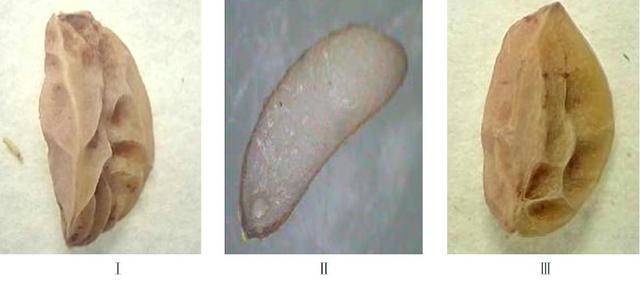
(1) Basic morphological characteristics of Thornless Chinese Holly seeds. The fruit of Thornless Chinese Holly is berry-like, usually spherical. The ripe red fruits hang on the branches and turn dark red after drying. The flesh is thick and juicy. Each fruit contains about 4-5 seeds. The seeds are narrowly lanceolate, and the outer dorsal surface is shaped like a ravine. Through rubbing and washing the fruits of Thornless Chinese Holly, clean and good seeds were obtained. Through measurement and observation of seed length, width, and endosperm, the following data were obtained, as shown in Figure 1.
Figure 1 Morphology and embryo development of Thornless Chinese Holly seeds
I and II show the morphological characteristics of the outer seed coat of Thornless Chinese Holly seeds; III shows the endosperm within the embryo of Thornless Chinese Holly seeds
The external morphology of the seeds was uniform, with length (6.64 +/- 0.35) mm, width (3.86 +/- 0.3) mm, height (3.72 +/- 0.25) mm, 1000-seed weight of 15.22 g, kernel-bearing rate of 78.26%, and the seed shell weight accounting for 81% of the complete Thornless Chinese Holly seed. The results showed that the thickness and heaviness of the seed shell led to seed dormancy to a certain extent.
(2) Determination of seed viability. Seed viability is the basic standard for testing whether seed growth and development are good or poor, and it also reflects seed quality. After testing, among the seeds used in the experiment, 187 were viable and 13 were non-viable. Viable seeds accounted for 93.5% of the total number of seeds, indicating that the quality of most of the experimental seeds was good.
(3) Permeability of seeds to water. The water absorption of intact seeds and scarified seeds is shown in Figure 2.
Figure 2 Water absorption curve of Thornless Chinese Holly seeds
As shown in Figure 2, in the early soaking stage, the water absorption of intact Chinese Holly seeds and scarified seeds was basically consistent. As time passed, in the middle soaking stage, the water absorption rate of scarified Thornless Chinese Holly seeds was higher than that of intact seeds. In the late soaking stage, the water absorption rates of the two types of seeds reached saturation and were consistent. The results showed that because the seed coat of Thornless Chinese Holly is hard, the water absorption rate of intact seeds increased slowly, and the hardness of the seed coat affected the water absorption rate of seeds to a certain extent.
2.2 Effect of Different Acid Scarification Durations on Seed Germination Rate. Because the seed coat of Thornless Chinese Holly is woody and hard, it hinders seed germination, but acid scarification treatment can reduce the seed shell, increase its permeability, and improve the seed germination rate. Through acid scarification treatment of Thornless Chinese Holly seeds for different durations, the most suitable acid scarification duration can be explored, as shown in Table 1 below.
According to Table 1, after acid scarification treatment of Thornless Chinese Holly seeds, the longer the acid scarification time, the greater the corrosion ratio of the seed shell, and the rotting rate also increased correspondingly, while the germination rate changed with changes in the seed shell corrosion ratio and rotting rate. The experimental results showed that acid scarification treatment of Thornless Chinese Holly seeds for 1 h was more suitable for reducing the weight of the seed shell, stabilizing the degree of seed rotting, and promoting the germination of Thornless Chinese Holly seeds.
Table 1 Effect of Different Acid Scarification Durations on the Germination Rate of Thornless Chinese Holly Seeds
2.3 Effect of Combined Treatment with GA3 and Concentrated Sulfuric Acid on Seed Germination Rate
Table 2 Effect of Different Concentrations of GA3 Treatment on the Germination Rate of Thornless Chinese Holly Seeds
According to Table 2, the combined treatment of different concentrations of GA3 solution and different acid scarification durations significantly improved the germination rate of Thornless Chinese Holly seeds. The germination rate increased with increasing GA3 concentration, but higher concentration was not always more beneficial; too high a concentration instead reduced the activity of the embryo of Thornless Chinese Holly seeds. The results showed that seeds treated with a concentration of 250 ml GA3 had the best germination effect.
2.4 Effect of Stratification Treatment on Seed Germination Rate
Stratification treatment is an effective method for breaking comprehensive seed dormancy. Stratification treatment can be divided into natural stratification, low-temperature stratification, and alternating-temperature stratification. Through exploring the effects of different stratification treatments (natural stratification, low-temperature stratification for 180 d, alternating-temperature stratification with warm temperature for 60 d + low temperature for 120 d) on the germination rate of Thornless Chinese Holly seeds, as shown in Figure 3.
Figure 3 Effect of Different Stratification Treatments on Seed Germination Rate
The experiment showed that after natural stratification and low-temperature stratification for 180 d, the germination rates of Thornless Chinese Holly seeds were 0.6% and 1.3%, respectively. Compared with natural stratification and low-temperature stratification, alternating-temperature stratification had a clear advantage in germination rate, reaching 5.8%. Therefore, it can be inferred that natural stratification had no obvious promoting effect on breaking dormancy of Thornless Chinese Holly seeds. Compared with natural stratification treatment, low-temperature stratification could break dormancy in some seeds, but the germination rate was also relatively low. However, Thornless Chinese Holly seeds treated with alternating-temperature stratification (first warm temperature, then low temperature) were more favorable for the growth and development of the seed embryo and improved the seed germination rate.
3 Discussion and Conclusion
3.1 Discussion
(1) Effect of seed coat on seed dormancy. Because the seed coat of Thornless Chinese Holly seeds is lignified, hard, and tightly compact, a series of seed coat barriers cause forced dormancy of the seeds. Overall, seed coat barriers usually refer to impermeability to water, impermeability to air, and mechanical barriers produced by the seed coat. A hard seed coat limits gas exchange between the seed embryo and the outside, blocks the release of oxygen and carbon dioxide, hinders respiration of the seed embryo, and cannot provide the necessary energy substances for seed germination. Many scholars have shown that the seed coat characteristics of hard lignification and densely arranged cells are the main factors causing seed dormancy. According to Li Jinyu's research on walnut seeds, the mechanical constraint of the seed shell is the main reason for slow seed germination. In Ilex fargesii, the poor air permeability of the hard and dense seed coat is one of the factors of forced seed dormancy. Xu Benmei et al.'s experiments pointed out that the forced dormancy of large-fruited seeds is mainly caused by poor air permeability of the seed coat. This characteristic is similar to that of Crataegus pinnatifida bunge., Sabina chinensis, Rosa laevigata, S. xylocarpa, large-leaved holly, and S. holocarpa. Through analysis and comparison of these theories, the impermeability to water, impermeability to air, and mechanical barriers of the seed coat in the Thornless Chinese Holly seeds in this experiment largely prevented seed germination and inhibited embryo growth.
Acid scarification treatment can effectively corrode the dense tissue cells outside the seed coat, reduce seed coat barriers and seed shell weight, enable the embryo to escape the constraints of the seed coat, enhance embryo permeability, and promote seed embryo germination. After concentrated sulfuric acid treatment of Thornless Chinese Holly seeds, the seed germination rate was greatly improved, and grasping the appropriate acid scarification time was crucial. If the acid scarification time was insufficient, the seed coat barriers could not be fully corroded, and the expected effect for seed germination could not be achieved. If the acid scarification time was too long, the seed coat would be fully corroded, causing irreparable damage to the seed embryo, making it prone to rotting and leading to seed embryo death.
(2) Effect of embryo development status on seed dormancy. After the fruit of Thornless Chinese Holly matured, it was harvested, the fruit was rubbed, and the seeds were air-dried for dissection. As shown in Figure 1, the seed embryo length was about 0.3-0.4 mm, only 1/10 of the embryo length at germination. At this time, the embryo was still at the embryo primordium stage; the young embryo took up energy from the nutrients in the endosperm to promote seed germination. After natural maturation of the seed, the seed embryo was still at the primary stage, and the embryo was not fully developed. At this time, morphological development and maturation had to be completed first before dormancy could be broken and germination promoted.
For how to accelerate the process of physiological after-ripening of Thornless Chinese Holly seed embryos, alternating-temperature stratification treatment is the most effective treatment method. During the warm stratification stage, the seed embryo only began to differentiate slowly, and the growth and development of the seed embryo were relatively slow, which is consistent with the conclusions obtained by Leonard et al. in research on American ginseng seeds. During the warm stratification process, the embryo may undergo a period of quiescence. Therefore, in the early warm stratification stage, the endosperm needed to draw a large amount of nutrients from the seed embryo, so the seed embryo grew slowly. During the low-temperature stratification stage, the seed embryo began to grow rapidly. After 120 d of stratification, most Thornless Chinese Holly seeds had completed the process of physiological after-ripening. However, the quality and developmental status of various embryos differed, and a small portion of Thornless Chinese Holly seeds still appeared semi-mature, resulting in inconsistent germination uniformity of Thornless Chinese Holly seeds.
(3) Effect of endogenous inhibitors on seed dormancy. Many plants have germination inhibitors in their fruits and seed coats, mainly including some organic acids, alkaloids, lipids, aldehydes, and other substances that directly or indirectly inhibit seed germination. Among them, coumarin and abscisic acid are two relatively strong inhibitors of seed germination.
GA3 treatment can effectively promote the growth and development of seed embryos. It can induce the endosperm to produce hydrolytic enzymes, converting storage substances in water from macromolecules into small molecules, such as starch hydrolyzed into sugar and protein hydrolyzed into amino acids, for absorption by the embryo. At the same time, it promotes the conversion between organic and inorganic substances in the embryo, enabling the embryo to complete the physiological after-ripening process. It can also promote cell division and elongation, promote DNA and RNA starch synthesis [Jishan Huayao], and can inhibit the accumulation of ABA in dormant seeds.
3.2 Conclusion
Through a series of explorations and studies on Thornless Chinese Holly seeds, the main factors affecting seed dormancy were sought. Thornless Chinese Holly seeds have the characteristic of a hard seed coat, with the seed shell accounting for 87.3% of seed weight and extremely poor air permeability, affecting material and gas exchange between the seed embryo and endosperm and hindering seed germination, which is one of the main factors causing seed dormancy. Acid scarification treatment can corrode the seed coat, break seed coat barriers, and accelerate the growth and development of the seed embryo, but it cannot make the seeds germinate earlier. Certain endogenous inhibitors exist in the seed embryo and endosperm, limiting embryo growth and development to a certain extent. Gibberellin GA3 can reduce endogenous inhibitors in the embryo and promote embryo growth and development. In addition, because Thornless Chinese Holly seeds have the characteristic of germinating in alternate years, the fruits after harvesting may be incompletely developed, and germination can only occur after physiological after-ripening. Stratification treatment is a commonly used method for breaking seed dormancy, divided into natural stratification, low-temperature stratification, and alternating-temperature stratification. Because Thornless Chinese Holly seeds have the physiological characteristic of germinating in alternate years and the seed coat characteristic of physiological after-ripening, natural stratification cannot break seed dormancy within a short time, and low-temperature stratification can only break the dormancy of some mature seeds, with a low germination rate. Alternating-temperature stratification (first warm temperature, then low temperature) treatment has a very significant effect on breaking seed dormancy, can accelerate seed growth and development, accelerate absorption by the seed embryo, and promote seed germination, and is the most suitable stratification treatment for breaking seed dormancy. Therefore, after understanding the various factors hindering dormancy of Thornless Chinese Holly seeds, the best method for releasing seed dormancy was concluded to be: 98% concentrated sulfuric acid for 1 h + 250 mg/L gibberellin solution soaking for 24 h + warm stratification for 60 d + low-temperature stratification for 120 d.