Growing a flower on the balcony that blooms in all four seasons, with yellow and white complementing each other, truly beautiful
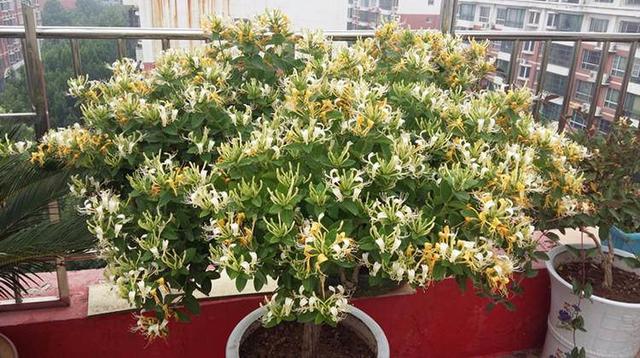
Japanese honeysuckle (Lonicera japonica) has climbing stems and tendrils, with emerald-green leaves that stay evergreen all year round; when it blooms, two flowers sit side by side on the same stem, initially silvery white, later turning golden yellow, with long petals and hanging stamens, old and new intermingling, yellow and white complementing each other, truly a lovely sight. In addition, the flowers produced by Japanese honeysuckle, after being dried in the sun, can also be used to make tea, with the effect of clearing heat and detoxifying.
For balcony cultivation of Japanese honeysuckle, it can be protected over winter on the balcony. Generally, after the onset of winter when the temperature drops to 0°C, fine dry soil should be piled under the pot and around it, and during severe cold spells, straw mats, gunny sacks and similar materials should also be placed over the pot for cold protection. When winter passes and spring comes and the weather warms up, the covering materials can be gradually removed, and by early March when the temperature reaches 6°C, all coverings can be completely removed.
Japanese honeysuckle should be repotted or turned out of its pot before spring budding, replacing part of the soil with new potting soil, combined with the application of base fertilizer. Use fertile sandy loam for the potting soil. Use decomposed cake fertilizer or sesame paste residue powder as the base fertilizer.
Japanese honeysuckle is not a flower that needs a lot of fertilizer. On the basis of applying base fertilizer, before each flush of flowers at Grain Rain, Grain in Ear and Major Heat, use an organic nutrient solution diluted 500 times, and let it seep into the soil along with loosening the soil and watering.
When watering potted Japanese honeysuckle, water only when the soil is dry and let it dry between waterings, avoiding repeated heavy watering. Before covering for winter, water thoroughly; during the winter period, if it is not very dry, you may skip watering, and if watering is needed, choose clear warm weather and water moderately in the midday sun to moisten the potting soil, without heavy watering. In the vigorous growing season, increase the frequency and amount of watering, and also pay attention to spraying the leaves, which both removes dust and increases humidity.
For balcony cultivation of Japanese honeysuckle, apart from growing tree-stump bonsai, there are two shaping forms: one is with stems and tendrils draping and hanging down; the other is with stems and tendrils climbing up a support. In order to make Japanese honeysuckle lush in leaves and abundant in flowers, pruning should be carried out. After the onset of winter, thin and weak branches and old, damaged branches should be thinned out, and 3~4 strong main branches should be selected and kept per plant; for the draping form, each main branch can be cut back to leave 30~40 cm; for the climbing form, they can be cut back to leave 50~60 cm.
Side branches on each main branch should have the weak removed and the strong kept, and for the strong branches selected and kept, only part of the branch tips should be cut off. Pruning during the growing season is mainly pinching the new branches after the flowering period to promote new growth; for the climbing form, branches and leaves should also be appropriately thinned according to requirements such as shading.
Image from flower friend: Qinghe hhydwg