Kerria Says Nothing but Longs: A Study of the Related Textual Research on Changdi and Tangdi
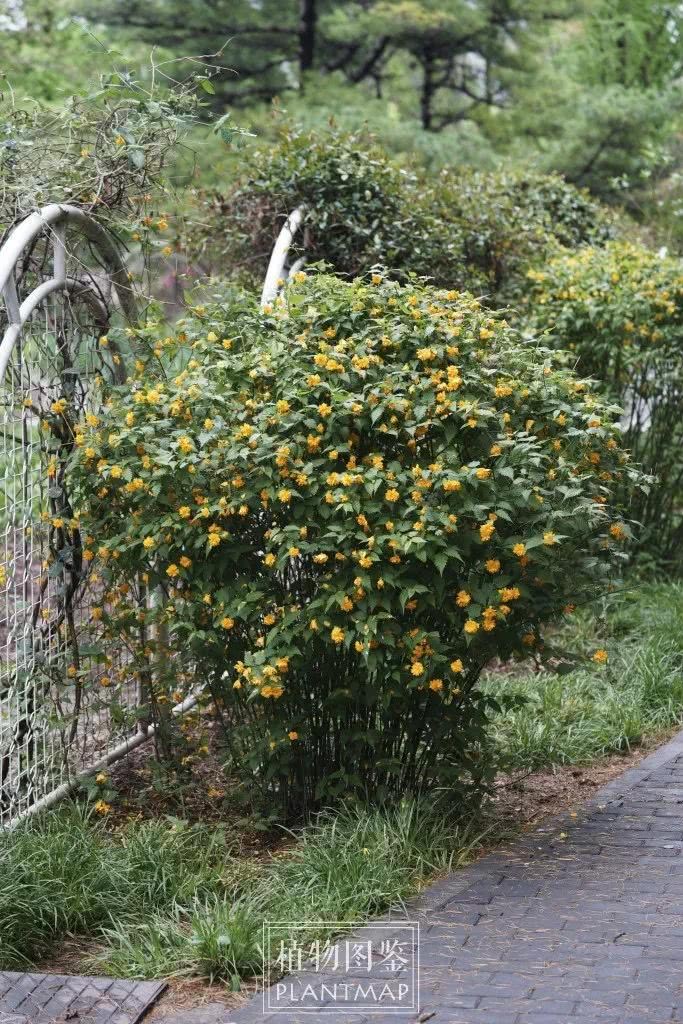
I first encountered kerria (Kerria japonica) on my third time joining the phenological observations of the Peking University Green Association. "So this is what kerria looks like! It is the plant used in the Book of Songs to symbolize brothers, isn't it?" Later I realized my memory was mistaken! What the Book of Songs refers to is "changdi," while "changdi" and "kerria" are two completely different plants. In addition, there are also "tangdi" and "tangdi" (written with different characters), and the four sound similar and look alike, and are often confused.
Kerria in full bloom
1 Kerria: Says nothing, but longs
The official Chinese name of kerria, Kerria japonica, is "kerria flower." It belongs to the Rosaceae family and the genus Kerria, is a deciduous shrub, and is a common ornamental garden plant. Kerria flowers come in single-petaled and double-petaled forms, and bloom abundantly. The Southern Song poet Fan Chengda (1126-1193) aptly described kerria with the line "green ground, gold threads, a knotted sash" ("Kerria by the Roadside at Shenjia Store"). When Gao Shitan, a member of the Northern Song imperial clan, saw kerria in full bloom after his country's fall, he was overcome with sorrow: "How can a stray orphaned official bear to look, it is so deeply like the imperial robe's yellow." ("Kerria")
In Japan, kerria is also called "yamabuki." The famous Edo-period haiku poet Matsuo Basho (1644-1694) once wrote a poem about kerria:
Yamabuki falls, quietly, without a sound, dancing, the sound of the rapids.
Note: long (rapid flowing water)
This poem has also been translated as "The rapids rush and gurgle, yet kerria blossoms fall in rustling showers."
The river's water rushes swift and powerful, flowing on without cease; on the bank, kerria blossoms fall, dancing in the wind, without a sound. Imagine this mood: two states of nature appear in the same time and space, and the "movement" of the flowing water all the more sets off the quiet beauty of the falling kerria, carrying a certain Zen quality.
Wild kerria in the mountains
Among traditional Japanese colors there is "yamabuki-iro," which refers to the color of the kerria flower. [1] It is said that by mixing gamboge from Chinese painting with a little cinnabar, then adding a touch of ochre, the kerria flower can leap onto the paper.
Double-petaled kerria
Single-petaled kerria
Yamabuki-iro
"Yamabuki-iro" appears in The Tale of Genji, The Pillow Book, and other Japanese classical literature. The Pillow Book is a collection of essays written by the Heian-period Japanese woman writer Sei Shonagon, completed around 1001. Sei Shonagon ("Sei" was taken from the family surname "Kiyohara," while "Shonagon" was a court office) once served for seven years as a lady-in-waiting in the palace, attending Empress Teishi, the empress of the 66th emperor of the Heian period. Though the two were mistress and servant, they got along harmoniously and were deeply attached. After the empress's death, the author left the palace and served no one else. In her later years she lived alone, recalling every little detail of her earlier palace life, dwelling on it constantly, and thus wrote The Pillow Book. In the book, the section "Kerria Petals" [2] tells a story of conveying feelings through flowers:
For a long time I had received no news from the Empress, and more than a month had passed, which had never happened before. Fearing that the Empress might also be doubting me, I was feeling uneasy when the lady-in-waiting chief of the palace came holding a letter.
……
When I opened it and looked, there was not a single written word on the paper, but there were kerria flower petals, with just one wrapped inside. On the paper was written: "Says nothing, but longs."
"Says nothing, but longs" comes from the Kokin Rokujo [3], an old song, whose full lyrics read:
The heart is like underground water surging,
Says nothing, but longs,
Better still than speaking.
After reading the letter, Sei Shonagon was deeply moved, tears even streamed down, and naturally she answered with the first half of the line. One letter, one petal, one love poem - such tacit understanding, not lovers, yet better than lovers. So can the kerria flower in Japanese culture be used to express the feeling of longing? Zhou Zuoren's translation annotates this passage as follows: The kerria flower is yellow, like the gardenia; the Japanese name of the gardenia means "mouthless," meaning its fruit does not split open even when ripe, and is homophonous with "mute." Here the kerria petal is used as a pun for not speaking, corresponding to the song's words. [4]
The "gardenia" in the explanation is also a traditional Japanese color, dyed from the gardenia's fruit, and its color is close to that of the kerria flower. Linking kerria with gardenia, and then with "says nothing," is still somewhat convoluted. Yet Sei Shonagon could immediately understand the meaning of the kerria petals in the letter, which shows she was indeed worthy of being the Empress's confidante. That such feeling could exist between mistress and servant is admirable.
Gardenia, and gardenia color
2 Changdi and Tangdi: Of all people in the world today, none are like brothers
The confusion between kerria and tangdi is not a modern matter. Li Shangyin's "Sent to Luo Shaoxing": "Tangdi yellow flowers bloom, forget-sorrow green leaves are even." The yellow flowers here should be the "kerria" mentioned above, not "tangdi."
It is generally believed that "tangdi" is another way of writing "changdi." "Changdi" first appears in "Changdi" in the Minor Odes of the Book of Songs. This poem praises the brotherly affection between brothers, and the well-known lines "The wagtail is on the plain, brothers rush to hardship" and "Brothers quarrel within the wall, but repel outside aggression" come from this poem:
The flowers of the changdi, the calyx and base so splendid [wei].
Of all people in the world today, none are like brothers.
In the poem, "calyx and base" is one explanation referring to the flower's calyx and base [5], using the calyx and base clinging closely together to begin the poem, so later generations often used "di hua" and "di e" to compare brothers, such as the late Tang famous general Gao Pian's frontier poem "Sent to My Elder Brother on the Frontier": "The di calyx are separated, messengers are rare, how many homesick tears wet the campaign robe. Before the barbarian flute's sound ends, the heart has already broken, across ten thousand li of barbarian sky no bird flies."
Guo Moruo wrote the play The Flower of Tangdi, adapted from the story in the Records of the Grand Historian: Biographies of Assassins in which Nie Zheng, entrusted by Yan Zhongzi, assassinates the Han minister Xia Lei. In the Records of the Grand Historian, after completing the assassination, Nie Zheng "cut the skin of his face, gouged out his eyes, and disemboweled himself," in order not to let his sister recognize him and thus implicate her. The people of Han exposed the corpse in the marketplace and offered a heavy reward to anyone who could identify the assassin. When Nie Zheng's sister Nie Rong learned of this, she guessed the assassin was her brother Nie Zheng. When she went to identify the corpse, she revealed her own identity and said something that shocked the people of Han: "How can I fear the punishment of death and in the end destroy my worthy brother's name!" She also died beside Nie Zheng. People of the time all called Nie Zheng's sister a martyr. When Guo Moruo wrote this play, it was during the War of Resistance, and he elevated the assassination in the original story from "a scholar dies for one who appreciates him" to the height of sacrificing oneself to avenge the "public enemy" of family and country. The opening of the play focuses on portraying the heroic image of the brother and sister who give their lives for their country and die in the effort [6]:
I do not wish to live on in cowardice, but only to die gloriously.
I wish to use my own life to save the common people and raise them up!
The common people have long been mired in misery, not one household in ten is whole.
……
I think that at this moment all the sisters and brothers under heaven are one by one trapped in deep water and scorching fire; if we can save them, then even if we sacrifice our own insignificant bodies, that is precisely the supreme happiness of life...
I hope your bright red blood bursts forth into flowers of freedom, blooming across China! (Act One, Scene Two)
The reason the play was titled The Flower of Tangdi is probably also to take the sibling affection of the brother and sister. Yu Guanying, explaining "Changdi" in the Minor Odes, said: "The poet uses the flower of the changdi to compare to brothers, perhaps because every two or three blossoms lean on one another, hence the association."
Having said so much, what kind of plant exactly is "changdi," that is, "tangdi"? Lu Ji, a scholar of the Wu state during the Three Kingdoms period, described it as follows in his Commentary on the Plants, Trees, Birds, Beasts, Insects, and Fish in Mao's Book of Songs:
Changdi, Xu Shen said: "It is the white di tree." It is like a plum but smaller, its fruit like a cherry, pure white. Today it is planted in official gardens. There is also the red di tree, also similar to the white di, its leaves like those of the hedge elm but slightly rounder, its fruit pure red, like the bush cherry but smaller, and it first ripens in the fifth month. From Guanxi, Tianshui, and Longxi, it is found in abundance.
Western Jin scholars believed Guo Pu's Erya statement that changdi's "fruit is like a cherry and edible" was not far from Lu Ji's description.
Changdi? White di? Red di? What exactly is it? From ancient times to the present there have been many related annotations and textual studies, yet none has led us to a clear conclusion. But what can be certain is that "changdi" and "tangdi" are a kind of tree similar to the cherry.
Fruit like a cherry? The image shows the bush cherry
3 Tangdi: How lush it is! The flowers of the tangdi
In the Book of Songs, besides "changdi," there is also "tangdi." "How Lush" in the Odes of Shao and the South uses the abundance of tangdi flowers to compare to the extravagance of a noblewoman's carriages, horses, clothing, and ornaments at her marriage:
How lush [nong] it is! The flowers of the tangdi.
How could it not be solemn and harmonious [yong]? The carriage of the royal lady.
As for what kind of plant "tangdi" is, the controversy is even greater.
Guo Pu's Erya Commentary holds that tangdi "resembles the white poplar, and in Jiangdong it is called fuyi." The Tang scholar Kong Yingda's Correct Meaning of Mao's Book of Songs and Li Shizhen's Compendium of Materia Medica also follow this view, holding that tangdi belongs to the poplar category. But Lu Ji believed "tangdi" was "ao plum." Qing scholars basically agreed with Lu Ji. The Book of Songs scholar Ma Ruichen (1777-1853) and Wang Xianqian (1842-1917) both did textual research on this, and their views are basically consistent. Ma Ruichen believed tangdi and changdi were both plants of the bush cherry kind. After a rather lengthy textual study, Wang Xianqian concluded: "The fruit of tangdi is called bush cherry, as large as a plum; the fruit of changdi is like the bush cherry but smaller, and both are di trees with only slight differences in species." In addition, the botanist Wu Qijun (1789-1847) directly equated tangdi with the bush cherry:
Bush cherry, in the Classic of Materia Medica it is of the lower grade. It is tangdi. Its fruit is like a cherry but red. In Wu it is called juemei, in Gushi it is called yangli. There are two kinds, single-petaled and thousand-petaled. The single-petaled kind bears much fruit and grows on field ridges; the thousand-petaled kind has rich flowers, and a single thread in the center connects to the base, commonly called chuanxinmei. After the flower falls, the center and base still hang among the branches, hence Master Cheng considered the di calyx very firm. The Tujing merges it with changdi as one, which cannot be relied upon.
Single-petaled and double-petaled bush cherry
According to Wu Qijun, the bush cherry flower also has two kinds, one single-petaled and the other "thousand-petaled." "Thousand-petaled" may be a double-petaled variety of the bush cherry. "After the flower falls, the center and base still hang among the branches" and "the di calyx very firm" describe more what the Book of Songs uses to compare to brothers, "the flowers of the changdi." But this also shows that in Wu Qijun's view, although tangdi and changdi are not the same plant, they are very similar.
Tangdi in today's Flora of China
In the modern Flora of China, however, the name tangdi belongs to a small tree with white flowers. Its fruit is about 1 cm in diameter, blue-black, with a fruiting period of September to October, absolutely unlike today's bush cherry and various cherries, but rather consistent with the "tangdi" depicted in the Japanese Hosoi Jun's Illustrated Names of Things in the Book of Songs, "the flower spikes droop, the petals are slender, white, and fragrant, and it is cultivated for ornament."
Tangdi in the Illustrated Names of Things in the Book of Songs
May 17, 2018, at Puhuangyu
[1] Many traditional Japanese colors are named after plants, such as "red plum," "peach," "daylily," "violet," and "gardenia." See http://nipponcolors.com/.
[2] (Japan) Sei Shonagon, translated by Zhou Zuoren: The Pillow Book, China Translation and Publishing Corporation, 2001 edition, p. 231.
[3] (Japan) Sei Shonagon, translated by Zhou Zuoren: The Pillow Book, China Translation and Publishing Corporation, 2001 edition, p. 247, note 105.
[4] (Japan) Sei Shonagon, translated by Zhou Zuoren: The Pillow Book, China Translation and Publishing Corporation, 2001 edition, p. 247, note 104.
[5] In oracle bone script, "bu" resembles the form of a flower base, and its original meaning is precisely flower base. Therefore a wooden drinking vessel shaped like a flower base is called a "cup." In Dream of the Red Chamber, the "pou" in "a pou of pure earth covers romance" should be explained as "cupping," that is, making the hands into the shape of a flower base. For the above, see Zou Xiaoli, Explaining the Origin of the Form and Meaning of Basic Chinese Characters (Revised Edition), Zhonghua Book Company, August 2007 edition, pp. 190-191.
[6] Published on October 10, 1920, in the Shanghai Shishi Xinbao - Xue Deng Supplement.
[7] (Jin) Guo Pu, annotated, (Song) Xing Bing, subcommentary: Annotated Erya with Subcommentary, Peking University Press, 1999 edition, p. 309.
[8] Yu Guanying: Annotated Selections of Poetry, People's Literature Publishing House, 1979 second edition, p. 172.
[9] (Jin) Guo Pu, annotated, (Song) Xing Bing, subcommentary: Annotated Erya with Subcommentary, Peking University Press, 1999 edition, p. 309.
[10] (Tang) Kong Yingda: Correct Meaning of Mao's Book of Songs, Peking University Press, 1999 edition, p. 570.
[11] (Qing) Ma Ruichen: Comprehensive Explanation of Mao's Book of Songs, Zhonghua Book Company, 1989 edition, p. 501.
[12] (Qing) Wang Xianqian: Collected Explanations of the Three Schools of the Book of Songs, Zhonghua Book Company, 1987 edition, p. 117.
[13] (Qing) Wu Qijun, edited by Zhang Xianrui et al.: Annotated and Explained Textual Research on the Names and Actualities of Plants, Traditional Chinese Medicine Antiquarian Books Publishing House, 2008 edition, p. 568.
[14] Chinese Academy of Sciences, Flora of China Editorial Committee: Flora of China, Science Press, 2004 edition, Flora of China volume 36, p. 403.
About the author: Jianghan Tangtang, company employee / art museum public education volunteer / freelance writer, currently living in Beijing.
Text and image editor: Jiang Moudao
This work is licensed under the (CC BY-NC-ND 4.0) license agreement. Please retain this statement when reproducing.
iPhone users can tip the author via the QR code below.