Honeysuckle bonsai is beautiful and can also be used medicinally, making it an excellent material for creating bonsai.
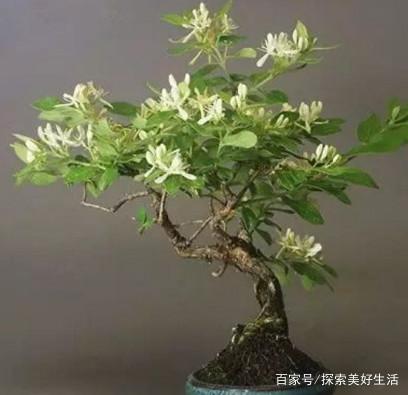
Honeysuckle (Lonicera japonica) is a fairly familiar plant, blooming from May to October each year. The flowers open white and turn golden yellow after 3 days, fragrant and very beautiful, and it also has high medicinal value. It is often seen in some flower teas or traditional Chinese medicines. When used as food, it has the effect of reducing internal heat, and growing it at home also has some mosquito-repelling ability.
Honeysuckle is a relatively easy-to-keep flowering plant with very strong survival ability. With regular pruning, it can also be grown as a bonsai. In summer, you can see dense honeysuckle blooming among the branches and leaves, giving off a faint floral fragrance. Its branches are spreading in nature, able to cling to nearby supports, and it can also be grown as a trailing houseplant.
Honeysuckle vines twine and intertwine, and it does not wither through the winter, with winter leaves turning slightly red; in spring and summer, it blooms continuously, first white then yellow, with yellow and white complementing each other, possessing both color and fragrance, and beautiful in both flower and leaf. Old stumps and old vines used to make bonsai, with trailing vines led downward, have an antique and elegant posture, unique in style, and hold high ornamental value.
Although honeysuckle has all kinds of stumps in nature, not too many are suitable for making bonsai, so you should try to choose stumps with well-developed root systems, thick and sturdy trunks, rugged and antique-looking, with bends and variations, a short and compact tree shape, thick and short dense internodes, and natural tapering transitions.