How are seedless grapes formed? Analysis of causes and risks
Factors in the formation of seedless grapes and risk analysis
1 Factors in the formation of seedless grapes
Seedless grapes have long been the direction of grape breeding worldwide and are also the consumer trend for table grapes worldwide. According to statistics from the World Food and Agriculture Organization, the global area cultivated with seedless grapes is about one-fifth of the total area cultivated with table grapes. At present, there are more than 100 seedless grape varieties in the world. The seedless grapes on the market are formed in two ways: one is by cultivating seedless varieties, and the other is for diploid or tetraploid varieties with a high rate of parthenocarpy, or triploid varieties with poor marketability under natural fruiting, or early-maturing varieties, which are formed after regulation with plant growth regulators.
1.1 Seedless varieties
Common seedless varieties on the market include Jingzaojing, Wuhe Zaohong, Brown Seedless, Flame Seedless, Summer Black, Emerald Seedless, Venus Seedless, Fantasy Seedless, Centennial Seedless, Crimson Seedless, Ruby Seedless, Redglobe Seedless, Autumn Royal, Zixiang Seedless, Bixiang Seedless, Jintian Royal Seedless, Honey Seedless, Ruifeng Seedless, and others. Among them, Brown Seedless, Flame Seedless, Summer Black, Emerald Seedless, Venus Seedless, Fantasy Seedless, Centennial Seedless, Crimson Seedless, Ruby Seedless, Redglobe Seedless, and Autumn Royal are introduced varieties from abroad; Jingzaojing, Wuhe Zaohong, Zixiang Seedless, Bixiang Seedless, and Jintian Royal Seedless are varieties bred in China [Jishan Huayao].
The grape variety Jingzaojing [5] was bred by the Botanical Garden of the Institute of Botany, Chinese Academy of Sciences. Its parent varieties Queen of the Vineyard and Thompson Seedless were crossed in 1960, it passed peer expert appraisal in 1984, and in August 2001 it passed the approval of the Beijing Municipal Crop Variety Approval Committee.
The grape variety Summer Black [6] (Black Summer, Summer Black Seedless), a European-American hybrid, originated in Japan, with the Japanese name サマーブラツク. It was bred in 1968 by the Yamanashi Prefecture Fruit Tree Experiment Station in Japan using Kyoho x Thompson Seedless, obtained new variety registration in August 1997, and was introduced into China in 2000 by the Japan Plant Garden Grape Research Institute. At present, it is one of the main cultivated varieties in southern China.
The seedless grape variety Ruby, also known as Ruby Seedless and Roubei Seedless, is a Vitis vinifera variety originating in the United States. It was bred by crossing Emperor with Pirovan075 and was introduced into China from California, USA, in 1986. It is currently planted in Shandong, Hebei, Henan, Liaoning, Hunan, Guangxi and other provinces (autonomous regions).
Wuhe Zaohong [7] is a triploid seedless variety, breeding number Wuhe 8611. It was bred by the Changli Fruit Tree Research Institute of the Hebei Academy of Agriculture and Forestry Sciences, crossed in 1986, and approved as a variety by Hebei Province in April 1998. Its parents are Zhengzhou Zaohong (2n=38) x Kyoho (2n=76). It is the world's first triploid seedless variety bred by crossing with a diploid as the female parent and a tetraploid as the male parent.
1.2 Seedlessness induced by plant growth regulators
For diploid or tetraploid varieties with a high rate of parthenocarpy, or triploid varieties with poor marketability under natural fruiting, or early-maturing varieties, dipping or spraying the inflorescences of seeded grapes with plant growth regulators before and after flowering can effectively hinder the fertilization process and produce seedless fruit. For the Kyoho-line varieties with the largest cultivated area in China, such as Zaotian, Yuxuan No.1, Jingya, Fujiminori, Zui Jinxiang, Hutai No.8, Pioneer, Cuifeng, Kyoho, Anyun Queen, Tamafeng, Takarabi, Shinshu Wase, Izunishiki and others, dipping the flowers with 12.5 mg*L-1 GA3 from 1 week before flowering to the beginning of flowering can induce seedlessness. Use on other grape varieties can also achieve seedlessness. Dipping the flower clusters (fruit clusters) of Muscat Hamburg grapes with GA3 at full bloom can also achieve seedlessness.
2 The relationship between plant growth regulators and contraceptives
Plant growth regulators are a class of chemical substances with biological activities the same as or similar to natural plant hormones, also called exogenous plant hormones. They can regulate and control plant growth and development, increase yield, improve quality, promote early ripening, and extend the fresh-keeping period. This is fundamentally different from what people understand as hormones or contraceptives. Contraceptives act only on humans and animals. Their principle is mainly to achieve contraception by inhibiting ovulation or hindering the transport of fertilized eggs. They are completely different from plant hormones in chemical structure, target of action, function and mechanism. Applying contraceptives to plants has no effect at all. Compared with animal hormones, plant hormones are completely different in both chemical structure and target proteins, just like one key opens one lock. If the structures of the key and the lock do not match, of course it cannot be opened. Therefore, plant hormones cannot exert effects in the human body; animal hormones also cannot act on plant cells.
3 China's management of plant growth regulators
In China, the production and sale of plant growth regulators are managed as pesticides. There are use guidelines for production and application, limited quantities are required for agricultural products after application, and supervision and management are guaranteed by detection methods and monitoring programs. First, China's management of plant growth regulators is implemented in accordance with the Regulations on Pesticide Administration issued by the Ministry of Agriculture. According to the regulations, manufacturers producing plant growth regulators must have the relevant qualifications, and sales units shall apply for a business license in accordance with relevant national provisions. Only after obtaining pesticide registration and completing production licensing may production, operation and use be carried out. China has very strict registration requirements for plant growth regulators. Before applying for registration, a large number of tests are required, with strict review and scientific evaluation in terms of product quality, efficacy, toxicology, residues, environmental impact and other aspects. Only when various tests prove that they have good efficacy, are safe for humans and livestock, and are harmless to the environment may registration be approved. Second, all plant growth regulators approved for registration must have safe use techniques formulated, including medication period, dosage, application method, scope of use, precautions and safety interval, and these must be clearly marked on the product label to guide farmers in safe use. Third, to ensure the safety of the final product, the national food safety standard GB 2763-2014 Maximum Residue Limits for Pesticides in Food also stipulates the maximum residue limits of plant growth regulators in some foods. In addition, there is a series of detection methods for plant growth regulators, and they are also parameters of long-term concern in routine monitoring programs, ensuring the safety of agricultural products to which plant growth regulators have been applied from the regulatory level.
4 Safety of the use of plant growth regulators on grapes
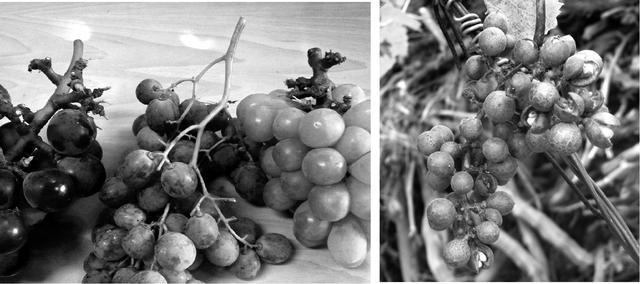
Although plant growth regulators are managed within the category of pesticides, they are not pesticides in the traditional sense for treating diseases, preventing insects and controlling weeds. First, their products are of low toxicity, and some are even listed as exempt substances for which no residue limit needs to be set because they are almost non-toxic. The toxicity of GA3 is lower than that of table salt (the LD50 of GA3 is >5 000 mg*kg-1, while the LD50 of table salt is 3 200 mg*kg-1). Second, the amount of plant growth regulators used is very small. For example, the effective concentration of GA3 used on grapes before and after flowering is 12-15 mg*kg-1. Excessive use has the opposite effect, causing side effects on grape inflorescences, such as thickening and hardening of the cluster stem, fruit cracking and berry shattering, making them lose market value (Figure 1). It can thus be seen that growers are also unlikely to use large amounts of plant growth regulators. Third, risk assessment results show that grapes treated with GA3 pose no potential risk to the human body. In 2015, the Ministry of Agriculture Agricultural Product Quality and Safety Risk Assessment Laboratory (Hangzhou) led the organization and implementation of the special project "Survey on the Use of Plant Growth Regulators on Fruits and Vegetables and Product Safety Assessment" (GJFP2015003), conducting product safety evaluations of plant growth regulators used on grapes in 4 provinces (municipalities), namely Henan, Shandong, Liaoning and Beijing. A total of 80 samples were collected, and after testing for GA3, it was shown that no GA3 was detected in any sample. Hou Yuru et al. [8] reported that spray applications of 0, 25 and 100 mg*L-1 were made 50 d before the ripening of Kyoho, and samples were taken at the fruit ripening stage. The GA3 content in the blank sample was 0.002 mg*L-1, and the GA3 residues in the fruit after treatment with the two concentrations were 0.001 and 0.005 mg*L-1 respectively, indicating that the residue of GA3 in grapes at the ripening stage after use is extremely low and not significantly different from the GA3 content in the blank sample. China has not established a limit for GA3 in grapes, but the residue is far below the residue limit standard of 0.2 mg*L-1 stipulated by Japan.
In the left figure, the middle is a normal fruit cluster, and the two sides show thick and hard stems caused by excessive use of plant growth regulators; the right figure shows mummified fruit.
Figure 1 Different effects of GA3 application on grapes
Plant growth regulators are used not only in China but also commonly in other countries. The European Union and Japan have registered plant growth regulators such as forchlorfenuron, abscisic acid and GA3 for use on various fruits. Because GA3 has low toxicity, the European Union has not established specific standards for GA3 residue limits in fruits [9].
5 Summary
Plant hormones and animal hormones cannot replace each other. Contraceptives cannot make fruit seedless, and plant hormones cannot regulate human growth and development. Seedless grapes are mainly related to varieties and the use of plant growth regulators. In addition, through risk assessment research on the use of plant growth regulators on grapes, it was found that they pose no dietary risk to the human body. Moreover, plants naturally produce quite a lot of plant hormones themselves, and no health hazards have been shown after consumption.