What are the influencing factors in sowing and seedling raising of Polygala fallax?
Study on the Influencing Factors of Sowing and Seedling Raising of Polygala fallax
1 Overview of the Test Site
The test site is located in Shishan Village, Xunzhong Town, Dehua County, Quanzhou City, Fujian Province, at latitude 25°26′58″N and longitude 118°15′18″E, in a low mountain and hilly area, at an altitude of 450 m. It belongs to the mid-subtropical mountain climate zone, with an average annual temperature of 19 °C, a frost-free period of 255 d, an annual rainfall of 1,580.22 mm, an annual relative humidity of 84%, and an annual sunshine duration of 2,166 h. It has obvious mountain climate characteristics, is mild and humid, and has superior water and heat conditions, suitable for the growth of Polygala fallax [10]. The previous crop at the test site was rice, and the sandy loam had not been polluted by highly toxic or high-residue pesticides in the earlier period.
2 Materials and Methods
2.1 Test Materials
The Polygala fallax seeds used in the test were collected in October 2015 from Dehua County, Quanzhou City, with a 1,000-grain mass of pure seeds of 62.5 g. The collected seeds were placed in a ventilated, dry indoor place to dry in the shade, and then the shade-dried seeds were stored in wet sand, with one layer of seeds and one layer of sand. The sand moisture was based on the standard that it would not scatter after being clenched into a ball by hand. They were turned once every 10-15 d, and attention was paid to maintaining the storage temperature and humidity to prevent the seeds from becoming moldy.
2.2 Test Methods
The seeds were sown on the seedbed, gently pressed into the soil, covered on the surface with substrate and a plastic-film arched shed, sprayed with water to maintain moisture, and fully fermented organic fertilizer (sheep manure fertilizer) was applied as base fertilizer, with compound fertilizer (N 15%, P 15%, K 15%) applied as topdressing. According to the characteristics of sowing and seedling raising of Polygala fallax and the growth status of the seedlings, a scheme was formulated through seedling-raising measures such as sowing density, covering substrate, and covering thickness to study their effects on the nursery seedling-raising effect of Polygala fallax.
2.2.1 Sowing Density
Sowing density is one of the core contents affecting seedling raising. Seedling-raising designs with different densities were carried out to screen the best sowing density. The test adopted the drilling sowing method, with each sample plot set at 1 sq m, 20 cm/row, and 5 treatments set for sowing density: 80, 100, 125, 165, and 250 grains, marked as I, II, III, IV, and V, repeated 3 times, and covered with soil after sowing and fertilizing.
2.2.2 Covering Substrate
The test set up 4 treatments: burned soil, red heart soil, burned soil:red heart soil = 1:2, and burned soil:red heart soil = 2:1, marked as S1, S2, S3, and S4, with a covering thickness of 1 cm, a plant-row spacing of 20 cm × 20 cm, 6 rows sown per treatment, 25 seeds per row, repeated 3 times.
2.2.3 Covering Thickness
In the test, burned soil:red heart soil = 2:1 was used as the covering substrate, and the covering thickness was set at 0.5, 1, 2.0, 3.0, and 4.0 cm before sowing. The treatments were marked as F1, F2, F3, F4, and F5, sown by drilling, with a plant-row spacing of 20 cm × 20 cm, 6 rows sown per treatment, 25 seeds per row, repeated 3 times.
2.3 Data Processing and Analysis
The data summary, analysis of variance, and Duncan multiple comparison of the test results were all carried out using DPS software.
3 Results and Analysis
3.1 Effects of Sowing Density on Seed Germination and Growth Status of Polygala fallax
Sowing density is a key indicator directly affecting the quality and yield of seedling raising, and it directly affects the emergence rate, seedling height, and basal diameter growth. This is because the water, nutrients, and light that the sowing substrate can provide per unit area are limited. Within a certain range, increasing sowing density can effectively improve the emergence rate, promote seedling height and basal diameter growth, and increase the quality and yield of qualified seedlings per unit area. However, if the sowing density is too high, the seedlings become crowded, nutrient acquisition is limited, light is insufficient, photosynthesis decreases, and this not only reduces the germination rate but is also unfavorable to seedling height growth and basal diameter growth, directly reducing the quality and yield of qualified seedlings per unit area.
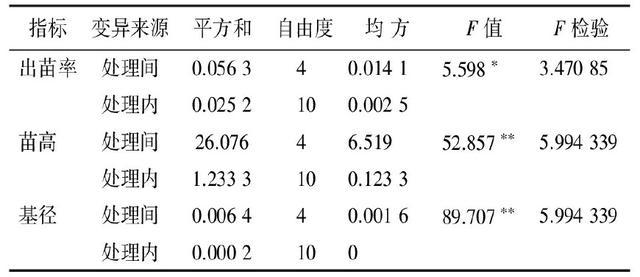
From the analysis of variance in Table 1, it is known that there are extremely significant differences in the emergence rate, seedling height, and basal diameter growth status among different sowing densities.
The Duncan multiple comparison in Table 2 shows that: (1) In terms of emergence rate, except for significant differences between II and I, V and IV, and II and III, there are no significant differences in emergence rate among the other treatments, and the emergence rate is highest when the sowing density of treatment I is 165 grains·m-2; (2) In terms of seedling height growth, except between I and V, there are significant differences in seedling height among the other treatments, and the seedling height is highest when the sowing density of treatment III is 125 grains·m-2; (3) In terms of basal diameter growth, there are significant differences among all treatments, and the basal diameter is thickest when the sowing density of treatment I is 165 grains·m-2. Therefore, considering all influencing factors comprehensively, the sowing density of Polygala fallax should preferably be selected as 125-165 grains·m-2.
Table 1 Analysis of Variance of Emergence Rate, Seedling Height, and Basal Diameter Under Different Sowing Densities
Note: * indicates significant difference at the 0.05 level; ** indicates extremely significant difference at the 0.01 level (the same below).
Table 2 Multiple Comparison of Emergence Rate, Seedling Height, and Basal Diameter Under Different Sowing Densities
3.2 Effects of Covering Substrate on Seed Germination and Growth Status of Polygala fallax
From the analysis of variance in Table 3, it is known that there are extremely significant differences in the emergence rate, seedling height, and basal diameter growth status among different covering substrates.
The Duncan multiple comparison in Table 4 shows that: (1) In terms of emergence rate, the emergence rates among all treatments reached significant differences, and the emergence rate was highest when the covering substrate was burned soil:red heart soil = 2:1. When burned soil or red heart soil was used alone as the covering substrate, the emergence rate was lower than when the two were mixed. This is because burned soil is a soil substrate with relatively high contents of readily available nitrogen, phosphorus, and potassium, with good permeability and resistance to hardening; while red heart soil has a certain water- and fertilizer-retention capacity, but its disadvantage is that the soil texture hardens easily. Mixing the two in proportion gives play to the advantages of both and optimizes the ratio, so that the substrate has good water and fertilizer retention, comprehensive nutrition, and is loose and permeable, which is conducive to seed germination and growth; (2) In terms of seedling height growth, except that the difference between treatment S1 and treatment S2 is not significant, the seedling heights among the other treatments all reached significant differences, and the seedling height was highest when the covering substrate was burned soil:red heart soil = 2:1. This is because the mixed use of burned soil and red heart soil easily promotes root growth; with well-developed roots, the ability to absorb soil nutrients can be effectively improved, thereby promoting seedling height growth; (3) In terms of basal diameter growth, except that the difference between treatment S3 and treatment S1 is not significant, the basal diameters among the other treatments all reached significant differences, and the basal diameter was thickest when the covering substrate was burned soil:red heart soil = 2:1. This is because the nutrient content of the covering substrate differs; the higher the proportion of burned soil in the substrate, the higher the nutrients contained in the soil, which can effectively promote the basal diameter growth of the seedlings. Therefore, considering all influencing factors comprehensively, the sowing covering substrate for Polygala fallax should preferably be selected as burned soil:red heart soil = 2:1.
Table 3 Analysis of Variance of Emergence Rate, Seedling Height, and Basal Diameter Under Different Covering Substrates
Table 4 Multiple Comparison of Emergence Rate, Seedling Height, and Basal Diameter Under Different Covering Substrates
3.3 Effects of Covering Thickness on Seed Germination and Growth Status of Polygala fallax
From the analysis of variance in Table 5, it is known that there are extremely significant differences in the emergence rate and seedling height growth status among different covering thicknesses, while there is no significant difference in basal diameter growth status.
Table 5 Analysis of Variance of Emergence Rate, Seedling Height, and Basal Diameter Under Different Covering Thicknesses
Table 6 Multiple Comparison of Emergence Rate, Seedling Height, and Basal Diameter Under Different Covering Thicknesses
The Duncan multiple comparison in Table 6 shows that: (1) In terms of emergence rate, except that the difference between F4 and F5 is not significant, the emergence rates among the other treatments all reached significant differences, and the emergence rate was highest when the covering thickness was 2.0 cm. When the covering thickness was in the range of 0-2.0 cm, the emergence rate increased with increasing thickness; when the covering thickness exceeded 2.0 cm, the emergence rate began to decrease with increasing thickness. This is because after sowing, if the covering soil is too thin, the seeds are easily washed out to the surface and exposed on the seedbed, lacking nutrients and water, which affects germination; while if the covering soil is too thick, the surface soil hardens easily after watering, causing insufficient oxygen supply required for seed germination, blocked respiration, weak growth vigor, and the seedlings are unable to push out of the soil surface, resulting in seed rot and missing seedlings; (2) In terms of seedling height growth, except that the difference between F1 and F5 is not significant, the seedling heights among the other treatments all reached significant differences, and the seedling height was highest when the covering thickness was 2.0 cm. Sowing and covering with soil can not only provide medium protection for the seeds, but also provide nutritional support for them, promoting seed germination and height growth. During the process of seed germination and breaking through the soil, as the covering thickness increases, the resistance encountered becomes greater, and seedling height growth is somewhat limited; however, after emerging from the soil, a certain thickness of soil support can instead promote seedling height growth; (3) In terms of basal diameter growth, the differences among all treatments were not significant, among which the basal diameter was thickest when the covering thickness was 3.0 cm. During the sowing, germination, and emergence period, seedling height growth is more vigorous than basal diameter growth, and the covering thickness temporarily has little effect on basal diameter growth. Therefore, considering all influencing factors comprehensively, the sowing covering thickness for Polygala fallax should preferably be selected as 2.0-3.0 cm.
4 Conclusion and Discussion
Sowing density, covering substrate, and covering thickness have crucial effects on seed germination and growth.
(1) When the sowing density of Polygala fallax is in the range of 80-165 grains·m-2, the emergence rate, seedling height, and basal diameter all show a trend of first increasing and then decreasing with increasing density. When the density is 165 grains·m-2, the emergence rate and basal diameter both reach the highest values, while seedling height reaches the highest value when the density is 125 grains·m-2. This is related to the interaction caused by the forced allocation of growth resources among individual plants due to density, because an increase in density can directly lead to intraspecific competition, causing changes in the growth amount and biomass of individual plants in the population [11]. Therefore, when sowing and raising seedlings, 125-165 grains·m-2 should preferably be selected as the optimal sowing density range.
(2) Selecting different covering substrates has a significant effect on the emergence rate, seedling height, and basal diameter of Polygala fallax seeds, which is related to the level of nutrients that the sown seedlings can absorb. When the covering substrate is burned soil:red heart soil = 2:1, the emergence rate, seedling height, and basal diameter all reach the highest values. Therefore, when sowing and raising seedlings, burned soil:red heart soil = 2:1 should preferably be selected as the optimal covering substrate;
(3) Because the seeds of Polygala fallax are relatively small and their ability to emerge and break through the soil is relatively weak, the choice of covering thickness at sowing is crucial. If the covering soil is too thin, insufficient moisture easily occurs on the surface, making seed germination difficult. When the covering thickness is in the range of 0.5-4.0 cm, the emergence rate, seedling height, and basal diameter of sown Polygala fallax seedlings change with the covering thickness. When the covering thickness is 2.0 cm, the emergence rate and seedling height both reach the highest values, while the covering thickness at which the basal diameter reaches the thickest value is 3.0 cm. Therefore, considering the effects of all factors comprehensively, 2.0-3.0 cm should preferably be selected as the optimal covering thickness range.