What to do when succulent leaves blister? A simple fix you can apply in one swipe
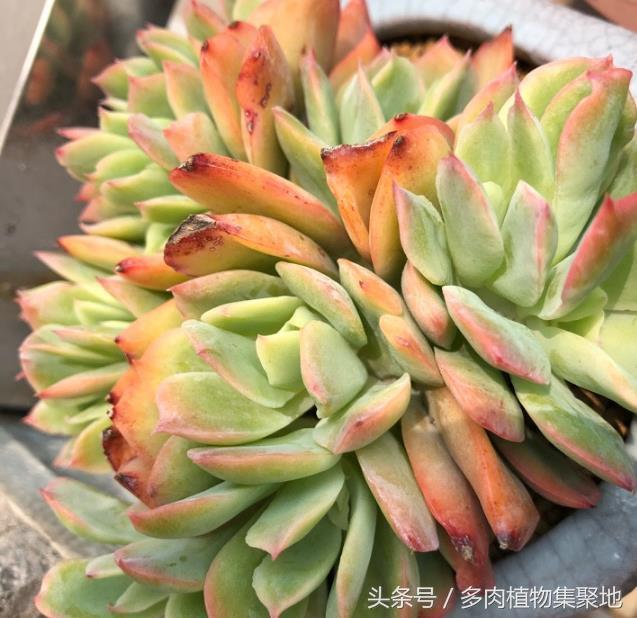
If the summer weather is hot and ventilation is poor, the leaves of some succulent varieties will blister, looking like acne. It is normal for Allen, Taodan and others to show this, and it will be fine by autumn. You can mix carbendazim into a paste, not too thick, and apply it to the blistered parts of the leaves. The key is still ventilation and cooling down.
Observing succulent leaves regularly is very important; a lot of information can be seen from the leaves of succulents. When a succulent lacks water, its condition still has not recovered 2~3 days after watering. This shows that the root system has not grown well. When there are not many roots, the succulent absorbs very poorly, and even if there is enough water in the soil, it cannot take it up.
At this point you can further analyze your own soil mix. If there is no problem with the soil mix either, then just wait! Do not, out of doubt, pull the succulent out to check. Succulents generally grow slowly, so recovery is also very slow. For a succulent in poor condition after cuttings, it will change after about 3 months. Of course, the temperature must be above 15°C, otherwise the recovery time will be longer.
How to grow succulents in summer? Water carefully, and try to choose nighttime for watering. Never water at noon (except on cloudy days). Stop watering during continuous high temperatures (normally there is no problem within a month; adjust according to actual weather conditions). Once cloudy days and cooling arrive, seize the opportunity to water. "Cutting off water" is only suitable for a small number of succulents; most do not need water cut off in summer, including Lithops and Sempervivum, which rot most easily in summer (here this refers only to the home environment). In particular, some succulents in poor condition still need water replenishment to recover. For example, if wrinkles appear, they still need watering to recover.
Most succulents go dormant in summer and winter, that is, they enter a dormant period. So-called dormancy is not absolute. For varieties such as Haworthia cooperi 'Silver' and Haworthia cooperi, most plants in the genus Frithia of Aizoaceae, and Lithops pseudotruncatella, the dormancy performance is not obvious. This also needs to be handled flexibly according to the state of each plant. The principle is that in the season when dormancy should occur, if the plant shows dehydration, the growth point loses its luster, or the overall color darkens and it feels soft, it should be treated as dormant.
There are also many different states of leggy growth, but overall leggy growth shows that the plant is still growing normally. Compared with those succulents that do not grow and have wrinkled leaves, it is much, much healthier. Leggy growth should only count as sub-health. The reason for this condition is too much water. But this is not a bad phenomenon. As long as there is sufficient sunlight at home, increasing sunlight time in later care and continuing to water will make the succulent plump up. Do not think this leggy growth is bad and stop watering, because at this time the succulents are in their growth period. If water is cut off at this time, growth will slow down, and it will be more difficult to make the succulent plump up.
This is a gathering place for succulent lovers, sharing succulent care tips. Welcome to follow and exchange ideas.