What is Sinningia leucotricha? Get to know this succulent plant
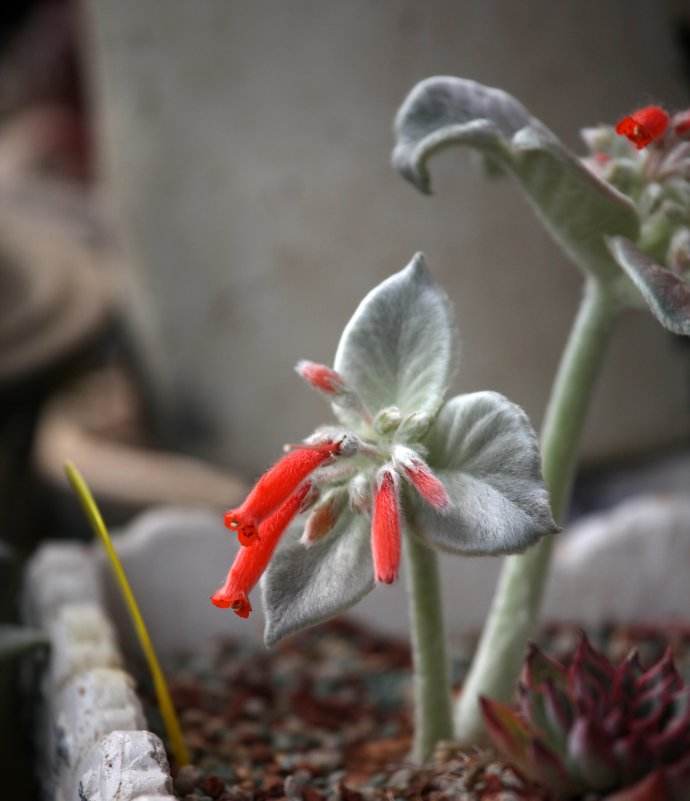
Sinningia leucotricha, also known as the Brazilian edelweiss, is a rupicolous plant and succulent belonging to the genus Sinningia (also called the gloxinia genus) in the family Gesneriaceae. It has an underground tuber, and the leaf surface is covered with dense, velvety masses of white hairs; the flowers grow at the tips of the branches, several blooming in clusters, with a relatively slender floral tube 3 to 4 cm long and about 2 cm in diameter, the petal tips slightly curved, orange-red or vermilion, covered on the outside with white hairs, blooming from spring to early summer, with the heaviest flowering in April and May. In the wild it is pollinated by hummingbirds. Sinningia leucotricha has a beautiful and unusual form and is suitable for growing in well-draining media; it can adorn bright windowsills, balconies, and indoor shelves, desks and similar spots.
Sinningia leucotricha
Morphological characteristics:
The plant has a spherical or sweet-potato-shaped fleshy stem (commonly called a "tuber"), with a yellowish-brown skin, fibrous roots, and green branches clustered at the top, 20-30cm tall, densely covered on the surface with short white hairs. The leaves grow on the upper part of the branches, elliptical or long-elliptical, opposite, entire, with pointed tips, green, 8 to 12 cm long and 4 to 6 cm wide, with dense, thick white hairs on the leaf surface and a glossy sheen. The flowers grow at the tips of the branches, several blooming in clusters, with a relatively slender floral tube 3 to 4 cm long and about 2 cm in diameter, the petal tips slightly curved, orange-red or vermilion, covered on the outside with white hairs, blooming from late spring to early autumn, with the heaviest flowering in April and May.
Sinningia leucotricha
Growing environment:
Spring and autumn are the peak growing periods; it blooms in April and May, begins dormancy after December, and can tolerate low temperatures of 5°C. A full dormancy is beneficial for flowering the following spring. It is propagated by seed. The seeds have a short lifespan, so sow them immediately after collecting, sowing on a mix of high-temperature-sterilized leaf mold and sand. They germinate in 1-2 weeks at around 20°C; after germination keep the medium moist, and transplant when there are 5-6 true leaves. Plants grown from cuttings do not easily form a tuber.
Sinningia leucotricha
Main value:
The Brazilian edelweiss is an extremely attractive indoor plant, grown both for its foliage and its flowers. During the flowering period you can enjoy its orange flowers, and at other times its fuzzy leaves, whose fine, soft hairs on the leaf surface closely resemble animal fur and make you want to reach out and stroke them; together with the plump tuber exposed above the soil, it adds a touch of endearing charm. Moreover, even for beginners it is a fairly easy succulent plant to grow. The careful care described above will of course make it even better, but if you do not have enough time to look after it, it will also quietly grow and even, when you least expect it, repay you with flowers.