Standardized Cultivation Techniques for Shandong White-Flower Salvia miltiorrhiza
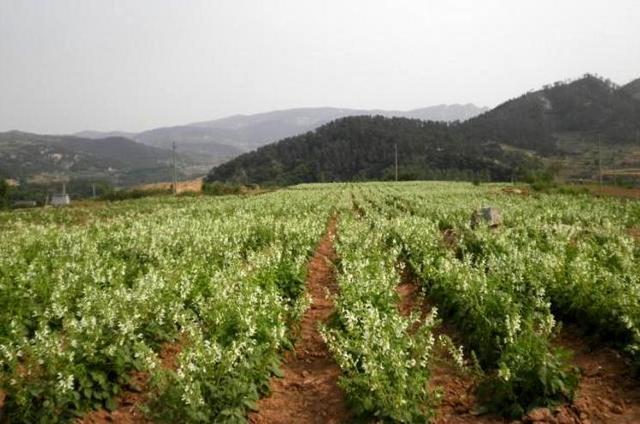
Shandong White-Flower Salvia miltiorrhiza and Its Standardized Cultivation
1. Site Selection and Land Preparation
White-flower Salvia miltiorrhiza prefers a warm and humid environment and has strong adaptability and cold resistance. To promote root growth and development, select deep, fertile, loose, humus-rich, well-drained sandy loam. For mountain land, choose sunny low-mountain depressions with ample light, sufficient rainfall, unpolluted water, and superior geographical and natural conditions.
2. Seedling Raising and Transplanting
After plowing the land fine and harrowing it level, make beds 100-150cm wide, apply sufficient base fertilizer, deep plow, water once, and when the soil is 70-80% dry, turn it over once, harrow fine and level, scatter seeds evenly on the bed surface, lightly tread once with the foot so that the seeds and soil are closely combined; there is no need to cover with soil. After sowing, thinly scatter a layer of wheat bran or rice bran on top. If the soil is dry, sprinkle water and always maintain soil moisture. After 2 months, transplanting can be done. When seedlings are 6-10cm tall, they can be transplanted. Before transplanting, water the seedbed once so that seedlings can best be lifted with soil. Transplant with row spacing x plant spacing of 30-35cm x 20-25cm, planting 4500-5000 plants per mu.
3. Fertilizer and Water Management
When seedlings are 6-7cm tall, thin them and set the stand. When seedlings are 15-17cm tall, carry out intertillage and weeding, and combine with applying 15-20kg of homemade organic-inorganic compound fertilizer mainly based on phosphorus fertilizer. The field must neither accumulate water nor become drought-stricken; pay attention to drainage in the rainy season and water during drought. Prune flower spikes and old stems. Except for inflorescences kept for seed production, from mid-April onward, successively remove the emerging inflorescences from other plants to keep nutrients concentrated in the roots and favor robust root growth. For seed-producing plants, after the seeds are harvested, the stems and leaves gradually wither, which is unfavorable to root growth; cut off the old stems so that new shoots regrow from the base and the roots continue to grow.
4. Disease and Pest Control
4.1 Root rot. It occurs easily in hot, rainy seasons. Affected plants have blackened roots and withered aboveground parts. Control methods: avoid continuous cropping in severely affected areas; choose dry, well-drained plots for planting; pay attention to drainage in the rainy season; during the onset period, drench with 70% carbendazim 1000-fold solution.
4.2 Leaf spot. It mainly damages the leaves. Diseased plants have nearly circular or irregular dark brown spots on the leaves, and in severe cases the leaves wither and die. This disease is a bacterial disease. It begins in May and continues until late autumn, with severe incidence in June-July. Control measures: Agricultural control: clean the field and deeply bury diseased and residual plants. Pay attention to drainage. Improve ventilation and light conditions. Practice crop rotation. Chemical control: during the onset period, drench roots with 50% carbendazim 800-fold solution or 70% thiophanate-methyl 1000-fold solution, 250mL per plant, then drench again after 7-10 days, for 2-3 consecutive times. Alternatively, use 70% thiophanate-methyl 500-fold solution or 75% chlorothalonil 600-fold solution, spraying once every 10 days for 2-3 consecutive sprays, spraying the stem base.
4.3 White grubs. The larvae cause damage by biting off seedlings or gnawing roots, resulting in missing plants or hollow roots, and the damage is severe. Control methods: apply fully decomposed fertilizer, preferably high-temperature compost; use light traps to kill adults; treat seeds with 75% phoxim emulsifiable concentrate at 0.1% of seed weight; during the field occurrence period, drench with 90% trichlorfon 1000-fold solution or 75% phoxim emulsifiable concentrate 700-fold solution.
4.4 Aphids. Adults and nymphs suck sap from stems and leaves, and in severe cases cause stems and leaves to turn yellow. Control methods: clear the garden in winter, and deeply bury or burn withered plants and fallen leaves; during the onset period, spray 50% pirimicarb or 40% dimethoate emulsifiable concentrate 1000-2000-fold solution, once every 7-10 days, for several consecutive times.
4.5 Silver-Y moth. The larvae bite and feed on leaves, occurring in summer and autumn. Control methods: use Bacillus thuringiensis powder containing more than 10 billion spores per gram at 1500-fold solution. In addition, 10% imidacloprid wettable powder 2500-fold solution or 5% tebufenozide emulsifiable concentrate 2000-fold solution can be selected and sprayed at the young larval stage, once every 20 days, for 1 or 2 control applications. At the young larval stage, spray 90% trichlorfon technical material 800-fold solution once every 7 days.
4.6 Cotton bollworm. The larvae damage buds, flowers, and fruits, affecting seed yield. Control methods: (1) Per 667 sq m, use 50% parathion emulsifiable concentrate, or 50% phoxim emulsifiable concentrate 100mL; or 50% acephate emulsifiable concentrate 150mL; or 2.5% deltamethrin emulsifiable concentrate or 20% fenvalerate emulsifiable concentrate 25mL; 2.5% cyhalothrin emulsifiable concentrate 30-40mL, diluted with 50-60kg water for spraying. (2) Mixed use of organophosphorus and pyrethroid insecticides gives relatively ideal control efficacy.
5. Harvesting and Processing
Harvesting can be done in both spring and autumn. After Frost's Descent, the leaves wither and underground growth stops. Dig out all the roots, remove all soil, remove the crown, and sun-dry them. Finished products must be thoroughly sun-dried for storage and placed in a dry, ventilated place to prevent moisture, mold, and insect damage. In summer, when stems and leaves are luxuriant, collect leaves and sun-dry them or make tea. During the flowering period, collect inflorescences and sun-dry them.