What are the key techniques for rain-shelter cultivation of Panax notoginseng?
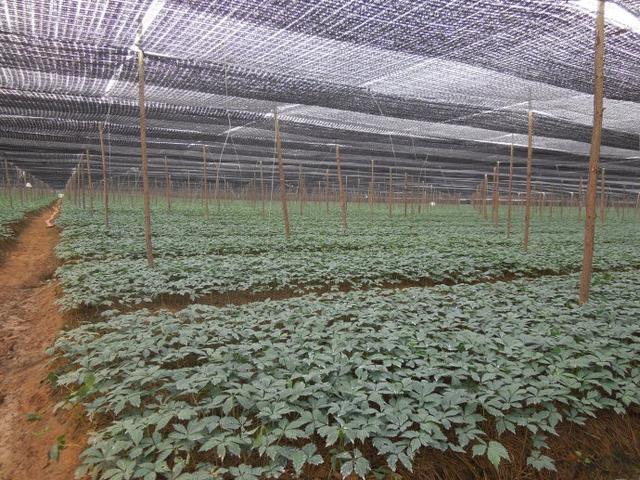
Key techniques for rain-shelter cultivation of Panax notoginseng
1 Morphological characteristics
Panax notoginseng is a perennial herb. The leaflets are oblong to obovate-oblong, with fine hairs on the veins on both sides; the stipules are ovate or lanceolate. The umbel bears many flowers; the pedicels are pubescent; the flowers are small, with scale-like bracts at the base; the calyx is 5-toothed; the 5 petals are yellow-green, oblong-ovate, with pointed tips. The drupe-like berry is nearly kidney-shaped and bright red when ripe. The flowering period is June to August, and the fruiting period is August to October [8].
2 Ecological habits
Panax notoginseng prefers warm, cool conditions and is intolerant of intense heat; the light it requires is usually 8%-20% of natural light. It prefers moisture and fears waterlogging; it is mostly cultivated in mountainous areas at 20-25°N, 95-115°E, and an altitude of 400-1 800 m; the suitable annual average temperature is 14-18 °C, the average temperature of the coldest month is 6-12 °C, the average temperature of the hottest month is 17-23 °C, the annual accumulated temperature of ≥10 °C is 4 200-5 900 °C, the annual precipitation is 900-1 300 mm, and the frost-free period is more than 280 d; the relative air humidity is 70%-80%, and the soil moisture content is 25%-30%; it has no strict requirements for soil, but overly clayey, overly sandy, and low-lying, easily waterlogged sites are not suitable for planting. It grows well in mixed carbonate rock and clastic rock yellow-red soil with convenient drainage and irrigation, deep soil layers, loose and moist texture, rich in humus, pH 5.5-7.0, a certain slope, and where Panax notoginseng has not been planted for at least 6 years [9].
3 Seed selection and seed treatment
In 3-4-year-old Panax notoginseng gardens with good growth and no pests or diseases, select tall, healthy plants with thick stems and broad, thick leaves as mother plants and strengthen their management [10]. Around November, select plump, disease-free mature fruits (red seeds) from the first and second batches for seed. Put the red seeds into a bamboo sieve, rub off the fruit skin, wash them clean, and dry the surface moisture. Soak the seeds for 10 min in a 400-fold dilution of 65% zineb wettable powder, or Xin Gao Zhi Mo, or a 1 000-fold dilution of 50% thiophanate-methyl wettable powder for disinfection (can be mixed with seed coating agents), to isolate viral infection, repel underground pests and diseases, without affecting the germination and imbibition function, while enhancing respiratory intensity and increasing the seed germination rate. Panax notoginseng seeds lose viability very easily after drying, so they should be sown immediately after harvest or preserved by stratification (storage time is generally only 45-60 d) [11].
4 Rain-shelter cultivation techniques
4.1 Site selection and land preparation
Select yellow-red soil or sandy loam with a slope of 5°-15°, good drainage, rich in organic matter, and slightly acidic to neutral. After the plot is selected, leave it fallow for half a year to one year and carry out 3 ploughings and 3 harrowings. The first ploughing and harrowing is in early November, and thereafter once every 15 d. The ploughing depth is 30 cm. Fully break up and turn the plot to bring pathogens and insect eggs in each soil layer to the surface, where they die after sufficient exposure to sunlight, reducing the number of pathogens and insect eggs the following year and lessening the occurrence of pests and diseases. If conditions permit, before turning the soil, spread grass and burn the soil, or apply 750-1 050 kg/hm2 of lime or 150-225 g/hm2 of 65% fenaminosulf wettable powder to disinfect the soil. During the last ploughing and harrowing, apply base fertilizer: for seedling plots, apply 300 kg/hm2 of special fertilizer for Panax notoginseng seedlings and 30 000 kg/hm2 of decomposed organic fertilizer (farmyard manure); for transplanting plots, apply 300 kg/hm2 of special fertilizer for Panax notoginseng and 37 500 kg/hm2 of decomposed organic fertilizer (farmyard manure), mix evenly, harrow finely, and level. Make beds facing south, 1.2-1.5 m wide, with length depending on the terrain. On flat land and gentle slopes, the bed height is 20-15 cm; on sloped land, the bed height is 15-20 cm. Shape the bed surface into a turtle-back form, loose below and firm above, to improve soil permeability. To ensure the quality of Panax notoginseng, it is necessary to consider whether pesticide residues and heavy metal content in the soil exceed the limits. The limit standards are as follows: BHC ≤0.2 mg/kg, DDT ≤0.2 mg/kg, Pb ≤50 mg/kg, Cu ≤80 mg/kg, Cd ≤2 mg/kg, Hg ≤l mg/kg, As ≤20 mg/kg.
Build the shade shed before sowing. Use Chinese fir, miscellaneous wood, or moso bamboo as posts, with a post length of 2.3 m and a stem diameter of 5-10 cm, arranged in straight rows both lengthwise and crosswise, with a row spacing of 3.0 m×1.8 m, buried 50 cm deep, leaving 1.8 m above ground; stretch No. 12 iron wire straight and fix it to the posts, and reinforce the edge posts with diagonal iron wire. First lay 1 layer of white transparent rain-shelter film, then cover with special plastic shade netting for Panax notoginseng, then add 1 more layer of shade netting with relatively high light transmittance (about 50%) (the light transmittance required for 1-, 2-, and 3-year-old Panax notoginseng is 8%-12%, 12%-15%, and 15%-20%, respectively). Finally, use No. 8 iron wire to pull tight in a ""-shaped pattern and fix it between the left and right posts, making the shade shed "M"-shaped to facilitate wind protection and drainage.
4.2 Sowing
Sow from December to January of the following year. After disinfecting and sterilizing the seeds, dibble them at a spacing of 5 cm×6 cm, broadcast a small amount of mixed fertilizer (using decomposed farmyard manure or mixed with other fertilizers) as cover, and cover with a thin layer of rice straw, mountain grass (rice straw and mountain grass must be cut into small sections), or pine needles (the mulch should be disinfected with lime sulfur in advance), to the extent that the bed soil or base fertilizer is not exposed, achieving the effect of maintaining bed surface moisture and suppressing weed growth. The seeding rate is 1.05 million-1.5 million seeds/hm2, equivalent to 150-180 kg/hm2 of fruits. After sowing and watering, cover with white plastic film to conserve water and fertilizer and increase yield.
4.3 Removing the film and releasing seedlings
When the emergence rate reaches 50% and the seedlings are 1-2 cm tall, directly remove the film to release the seedlings. The time is best before 11:00 or after 16:00. At the seedling holes, earth up promptly to protect the roots.
4.4 Seedling management and transplanting
During dry weather, water frequently; after rain, drain promptly to prevent waterlogging, maintaining 25%-30% soil water-holding capacity. Weed regularly (chemical herbicides are prohibited), ensuring no weeds on the bed surface or along the ditch edges. During the seedling stage, topdressing is mainly phosphate fertilizer, generally applied 3 times: in March at the full-stand stage, in June at the leaf-expansion stage, and in October before transplanting. Topdressing should be done on sunny mornings after the dew on the leaves has dried. After fertilizing, use a thin bamboo pole or similar to shake off the fertilizer from the leaf surface.
Transplant after 1 year of seedling raising, from December to January of the following year. When transplanting, lift seedlings, select seedlings, and transplant them at the same time. When lifting seedlings, prevent damage to roots and buds; when selecting seedlings, remove diseased, damaged, and weak seedlings, and grade the seedlings (seedlings). Before planting, soak them in zineb or polyoxin, etc., for sterilization, take them out and let them dry slightly, and plant at a spacing of (10 cm×12.5 cm)-(10 cm×15 cm) and a density of 390 000-480 000 plants/hm2. When planting, point the buds toward the upper side of the slope, let the seedling roots spread naturally, and place the seedlings from low to high along the slope. After planting, cover with fine soil and then with rice straw, mountain grass, or pine needles, water thoroughly to settle the roots, and cover with white plastic film.
4.5 Field management
4.5.1 Releasing and replanting seedlings When Panax notoginseng emerges from the soil in a hook-like shape, break the film to release the seedlings and earth up the roots. At the same time, carry out a comprehensive inspection. If dead and missing plants are found, remove them promptly and replant.
4.5.2 Weeding and earthing up Panax notoginseng is a shallow-rooted plant, and its root system is mostly distributed in the surface layer of the plot, so intertillage is not suitable, to avoid damaging the roots. After the seedlings emerge, weeds on the bed surface should be removed promptly, and the rhizomes and roots exposed above the ground should be earthed up.
4.5.3 Water management In drought, water to keep the bed surface moist, preferably in the morning or evening; after rain, drain promptly to prevent waterlogging and avoid root rot and other diseases caused by standing water. Avoid prolonged drought or long-term waterlogging, and maintain soil water-holding capacity at about 25%.
4.5.4 Topdressing Topdressing is mainly decomposed organic fertilizer, supplemented by compound fertilizer and various trace element fertilizers. Nitrate nitrogen fertilizer and human excrement and urine are prohibited. Apply topdressing once each from April to June and from August to October, with an application rate of 37 500 kg/hm2 each time. The demand of Panax notoginseng for nitrogen, phosphorus, and potassium varies with soil fertility and each growth stage, generally 2:1:3 (annual). The use of special fertilizer for Panax notoginseng is advocated, and chemical fertilizers can also be used in combination with organic fertilizers.
4.5.5 Bud removal When red seeds are not the harvest target, in mid-to-late July, when the flower buds of Panax notoginseng grow to 3-5 cm, remove them manually on a sunny day. Removing the flower buds can reduce nutrient consumption in the aboveground part and concentrate supply for underground root growth, playing an important role in increasing the tuberous root yield and total saponin content of Panax notoginseng.
4.5.6 Pest and disease control The main diseases of Panax notoginseng are root rot, black spot, and original spot disease. For root rot, drench the roots with a 300-500-fold dilution of 58% metalaxyl wettable powder or 50% carbendazim wettable powder, combined with spraying Xin Gao Zhi Mo to enhance the control effect, or use 10% yekujing wettable powder + 70% fenaminosulf wettable powder + fine soil (1 kg:1 kg:150 kg) as poisonous soil, which gives a relatively good effect; for black spot, spray with a 500-fold dilution of 40% mancozeb wettable powder or a 1 000-fold dilution of 58% procymidone wettable powder, or spray with a 600-fold dilution of an equal mixture of 45% amobam wettable powder and 80% zineb wettable powder; for original spot disease, spray with a 800-fold dilution of 58% metalaxyl-mancozeb wettable powder or a 500-fold dilution of 65% zineb wettable powder once every 7 d, for 2-3 consecutive sprays.
The main insect pests of Panax notoginseng are aphids, red spiders, and scale insects. For aphids, spray the leaf surface with a 1 500-fold dilution of 3% acetamiprid emulsifiable concentrate or a 2 000-fold dilution of 50% pirimicarb wettable powder; for red spiders, after late March, spray 0.2-0.3 Baume lime sulfur mixture once every 7 d, for 2-3 consecutive times; during the peak incidence period from June to July, spray a 2 000-4 000-fold dilution of 5% hexythiazox emulsifiable concentrate; for scale insects, during the young instar stage, spray a 1 000-2 000-fold dilution of 25% buprofezin suspension concentrate or 40% methidathion emulsifiable concentrate for control.
5 Harvesting and processing
5.1 Harvest time
The tuberous roots of spring Panax notoginseng (not retained for seed) are dug from September to December, and the tuberous roots of winter Panax notoginseng (retained for seed) are dug from November to December (20-30 d after picking the red seeds). The picking times for red seeds, stems and leaves, and flowers are October to November, September to December, and mid-to-late July, respectively.
5.2 Harvesting methods
Tuberous roots: Use homemade bamboo strips or wooden sticks sharpened at the tip, and dig sequentially from one side of the bed to the other. If the soil is too dry and compacted, water it and dig again after 3 d. When digging, prevent root damage and ensure the tuberous roots are intact. Mechanically damaged or diseased tuberous roots must be stored separately. Red seeds: When the fruits turn from green to red and become glossy, they are mature and can be picked and stored in batches, or picked all at once after they turn fully red. Stems and leaves: Select healthy stems and leaves and cut them 2-4 cm above the ground. Flowers: When the flower buds grow to a diameter of 3-5 cm, pick them at the base of the bud.
5.3 Primary processing
Tuberous roots: Follow the process flow of "fresh Panax notoginseng sorting → cleaning → trimming → drying → polishing → grading." First, remove diseased roots, leaves, and impurities; quickly rinse with drinking water to remove mud and sand; then remove fibrous roots less than 5 mm in diameter; air-dry or dry by baking at 50-60 °C until the moisture content is 40%-50%; cut off the lateral roots and rhizome heads 4-6 mm above the main root surface, so that after drying the trimmed opening is level with the main root surface; air-dry or bake the main roots, rhizome heads, lateral roots, and fibrous roots separately at 40-50 °C until the moisture content is below 13%; place the dried main roots together with polishing materials in a polisher (coarse chaff, rice grains, buckwheat, dried pine needle sections, etc.) and polish until the surface of the main roots is brown-black and glossy, which is the finished product; finally, grade according to relevant requirements.
Red seeds: Same as seed treatment.
Stems and leaves: Soak in 0.1% dilute hydrochloric acid or 2% quicklime for 2-3 h, rinse clean with running drinking water, and finally dry by baking at 30-60 °C until the moisture content is below 10%.
Flowers: Rinse with running purified water, then dry until the moisture content is below 10%.
6 Packaging and storage
The finished products after primary processing must be packaged in dry, clean, odorless, pollution-free containers that do not affect quality (such as bamboo products, cartons, woven bags, gunny bags, etc.), and labels must be attached indicating the product name, grade, net weight, gross weight, place of origin, production date, and execution standards, etc.
Products should be stored separately in a clean, dry, ventilated, odorless, and pollution-free dedicated warehouse. Products with a moisture content exceeding 13% must not be put into storage.