How do you grow a hoya plant on a balcony? Master 4 points and flowers will cover the branches and burst into a ball waterfall
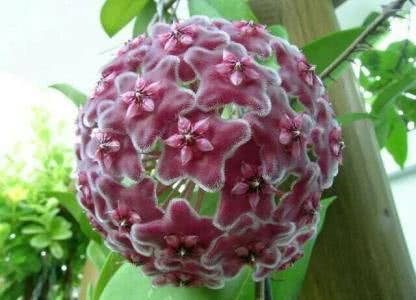
Some flower-growing friends always keep some novel flowers at home, and the hoya plant has come into everyone's view. Its leaves are emerald green, and its flower shape is peculiar, with each small petal forming a hemisphere. When flowers cover the branches, one small ball after another hangs in the air, incredibly beautiful.
The hoya plant is a perennial evergreen vine with a very strong climbing ability, and it is most suitable for growing on a balcony. Its flowering period is from April to June, and right now is the peak blooming period.
Caring for a hoya plant is also fairly simple. You only need to know these 4 points well, and flowers will cover the branches and burst into a whole waterfall of balls!
1. Light
The hoya plant likes a semi-shaded environment, and some scattered light is enough to let it grow very well. It only needs 3-4 hours of scattered light each day to bloom very well. It must not be exposed to direct sunlight, otherwise the leaves will turn yellow, dry up and fall off. It can be placed on a south-facing balcony for care.
2. Watering
The hoya plant is a succulent plant and is fairly drought-tolerant. Although it likes a humid environment, it must not be watered frequently, otherwise it will cause root rot. Remember the principle of "water when dry, and when wet, water thoroughly." When the air is dry, spray some water around it and on the leaves more often to increase humidity.
3. Fertilizing
Fertilizing should mainly use nitrogen, phosphorus and potassium fertilizers. During the growing period, apply diluted cake fertilizer 1-2 times a month, and some bone meal can be buried in the potting soil to increase the soil's nutrients. Once it enters the flowering period, a 01% potassium dihydrogen phosphate solution can be sprayed on the leaves every week to promote more flowers and extend the flowering period.
4. Soil
The hoya plant likes fertile soil with good drainage. You can choose wood ash, crushed wood chips and vermiculite mixed in a 4:3:3 ratio, and then place some ceramic granules or tile pieces at the bottom of the flower pot to increase air permeability and prevent water accumulation in the pot.
That is all for the introduction to the hoya plant. If flower-growing friends have other additions, you can share them with everyone in the comment section below. If you want to learn more about flower-growing knowledge, you can follow Huajianke!