Phalaenopsis reblooming experience: one bloom lasts seven or eight months, and it reblooms beautifully every year
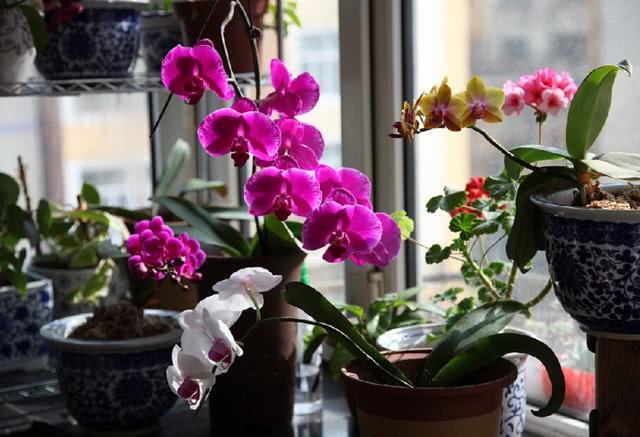
This year my Phalaenopsis bloomed right around the Spring Festival. These past few days, the warm breath of spring has set the Phalaenopsis fluttering like colorful butterflies, with vivid colors and large blooms, quite a lively sight. These Phalaenopsis have been in my home for quite a few years, reblooming every year. Some bloom several times a year, and some flower spikes, once they open, keep going for seven or eight months without pause, absolutely gorgeous.
Gardeners often ask me for my secret to growing them, but honestly, I am almost embarrassed to say there really is nothing special. In fact, when growing flowers you should still choose plants suited to your local environment. Take this Phalaenopsis, for example: I have found that those on forums complaining that reblooming is difficult are mostly gardeners from the south. This is really because although in our north the winter outside is minus ten or twenty degrees, indoors we have heating, so room temperature can reach plus twenty-something degrees, and when sunny weather comes along, the colorful butterflies naturally arrive uninvited.
First, the pot for planting Phalaenopsis should be chosen with a certain depth. The roots of Phalaenopsis are very similar to those of Clivia, quite fleshy. Personally, I think when matching a pot to a Phalaenopsis you should still choose a slightly deeper pot based on the length to which its roots grow. The pot does not have to be very large, but a pot with a certain depth lets the Phalaenopsis roots stretch out fully and gives the roots somewhere to grow, making it easier for them to absorb nutrients.
Second, the choice of potting medium. A newly purchased Phalaenopsis, after being left to sit for two days to get used to your home environment, generally needs to have its potting medium changed and be repotted. Phalaenopsis is an epiphytic orchid, so an airy potting medium such as sphagnum moss is enough. Generally, sphagnum moss more than a year old no longer has high nutritional value, and at this point you can replace it. Remove the old sphagnum moss, trim away the Phalaenopsis's dead roots, and if conditions allow, soak the Phalaenopsis roots in a water solution of "carbendazim" to sterilize and disinfect them. Then repot with fresh sphagnum moss.
Third, necessary fertilizing. At first, I chose to fertilize the Phalaenopsis by mixing "monopotassium phosphate" into the water each time I watered, but the effect was not obvious. Later, I simply gave up this fertilizer and directly used the organic nutrient solution I use for other flowers at home as the nutrient fertilizer for the Phalaenopsis, and the effect showed immediately. The increase in trace elements such as phosphorus and potassium made the flower spikes the Phalaenopsis put out thick and strong, and the flowers blooming on the stems were both numerous and long-lasting. A single flower spike blooming for several months also became an ordinary occurrence, with butterflies to admire every day, which is such a delight.
Finally, let's talk about watering Phalaenopsis. Phalaenopsis roots are thick and strong, and too much water is undoubtedly disastrous, causing root rot. Generally, watering can be guided by two points: when the sphagnum moss potting medium of the Phalaenopsis dries out, and when you insert your hand to the bottom of the sphagnum moss and it also feels dry, then it is time to water; if you are still not sure, you can pinch the Phalaenopsis leaves with your hand, and at this point they will definitely feel soft, so go ahead and water decisively. Mix a little organic nutrient solution fertilizer into the water, then either use the soaking method or repeatedly pour water through the sphagnum moss in the Phalaenopsis pot until all the sphagnum moss has absorbed enough water. Normally, you can mist the Phalaenopsis leaves with water, especially in the hot summer. Of course, in midsummer you should still be careful to give the Phalaenopsis appropriate shade and strengthen ventilation. Generally speaking, Phalaenopsis has almost no common pests or diseases. However, when ventilation is poor, the occurrence of pests and diseases cannot be ruled out, and in summer this requires special attention.