This flower blooms freely no matter whether you plant it on a balcony or a terrace
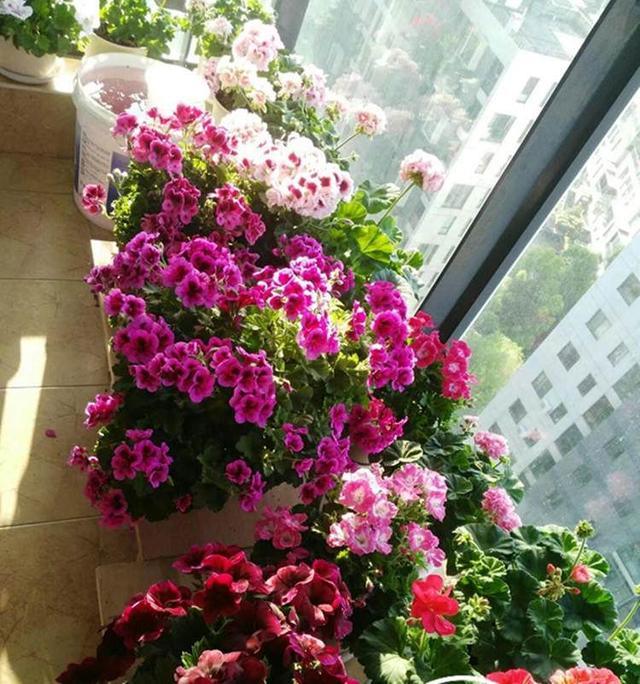
Geranium (Pelargonium) is a flowering plant that easily fills out its pot. Whether you plant it on a balcony or a terrace, with just a little attention to a few care tips it will soon bloom freely. With various colors interwoven, the balcony or terrace becomes a sea of flowers, especially spectacular.
Generally, there are 2 ways to plant geraniums on a balcony or terrace: one is the small potted flowering plant form, and the other is the single-stem tall-trunk form. Most gardening enthusiasts grow them as small potted flowering plants, which is more common, and for growing geraniums as small potted flowering plants, there are just a few tips to master.
1. Repotting and changing the soil
For small potted geraniums on a balcony or terrace, repotting should be done in autumn, because geraniums go dormant between June and July, and after they resume growth, the rotted roots should be cleaned up and the soil replaced. The potting soil should be a loam rich in humus. When repotting, you can place a few slices of horse hoof or cattle or sheep hoof pieces at the bottom of the pot as base fertilizer. Place the geranium plant in the center of the pot, hold it upright and fill with soil. After filling, water thoroughly immediately, and once the water has been absorbed, water once more. Newly potted seedlings need to be shaded for 3~7 days, after which they can grow normally.
2. Fertilizing
Whether you grow geraniums on a balcony or a terrace, in addition to using base fertilizer when repotting, top dressing can be applied once every two weeks. For top dressing, use an organic nutrient solution fermented purely from plants, diluted 500 times with water and poured at the roots; during peak blooming, it can be applied once a week (between June and July in summer, the plant is in a semi-dormant state, so generally no fertilizer is applied). After fertilizing, spray water to prevent residual fertilizer liquid on the leaves from causing damage.
3. Watering
Spring and autumn are the vigorous periods of growth and blooming for geraniums, so the water amount can be somewhat more. Generally, water at 9~10 o'clock in the morning. In summer, it is best to water in the early morning and in the evening every day. In winter, when the weather is cold and growth is slow, there is no need to water every day; you can water according to the weather conditions and the dryness or moisture of the potting soil, and if the soil is dry, water it. In winter, it is best to water at 10 o'clock in the morning, and during the dormant period, the frequency of watering should be reduced as much as possible. After pruning, generally do not water for a week, to avoid the cut openings being moistened by water and rotting.
4. Pruning
When growing geraniums on a balcony or terrace, pruning is essential for short, sturdy growth and a beautiful plant shape. Generally, pruning is done three times a year: in March, do thinning pruning, cutting away overly dense branches and thin, weak branches. After the blooming season in May, cut away spent flowering branches and overly dense branches. After the dormant period in July and August, carry out shaping pruning together with repotting, so that each plant has 3~5 branches, and also remove overly dense leaves and large leaves that cover the tender buds.
Overly vigorous branches should also be pinched back to encourage new branch growth and make the plant's branches evenly distributed. After blooming, short pruning should also be done, generally leaving the current year's branches 3~5 cm long.
If gardening enthusiasts want to cultivate geraniums into a single-stem tall-trunk tree form, it is generally recommended not to pinch back, and to pinch back only when the plant has grown to a height of 70~80 cm. When potting, to prevent lodging, set up a support to keep the branches fixed.