This flower is a darling of summer; no matter how hot it gets, it still blooms.
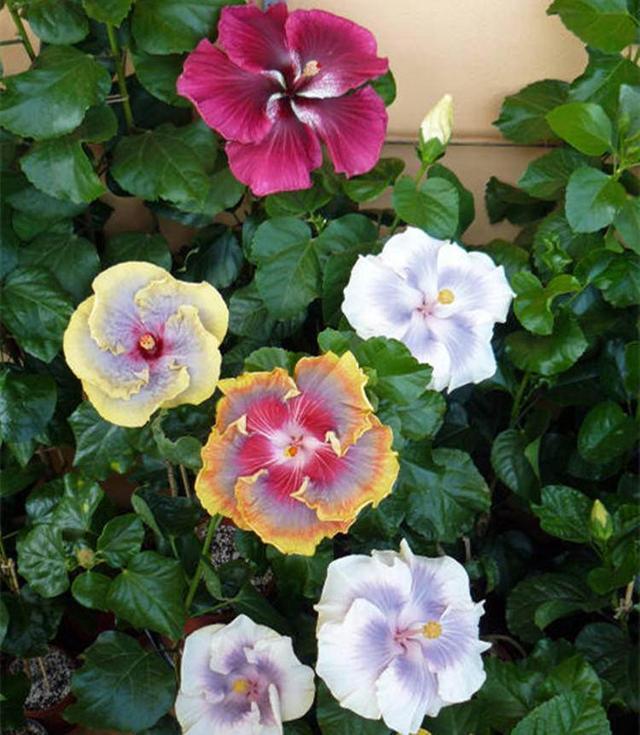
Hibiscus (Chinese hibiscus) grows vigorously and has a long flowering period. Even during the hottest part of summer, it can still bloom freely; it is truly summer's "darling," never afraid of the heat. Even when it is hot, it still blooms just the same, and the hibiscus has brilliantly colored flowers, with its blooming momentum lasting without decline. It is a flowering plant very suitable for growing in pots in summer.
When hibiscus is cultivated on a balcony, with ample sunlight and relatively high temperatures, it is just right for the growth of hibiscus. If managed well, cuttings propagated in summer and autumn can bloom in early summer of the following year; cuttings taken in early spring can bloom the same year.
After the hibiscus seedlings are potted, when the surface soil becomes hard after several waterings, the soil should be loosened in time to create good aeration conditions for the seedlings to continue growing new roots and young roots. When new leaves grow, a dilute organic liquid fertilizer for flowers can be applied once every 10-15 days, diluted 500 times, poured directly onto the soil.
Hibiscus has strong sprouting ability and branching ability. At the top of the main and side branches or below the pruning cuts, spring sprouting can generally form 3-5 relatively long branches. Therefore, hibiscus is easy to shape and tolerant of pruning. Generally, keep a trunk height of 20 cm and pinch off the growing tip to encourage new branches to sprout from the lower part. The 3-4 long branches that sprout can all be retained, and the lower axillary buds can be removed or the lower short branches can be cut off.
When the spring buds begin to swell in the second year, repot into a 21-24 cm pot. Use 4-5 parts sandy loam, 4 parts leaf mold, and 1-2 parts decomposed cake fertilizer or sesame paste residue powder to make the soil added to the pot. Use a small amount of hoof and horn pieces at the bottom of the pot as base fertilizer. At the same time, select and retain 2-3 branches that are evenly distributed and similar in growth vigor as main branches. Leave the main branches about 10 cm long and cut them back short, and prune away the remaining branches so that nutrients are concentrated to supply the growth of the retained branches.
When moved outdoors in the spring of the third year, repot into a 24-30 cm pot. At this time, on each main branch, select and retain two long branches with suitable growth directions as side branches. Leave 2-4 buds on the side branches and cut them back short, and on each main branch below the side branches, retain 1-2 short branches 10-15 cm long, without pruning and letting them grow freely. After these retained short branches sprout, they can show buds and bloom in late spring and early summer.
After the fourth year, generally no larger pot is needed anymore, but the pot should be turned out every spring, otherwise it is unfavorable for subsequent growth, bud formation, and flowering. While turning out the pot, pruning should continue, that is, thinning out overly dense, weak, overlapping, and crossing branches, and for the retained evenly distributed side branches, leave 2-4 buds on each branch and cut them back short. However, part of the 10-15 cm short branches growing on the main branches should still be appropriately retained so that they bloom in late spring and early summer.
Hibiscus is generally moved outdoors in mid-to-late April. After being moved outdoors, water thoroughly once first. Later, because the plants pruned by cutting back have few branches and leaves and need little water, watering should be controlled. The method of alternating large and small waterings can be adopted, that is, when the top of the potting soil is dry but the lower part is not dry, water lightly; when both the top and bottom are dry, water heavily, so that the potting soil remains in the best state of dryness and moisture.
Summer is hot, evaporation is high, and it is also the season when hibiscus grows vigorously and shows buds and blooms, so its water demand is greatest. Therefore, in addition to watering sufficiently and thoroughly every morning, if the potting soil appears dry in the afternoon, it should be watered once more. Hibiscus likes humid environmental conditions. In dry spring and summer and in the hot weather of midsummer, if water is often sprayed on the leaves, the plant can grow faster, the leaves will be glossy, and the flowers will be large and brightly colored.
Hibiscus has a long growth period and blooms continuously, so it should be fertilized frequently according to the size of the plant and its growth and development. Fertilization should mainly use nitrogen and phosphorus fertilizers. When repotting or turning out the pot, apply a small amount of leaves at the bottom of the pot as base fertilizer. Ordinarily, apply an organic nutrient solution about once every 10 days, and during the vigorous growth period, apply an organic nutrient solution once every 3-5 days to promote growth and flowering.
Image from flower friend: sean060060