The 10 Most Expensive Succulent Plants in the World, the Priciest One Costs as Much as a Down Payment on a House
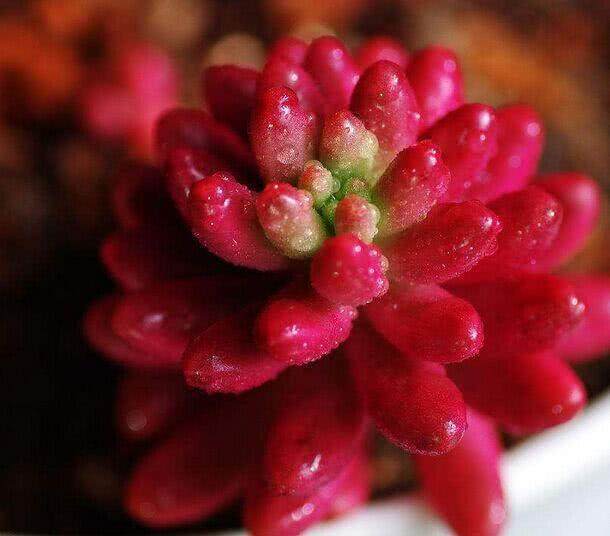
These days we can often see succulent plants in offices or homes. Succulents are easy to grow and hard to kill, and they can be used to decorate interiors as well as having a good anti-radiation effect, so they are deeply loved by some office workers. But succulents differ from one another too. Some succulents are not something ordinary people can afford, just like these 10 plants, each of which costs enough to buy the down payment on a house.
1. Haworthia truncata
Haworthia truncata, also known as truncated haworthia and truncate twelve, is a perennial herbaceous plant in the family Asphodelaceae, genus Haworthia. The cross-section of the new leaves is partly transparent and appears grayish-white. It is robust in habit, with relatively thick and sturdy roots. Some varieties also have grayish-white transparent patterns on the leaf cross-sections. Its horticultural variety Haworthia truncata 'Variegata' has yellow or pink markings on the leaves. This species likes cool, ample yet soft sunlight. It tolerates drought and partial shade, dislikes damp shade, is not cold-hardy, and fears high temperatures. Propagation methods include leaf cuttings and division. Haworthia truncata has a peculiar form and beautiful leaf color, and is a rare ornamental flower variety.
2. Ariocarpus fissuratus
Ariocarpus fissuratus, a plant in the cactus family, has a peculiar appearance and many delicate, gorgeous flowers. The spherical plant body grows singly or in clusters, growing in a cushion-like form, with a single sphere 10 cm to 15 cm in diameter, flat at the top and covered with dense white or yellowish-white wool. The epidermis has thick, hard triangular tubercles; the surface of the tubercles is grayish-green to brownish-green, cracked into irregular grooves, with a longitudinal groove in the very middle extending all the way to the axil of the tubercle, and bearing short wool. The flowers are terminal, bell-shaped, pink, 3.5 cm to 4 cm long, very gorgeous and eye-catching, and often several bloom at the same time.
3. Lithops
Lithops belongs to the order Caryophyllales, with a flowering period from midsummer to mid-autumn. Lithops has a peculiar form and gorgeous flowers, which leads many enthusiasts to collect and cultivate them specially, giving them high ornamental value.
4. Aloe polyphylla
The leaves of Aloe polyphylla are tightly spiraled clockwise or counterclockwise, arranged into an even circle; it is propagated asexually by techniques such as transplanting seedlings or cuttings, likes environments with extreme day-night temperature differences, and is the rarest high-mountain aloe in the world.
5. Haworthia maughanii 'Variegata'
Haworthia maughanii 'Variegata' is a variegated mutant variety of Haworthia maughanii, with irregular markings on the leaf surface, yellow being the most common, and orange-red, pale pink, and silvery-white being rare.
6. Pachypodium brevicaule
The outer skin of Pachypodium brevicaule is brown to gray, with irregular protrusions and prickles. The leaves are oblong, dark green, with the petiole attached directly to the protruding parts of the rootstock.
7. Haworthia cooperi 'Neon Lights'
Haworthia cooperi 'Neon Lights' is a classic variety of Haworthia cooperi, loved by many succulent enthusiasts for its large and translucent windows, smooth purple-black leaves, and colorful variegation, and is a variety many enthusiasts dream of owning. At present, a good plant can even cost more than 20,000 yuan. Haworthia cooperi 'Neon Lights', this editor really loves it, super loves it, wants to buy it.
8. Aztekium ritteri
Aztekium ritteri, also known as the wrinkled-rib cactus, is a succulent plant in the cactus family, genus Aztekium, distributed in a small valley in northeastern Mexico. The plant grows on steep rock walls covered with limestone rocks. There have also been records showing that the plant is distributed on other steep gypsum surfaces similar to the above location. Compared with the relatively sunny south slope, Aztekium ritteri seems to prefer the relatively shaded north slope of the mountain. Aztekium ritteri grows extremely slowly (only about 1 mm per year), and its appearance is very special, so it is usually not confused with other species.
9. Pelargonium carnosum
Pelargonium carnosum belongs to the family Geraniaceae, genus Pelargonium, and is native to Namibia in Africa. Pelargonium carnosum and Pelargonium triste are similar in appearance; the difference is that the roots of Pelargonium carnosum are thinner than those of Pelargonium triste, and the tuberous roots of Pelargonium carnosum are thicker and larger. Moreover, the petals of Pelargonium carnosum do not have the red markings at the base of the petals that Pelargonium triste has. Pelargonium carnosum is a very representative species in the genus Pelargonium, and also the species with the narrowest production area within the genus[1], and at present it circulates in small quantities on the market in mainland China.
10. Lophophora williamsii
The plant body is oblate-spherical, with many ribs; the epidermis is blue-green to gray-green, covered with white powder; the wool at the top is white and thick; the flowers are pink, purplish-red, or pale yellow-white. Lophophora williamsii is a plant in the cactus family, genus Lophophora, native to western North America. Plants of this genus contain an alkaloid called mescaline, which produces hallucinations after being taken, and is called the poisonous cactus by succulent enthusiasts.