Growing a goji berry bonsai from a single seed: red berries cover the branches, beautiful and easy to grow, and you can even brew tea with them
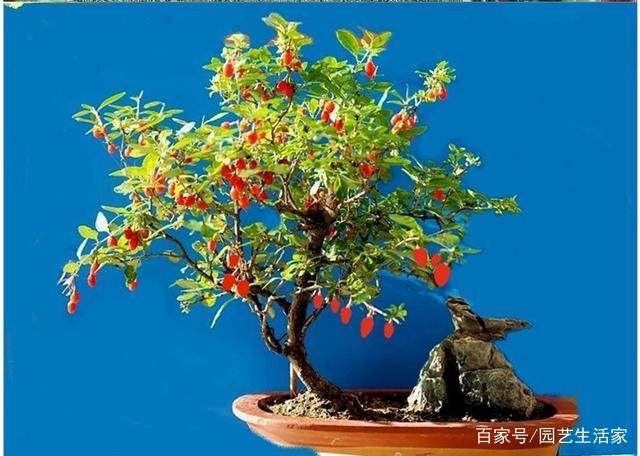
Everyone is familiar with goji berries; they can be used to make tea or cook porridge, and they are an excellent health tonic. Goji berries are rich in carotene and are a very good tonic. Whether used in soups or steeped in water, they have very good health benefits. As people's living standards keep rising, the demands on goji berry quality are becoming stricter and stricter. In fact, by making use of the spare space at home and growing a few pots of goji berry bonsai, you can not only improve your home environment, but also pick and eat them anytime, delighting the mood and nurturing the character. A goji berry seedling actually only needs a single goji berry seed: scatter it in the soil, let it sprout, and graft it onto a potted plant. Today I will share with you the planting, care and management of goji berry bonsai:
1. Soil selection. As for soil selection, goji berries do not have high soil requirements, but you still need to choose soil with good drainage, and absolutely avoid clayey and waterlogged soil. For potting soil, it is best to mix 1 part leaf mold, 1 part garden soil, 1 part river sand, and a large amount of bone meal and other base fertilizers.
2. Light. Goji berries like sunlight, so when growing goji berry bonsai, it should be placed in a sunny spot indoors for care.
3. Watering. For watering management of potted goji berries, water thoroughly when the soil is dry. During the high-temperature dormant period in summer, the plant's growth stalls and the leaves drop; at this time watering should be controlled. Goji berries are drought-tolerant, so never let them become overly wet or waterlogged.
4. Fertilizing. For potted goji berries, usually apply a liquid fertilizer mainly based on phosphorus fertilizer about once a week; in winter apply well-rotted base fertilizer; during peak flowering, apply 2-3 additional applications of nitrogen fertilizer. Repotting is a very important step for potted goji berries. When repotting and changing the soil, apply sufficient base fertilizer, and add superphosphate and other phosphorus-potassium fertilizers as base fertilizer.
5. Shaping and processing and bonsai styling. When growing bonsai, if you want it to have a good shape, then you must appropriately bend and prune the branches and trunk. Large branches should be bent and pruned in winter; small branches can be bent in summer and autumn. New branches can be bent at any time with suitable metal wire such as iron, lead or copper. Goji berry wood is relatively brittle, so be careful to use gentle force when working, and do not be too rough.
6. Pruning. If you want the goji berry bonsai to look good, the corresponding pruning and shaping work is essential. In addition, if you do one leaf-picking in early summer, it can produce fresh green new leaves, which is good for viewing. Do another leaf-picking in early autumn so that flower buds and leaf buds emerge at the same time; then in late autumn you can see the ornamental effect of red berries and new leaves setting each other off.
The whole goji berry plant is a treasure: its leaves, fruit, roots and bark can all be used as medicine, and it is a precious Chinese medicinal herb. Its fruit is commonly called goji berry and has the functions of nourishing the blood and moistening the lungs, tonifying the liver and brightening the eyes, strengthening the stomach and boosting essence, and premature death. It is usually made into tonic products such as goji berry wine, goji berry paste and goji berry porridge. Flower lovers who like to brew goji berries as tea can keep a pot of goji berry bonsai at home; it can be enjoyed for viewing and also eaten. Care and management are also very simple.