Phalaenopsis has a long natural growth cycle; it takes about 3 to 4 years from a small seedling to flowering.
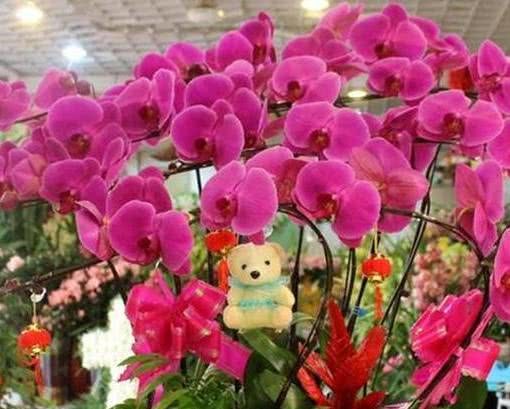
Phalaenopsis has a long growth cycle. In nature, it takes about 3 to 4 years from a small seedling to flowering. Under good artificial cultivation conditions, extending daily light exposure to 14 hours, keeping the nighttime temperature at around 21°C, and strengthening water and fertilizer management can shorten the time from small seedling to flowering, requiring about 1 to 2 years from small seedling to bloom. Most Phalaenopsis varieties bloom in spring, and some also bloom in summer; the flower stalk emerges from the leaf axil,
bearing several flowers that open in succession, and each flower can stay open for more than a month. Phalaenopsis is named for its butterfly-like flower shape. Its flowers are elegant in form and gorgeous in color, making it a treasure among tropical orchids, and it has the reputation of being the "queen of orchids." Phalaenopsis is generally propagated by tissue culture, but this requires certain techniques and conditions, and only professionals can do it. So how should Phalaenopsis be propagated in home cultivation? Repotting methods for growing Phalaenopsis: the growing medium for Phalaenopsis must drain well,
and have a certain water-retaining capacity. Commonly used media include moss, fern roots, bark, charcoal, expanded clay pellets, etc. Repotting should be done in summer during the growing season. The method is to first take the plant out, remove the old growing medium, and cut off aged and rotted aerial roots, then place a layer of charcoal pieces at the bottom of the new pot, put the plant in, fill in fresh medium, press it down firmly, and water thoroughly. The repotting time should depend on the growing medium. Sphagnum moss medium will rot in 1 to 2 years,
and when it rots it secretes extremely acidic substances that can damage the aerial roots. If it is not replaced in time, it will cause root rot. Therefore, when using sphagnum moss or bark as the medium, repot once every 1 to 2 years of cultivation; when growing in coconut husk, repot once every 2 to 3 years; when growing in expanded clay pellets or charcoal, repot once every 3 to 5 years. However, fertilizer must be applied frequently and lightly to make up for the nutrients these media contain little or none of. The method is to first cut off the part of the flower stalk that has already finished blooming, then use a blade or sharp knife to carefully remove the bracts between the first to third nodes on the upper part of the flower stalk,
exposing the bud points in the internodes. Use a cotton swab to evenly apply a bud-forcing agent or hormones such as indolebutyric acid to the exposed internode nodes. After treatment, place the orchid plant in a semi-shaded spot and keep the temperature at 25-28°C. After 2-3 weeks, the buds will be seen growing leaves, and after 3 months they will grow into small Phalaenopsis seedlings with 3-4 leaves and aerial roots. Cut off the small seedlings and pot them up, and they can become a new orchid plant. The principle of the stem-cutting propagation method is to destroy the stem apex growing point to induce latent buds to grow.
Although there are 1-3 latent buds in the leaf axils of a Phalaenopsis plant, most of them cannot sprout into plants. You can wait until the plant keeps growing upward and the stem nodes are relatively long, then cut off the upper part of the plant with roots using a sterilized sharp knife or scissors, and plant it in a new pot to let it continue growing, while giving the lower part with the rhizome proper water management, and before long new buds will sprout. 4. Tissue culture: Using tissue culture to propagate Phalaenopsis can obtain excellent genetic characteristics completely identical to those of the mother plant.
Phalaenopsis seedlings produced by this method are called mericlones or tissue-cultured seedlings. The plant tissue used for meristem culture (explant) can be the terminal bud (shoot tip), stem segments (dormant buds), or young leaves or root tips, but currently the most common is to use Phalaenopsis flower stalks. Temperature is one of the keys to caring for Phalaenopsis. The suitable growing temperature for Phalaenopsis is 18-30°C, with no more than 30°C being preferable, but in summer, indoor temperatures are often above 30°C. At this time, Phalaenopsis can be placed in a ventilated, semi-shaded spot,
which helps it get through the hot summer. The minimum temperature in winter should be kept above 15°C, and attention should be paid to increasing warmth in autumn and winter, at the turn of winter and spring, and when winter temperatures are low. Proper light can promote flowering in Phalaenopsis and make the flowers more brightly colored and longer lasting. Generally, it should be placed in a spot with diffused light indoors, and not exposed to direct sunlight. From May 1 to October 1, it can be placed in a south-facing balcony in a spot not exposed to direct sunlight, and from October 1 to May 1, it can be placed near a south-facing windowsill to receive sufficient sunlight. In addition, the normal growth of Phalaenopsis requires flowing fresh air, so home-grown Phalaenopsis must have good ventilation.