Application Value and Cultivation Techniques of Siberian Rowan
Application Value and Cultivation of Siberian Rowan
1 Fruit Nutritional Composition
The fruit of Siberian rowan contains 25.9%-29.8% dry matter, 15%-18% sugar, 2.5%-4.3% acid, 27%-35% sorbitol, 43-67mg/g carotenoids, 123-326mg/g vitamin C, 520-850mg/g active P, 6.3% pectin, about 2% triterpenes (under complete dry matter conditions) and up to 1.15mg/g phylloquinone (under wet matter conditions). Among fresh fruit and berry plants, the content of carotenoids, vitamin C and active P substances in Siberian rowan fruit ranks first [2].
2 Application Value
2.1 Economic Value
2.1.1 Edible value. As a raw material, Siberian rowan fruit can be stored for a long time without quality change; in an air-dried state it can be stored for 1 year, and in a frozen state it can be stored for 3 months. However, because fresh fruit has a bitter, sour and astringent mixed taste, it is rarely eaten directly; only after the first frost does the flavor become mellow. Rowan fruit can be used in the processing of traditional foods such as stewed fruit, juice, jam, puree, preserved fruit, as well as sun-dried and air-dried fruit and rowan brandy. Rowan fruit can also be used to make rowan pies, dumplings, thick soup, kvass and various condiments, and can also be used as a substitute for tea. The carotenoid colorant in the fruit can be applied in the food industry; pectin substances can serve as pharmaceutical emulsifiers and stabilizers for suspensions, and can be used to produce fruit gum and fillings for various candies; the sorbitol (sucrose-free) extracted from the fruit as pure vitamin syrup can serve as a sugar substitute, can be used as a material in the prescribed diet of diabetic patients, and can be used in children's diets. Because Siberian rowan fruit is rich in nutrients, its development prospects are very broad.
2.1.2 Medicinal value. The oil concentrate of carotenoids in the fruit, like pure oil, can promote corneal epithelialization in the treatment of eye burns (scalds) of any cause, and at the same time promote the regeneration of damaged skin; these indicators exceed those of sea buckthorn oil. Phylloquinone (vitamin K1) can prevent anemia and leukemia, and triterpenes are drugs for treating arteriosclerosis. Rowan fruit also has diuretic and tonic properties. With the improvement of people's living standards in our country, there are higher requirements for quality of life and health. Therefore, the demand for the fruit of this tree species and its processed products is enormous.
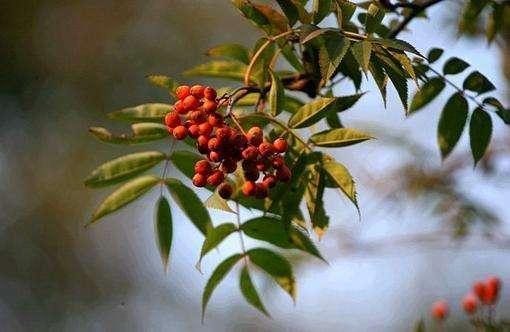
2.1.3 Landscape value. The Siberian rowan tree is 6-12m tall, with an elliptical crown, gray glossy bark, and red-brown branchlets with soft hairs. It has odd-pinnate compound leaves, and the leaves are dark green. The compound corymb is white, with many densely packed flowers. The fruit is round, red or orange-red, and persists in winter. This tree species is a valuable ornamental landscape tree; its trunk is straight and its tree form is imposing. In spring, white flowers bloom in profusion, filling the branches; in summer, the leaves are emerald green and sway in the wind; in autumn, red fruits are abundant and the leaves turn fiery red; in winter, the fruit persists and contrasts with auspicious snow, bright red and brilliant, with extremely high ornamental value.
2.1.4 Timber value. Siberian rowan has a red linear porous xylem; the wood is of fine quality, wear-resistant, corrosion-resistant, and free of cracks. It can be used to make various decorations and furniture, and can be widely used in the shipbuilding industry. The bark can also be used as a tanning material. At present, excellent timber forest lines have been bred in Russia and Japan.
2.2 Ecological Value
Under natural conditions, Siberian rowan can provide shelter and food for wild animals and birds, and its fruit is a high-quality bird food. The root system of Siberian rowan is very well developed; it is a pioneer tree species for soil and water conservation. 76%-82% of the root system is distributed in the surface soil at 40-50cm, and individual roots can extend to a soil depth of 2m. It can be widely used for greening barren hills, soil and water conservation, and ecological restoration and reconstruction, which increases the diversity and ecological stability of forest stands, improves the soil, enhances the protective function of ecological forests, and protects lucid waters and lush mountains, with broad market prospects.
3 Cultivation Techniques
3.1 Site Selection
It is advisable to choose flat land or gentle sloping land with sufficient light, good soil permeability and good drainage.
3.2 Land Preparation
The planting plot should be prepared in the autumn of the year before planting. Apply 10000-20000kg/hm2 of farmyard manure, plow and level the soil, and form ridges or beds in a north-south direction.
3.3 Planting
3.3.1 Seedling selection. Seedlings that have been transplanted for more than 2a should be used for planting. The ground diameter of the seedling should be >=0.5cm, the root length should be >=10cm, the number of lateral roots should be >=5, and the height should be 30-50cm.
3.3.2 Planting time. Both spring and autumn are suitable. In spring, mid-to-late April is suitable; in autumn, late September to mid-October is suitable.
3.3.3 Planting method. Plant in holes, 1 seedling per hole. The planting hole diameter is 40cm and the depth is 30cm. The plant and row spacing is 1m x 2m or 2m x 2m. Keep the root system moist before planting. Plant at the center of the hole surface, with the root system spread out. Water thoroughly after planting.
3.4 Post-planting Management
3.4.1 Fertilizer and water management. According to soil fertility, topdressing can be carried out during the growing season. Irrigate according to soil moisture conditions, and drain promptly on rainy days.
3.4.2 Intertillage and weeding. Carry out 3-5 times each year in spring and summer according to actual conditions.
3.4.3 Shaping and pruning. Prune young trees according to different cultivation purposes. There are 2 types: single-trunk and multi-trunk. For the single-trunk type, prune the young buds and young branches sent out from the trunk; for the multi-trunk type, combine bud removal when the tree is young to determine 3-4 trunks. Pruning is divided into winter pruning and summer pruning. For plants planted for 1-3a, cut off overly dense, overly weak branches and diseased and damaged branches, remove buds, remove root suckers, and prune the crown shape. For adult trees, thin out weak twigs, diseased branches, dead branches and crossing branches throughout the crown.
3.4.4 Pest and disease control
The main disease is seedling canker. In spring and autumn, apply whitewash to the trunk of seedlings more than 3a old; when the disease occurs, apply 50% N-(2-benzimidazolyl)-carbamic acid methyl ester or 70% 1,2-bis(3-methoxycarbonyl-2-thioureido)benzene; in autumn, clear away dead branches, fallen leaves and diseased plant residues and burn them in a centralized manner.
The main insect pests are red spider mites, aphids and yellow slug moths, which can be controlled by spraying 1.2% bitter smoke emulsifiable concentrate solution or omethoate.
3.5 Seedling Lifting and Transport
For large seedlings, use the soil ball lifting method, with the soil ball diameter >=(8-10) times the root collar. During transport, prevent the soil ball from breaking apart and the branches and trunk from being damaged.
3.6 Fruit Harvesting and Storage
Harvest around mid-September each year. When picking, place gently in small baskets to prevent crushing, and harvest, transport and store promptly, avoiding sun and rain. After harvesting, the fruit should be refrigerated as soon as possible.