Key Technical Points for Early-Forcing and Late-Extending Cultivation of Potted Apple
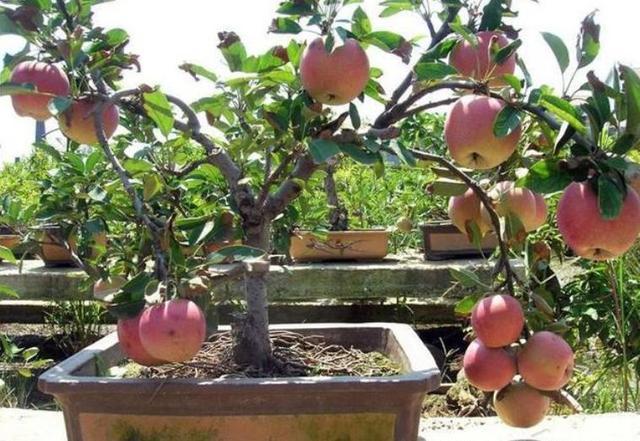
Early-Forcing and Late-Extending Cultivation Techniques for Potted Apple
Potted apple is a new development. Its emergence has been welcomed and valued by undertakings such as leisure agriculture, sightseeing tourism, and landscaping. Its development and popularity are a sign of the improvement of China's social economy and people's living standards, and also a trend of the working people pursuing beauty in life and environment.
For farmer production, 666.7 sq m can hold 1500-2000 pots with a diameter of 26-33 cm, each pot bearing 2.5-4.0 kg of fruit, with a yield of over 5000 kg per 666.7 sq m. Pots with a diameter of 40-60 cm can hold 400-500 pots, each pot bearing 10-15 kg of fruit, with a yield of over 5000 kg per 666.7 sq m. Plant trees in the 1st year, achieve a certain yield in the 2nd year, and reach full production in the 3rd year.
1 Variety Selection
1.1 Early-Maturing Varieties
July Fresh (K9) is extremely early-maturing, ripening in May-June, cold-resistant, high-yielding, early-fruiting, with bright and attractive skin, pale yellow flesh, moderate sweet-sour flavor, strong aroma, and superior quality.
1.2 Late-Maturing Varieties
Hanfu, Huahong, Hanxiang, etc. are extremely cold-resistant and exceptionally high-yielding, belonging to large-fruited high-quality new varieties. For potted cultivation, single fruit weight can all exceed 0.5 kg, and the yield per 666.7 sq m can exceed 5000 kg. After planting, there is a certain yield in the 2nd year, and full production in 3 years. The skin is fully red, the fruit shape is upright and attractive, the flesh is entirely pale yellow, and both the acid content and sugar content exceed those of "Red Fuji." The sweet-sour flavor is moderate, the taste is excellent, the firmness is high, and it is storage- and transport-resistant. If not picked, potted fruit never drops; with delayed cultivation, fresh fruit remains on the tree throughout the winter without deteriorating or fading.
2 Selection and Treatment of Flower Pots
In the 1st year, select flower pots of 26-33 cm, punch 6-7 holes in the bottom of the pot the thickness of a finger to facilitate aeration, soak in 50% carbendazim 800x solution for 24h, then fill with nutrient soil and plant seedlings. After 1-2 years of fruiting, switch to larger pots with specifications of 40-60 cm. When changing soil, pay attention to root pruning, once every other year.
3 Preparation of Nutrient Soil
Formula 1: Sand, black soil, and horse manure at 1/3 each, plus a small amount of decomposed chicken manure powder (100-150 g). Formula 2: 2 parts topsoil from fields, 1 part decomposed crushed firewood and grass, 1 part perlite, 1 part cattle and horse manure. Formula 3: 2 parts aged rice husks, 1 part garden soil, 1 part barnyard manure.
4 Water and Fertilizer Management
4.1 Watering
For potted apple, water and fertilizer management is crucial. It is the main factor determining yield and quality, and the key to achieving high or low economic returns. For large-scale production, dedicated personnel must be responsible, manage carefully, and observe frequently. Wilting leaves indicate severe water shortage. However, one should not water every day either; supply water according to weather changes, water when dry and stop when wet, and stop once thoroughly watered. Do not irrigate heavily or repeatedly, to avoid diluting the nutrients in the pot, wasting manure, or causing root rot.
Large, thick, dark green leaves indicate appropriate fertilizer and water levels; yellowing of the heart leaves indicates watering is too frequent and should be adjusted promptly. If heavy rain occurs after watering, lay the flower pots on their side to prevent rain, and stand them up again once the weather is confirmed clear. In short, both too much and too little water are unsuitable for the growth of potted fruit trees. One must master this correctly.
4.2 Fertilization
Choose high-quality, decomposed, potent farmyard manure as topdressing, such as chicken manure, pig manure, sheep manure, etc. The amount of fertilizer depends on pot size. For 26-33 cm pots, apply 4-5 g of urea per pot, slightly more compound fertilizer, and 150-250 g of farmyard manure; double for large pots. Water promptly after fertilizing. Apply topdressing 5-6 times per year: once before flowering and once after flowering, 2-3 times during fruit development, and once after fruit picking. In the early stage, nitrogen fertilizer should dominate; in the later stage, phosphorus and potassium fertilizer should be more abundant. Spray foliar fertilizer during the growing season: spray 0.2%-0.3% urea in the early stage, and spray 0.2%-0.3% monopotassium phosphate 3-4 times at 10d intervals during fruit coloring in the later stage. Spraying fertilizer is best done on cloudy days or in the evening to facilitate absorption.
5 Shaping
5.1 Ornamental Type
After planting, cut the trunk at 30-40 cm. Lateral branches emerging 10 cm from the pot, when they grow to 15 cm, keep 8-10 leaves and pinch; for new shoots emerging after pinching, keep 2-3 leaves and pinch again; for new shoots emerging thereafter, keep 8-10 leaves and pinch, pinching several times a year. However, stop pinching in mid-July to prevent new shoots emerging in autumn from failing to mature that year. Shapes include triangular, semicircular, upright multi-form, pagoda, fan, and free-form, etc. In addition to maintaining and adjusting an attractive tree shape, one should also maximize fruit yield and fruit quality as much as possible.
5.2 Production Type
After planting, cut the trunk at 30-50 cm. Mostly follow the shaping of open-field apple trees, with 5-main-branch two-tier or spindle shape being preferable. Lateral branches should be pinched when they grow to 20-30 cm; 2nd and 3rd new shoots can be pinched at 10-20 cm. During the growing season, remove overly dense branches, competing branches, parallel branches, and water sprouts. Thinning branches should be done early rather than late, and should be carried out before the branch tips lignify. After the tree enters dormancy, prune fruiting trees; cut fruiting branches back by 1/2 or 1/3, remove overly dense small branches, gradually expand the canopy year by year, and work toward a large-branch form that strengthens the main branches' load-bearing capacity. Balance tree vigor, let fruiting branch groups fill the space, and make the tree healthy and beautiful.
6 Twisting and Bending Shoots
A beautiful tree shape is the foundation for potted apple, and bearing more and better fruit is the key. To produce more and better apples, each year when new shoots of the fruit tree grow to 10-13 cm and are semi-lignified, vigorous branches must be twisted and bent. Twisting the semi-lignified middle-upper part of a branch downward is called twisting; bending it until injured but not broken is called bending. Twisting and bending can hinder nutrient transport, weaken tree vigor, and facilitate flower bud formation and fruiting branch maturation. Fruit produced through twisting and bending is large and of high quality, especially fruit from terminal flower buds, which is very large, some exceeding 500 g.
7 Flower Thinning and Fruit Thinning
Flower thinning should be done early rather than late. Before flower buds break, cut off excessive axillary flower buds and surplus branches; during the flowering period, excess flowers on branches can also be thinned. When thinning flowers, keep the central flower and the first side flower of each inflorescence. Protect terminal flower buds on short branches as much as possible. The 1st fruit thinning should be done when fruits are the size of soybean grains; the 2nd should be done when fruits are the size of hawthorn, which is the fruit-setting stage. Bag immediately after fruit set is determined. Bagging can improve fruit appearance, making fruit smooth and attractive with bright color, reduce the number of pesticide sprays, prevent contamination, and increase the proportion of high-quality fruit.
8 Temperature Management
8.1 Temperature Management for Early-Maturing Varieties
In early January, potted apples in the Shenyang area have passed their natural dormancy period. Move well-dormant early-maturing potted apples into the greenhouse. The greenhouse temperature should be a maximum of 10 degrees C during the day and around 0 degrees C at night, with the temperature increasing 1-2 degrees C per day. Before flowering, the maximum temperature should not exceed 20 degrees C; during the flowering period, the temperature is best controlled at 17-18 degrees C. The flowering period generally lasts about 10d. After fruit set, gradually raise the temperature, with 25-28 degrees C during the day being suitable, not exceeding 30 degrees C. High temperatures of 35 degrees C are harmful to many plants and should be avoided. A day-night temperature difference of 10-15 degrees C is suitable. When open-field apple trees have abundant new leaves, greenhouse potted apples can be ventilated and hardened; roll up 1/3 or 1/4 of the plastic during the day. After 5-7d, remove the plastic, and the temperature will be the same as that of open-field apples.
8.2 Delayed Domestication of Late-Maturing Varieties (Extended Leaf Growth)
For late-maturing large-fruited apples such as "Hanfu," in the 1st year, by delaying flowering, fruit maturity can only be delayed to mid-November or early December. If later ripening is needed, delayed domestication treatment is required. The method is: before fruit picking, keep the soil in the flower pot as moist as possible, maintain a temperature above 10 degrees C, and do not let the leaves drop. Even after the fruit is picked, let the leaves continue to grow until they drop before entering dormancy. Extend leaf growth by at least half a month each year for 2-3 consecutive years, and the maturity period of late-maturing varieties can be delayed to after New Year's Day. The later the late-maturing varieties mature, the more popular they are and the higher the economic benefits.
9 Control of Major Pests and Diseases
9.1 Apple Valsa Canker
Focus on prevention, strictly prevent tree freezing injury, strictly prevent nutrient soil from being sticky and heavy, and prevent excessive watering. For chemical control, look for disease spots before the tree body sprouts, scrape off diseased tissue with a knife, and apply Fulanmudi, Fubiqing, etc. to the diseased scars, once every half month, 2 times total.
9.2 Apple Ring Rot
Control methods: Strengthen production management and fertilize reasonably. For chemical control, spray 50% carbendazim 700x solution or Fuxing 800x solution during the young fruit stage. After harvesting, immediately store in a low-temperature warehouse, generally at around 1 degrees C, where disease incidence is lower.
9.3 Insect Pests
Aphids: Spray 10% imidacloprid 2500-5000x solution for prevention before leaf expansion, and spray 1-2 more times in the early fruit-setting stage. Observe carefully during the peak new shoot growth period; if aphids are found, spray 3% acetamiprid 2000-3000x solution or 40% yamiemiduo 1000x solution.
Red spider mites: Spray 3-5 degrees Be lime sulfur mixture before bud break. After fruit set and during the peak new shoot growth period, when temperatures are high, spray 5% hexythiazox 2000x solution or 20% miediejing 2500x solution. When spraying, apply the pesticide to the underside of leaves, ensuring all leaves on the tree are covered. For other pests and diseases, follow the pest and disease control methods for open-field apple production.