Deutzia flowers bloom in flawless white, with high ornamental value
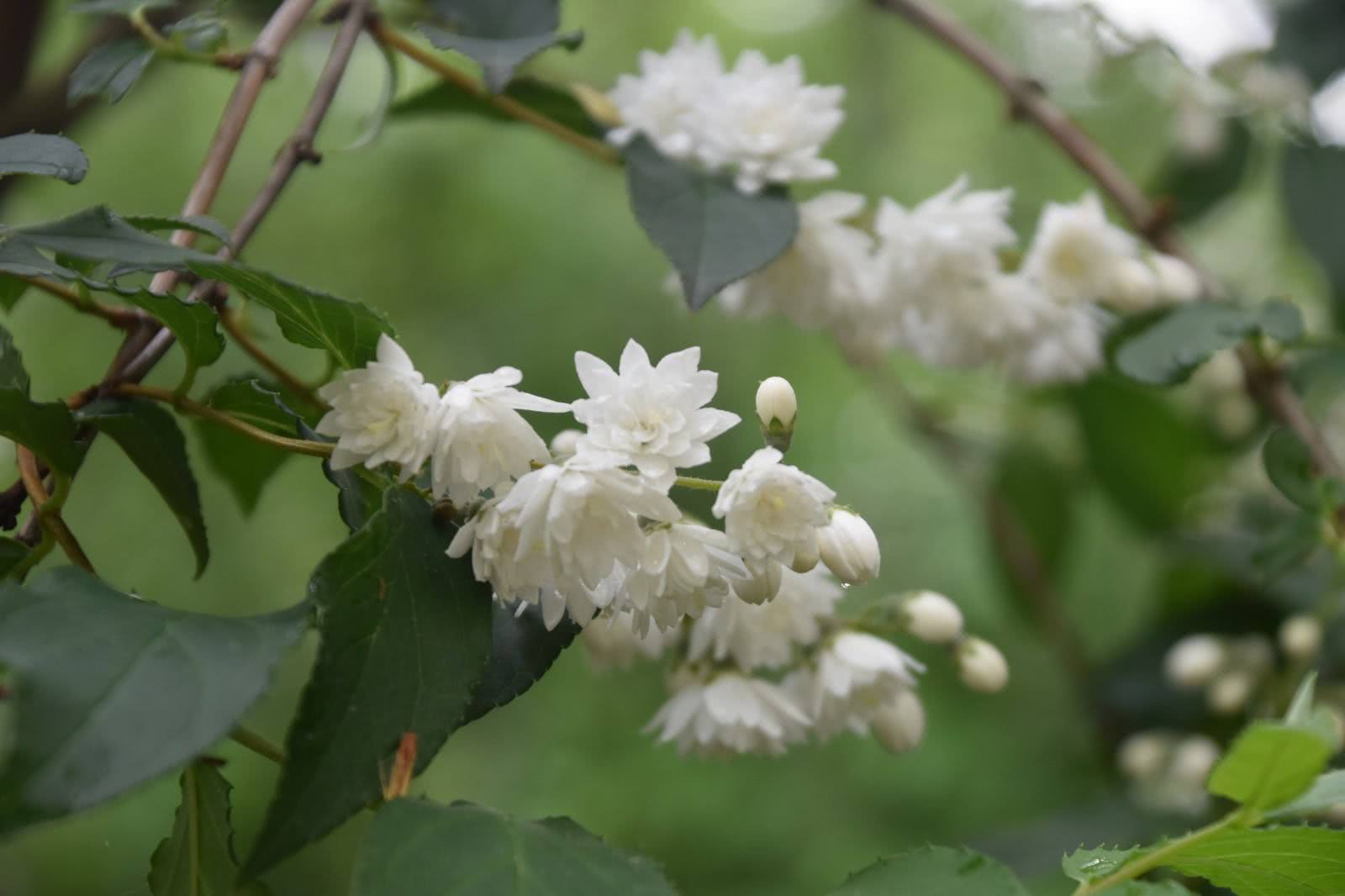
Deutzia is a deciduous shrub in the family Saxifragaceae, genus Deutzia. The bark peels off in thin flakes. The branchlets are hollow, reddish-brown, and covered with stellate pubescence when young. Panicles, corymbs, cymes, or racemes, 5 cm-12 cm long, with 5 petals, white or tinged with a faint red flush on the outside. In early summer the tree is covered with white flowers, clean and elegant, and its double-flowered variety is even more beautiful. It has long been cultivated in gardens at home and abroad. It is suitable for group planting on lawns, roadsides, hillsides, and forest edges, and can also be used as a flowering hedge and as planting material for rock gardens. The flowering branches can be used for vase arrangements. The roots, leaves, and fruits are all medicinally useful.
Deutzia
Morphological characteristics:
Deciduous shrub, rarely semi-evergreen, up to 3 m tall. The bark peels off in thin flakes, the branchlets are hollow and reddish-brown, with stellate hairs when young, and the old branches are smooth. Leaves opposite, with short petioles; the leaf blade is ovate to ovate-lanceolate, 5-12 cm long and 2-4 cm wide, with a pointed tip, a slightly rounded base, small serrations along the margin, and stellate hairs on both surfaces, rough to the touch.
Erect panicles, flowers white or with pinkish spots; the calyx tube is bell-shaped, fused with the ovary wall, woody, with 5 lobes, erect, persistent in fruit; petals 5, oblong, with stellate hairs on the outside; the filaments have 2 long teeth at the tip; styles 3-5, free, the stigma often decurrent. The capsule is nearly spherical, flattened at the tip with a short beak and reticulate veins. Flowering period May-June, fruiting period October-November
Deutzia
Growing environment:
It is mostly found in valleys, roadsides, rock crevices, and scrub on low hills. It prefers light and tolerates slight shade. It likes a warm, humid climate, but is cold-hardy and drought-tolerant. It is not demanding about soil, but soil with humus, a pH of 6-8, and good drainage is preferable. It is vigorous, sprouts readily, and tolerates pruning.
Landscape uses:
In early summer, Deutzia bears dense, plain and elegant white flowers, and is often planted in groups at the corner of a lawn, beside buildings, or at the forest edge paired with rocks; if combined with Philadelphus, which has a similar flowering period, they bloom in succession and can extend the viewing period of the shrub grouping. It is suitable for group planting on lawns, roadsides, hillsides, and forest edges, and can also be used as a flowering hedge and as planting material for rock gardens. The flowering branches can be used for vase arrangements.
Deutzia
Medicinal value:
The roots, leaves, and fruits of Deutzia are all medicinally useful. It is used in folk medicine as a fever-reducing drug; it is toxic, so use it with caution.
"Sou" means urine, and "shu" means to dredge and smooth, so "Soushu" (Deutzia) means diuretic, because the roots, leaves, and fruits of Deutzia can all be used medicinally. The white flowers that Deutzia bears make it appear even more flawlessly white.