Variety Introduction to the Succulent Plant Sedum dasyphyllum
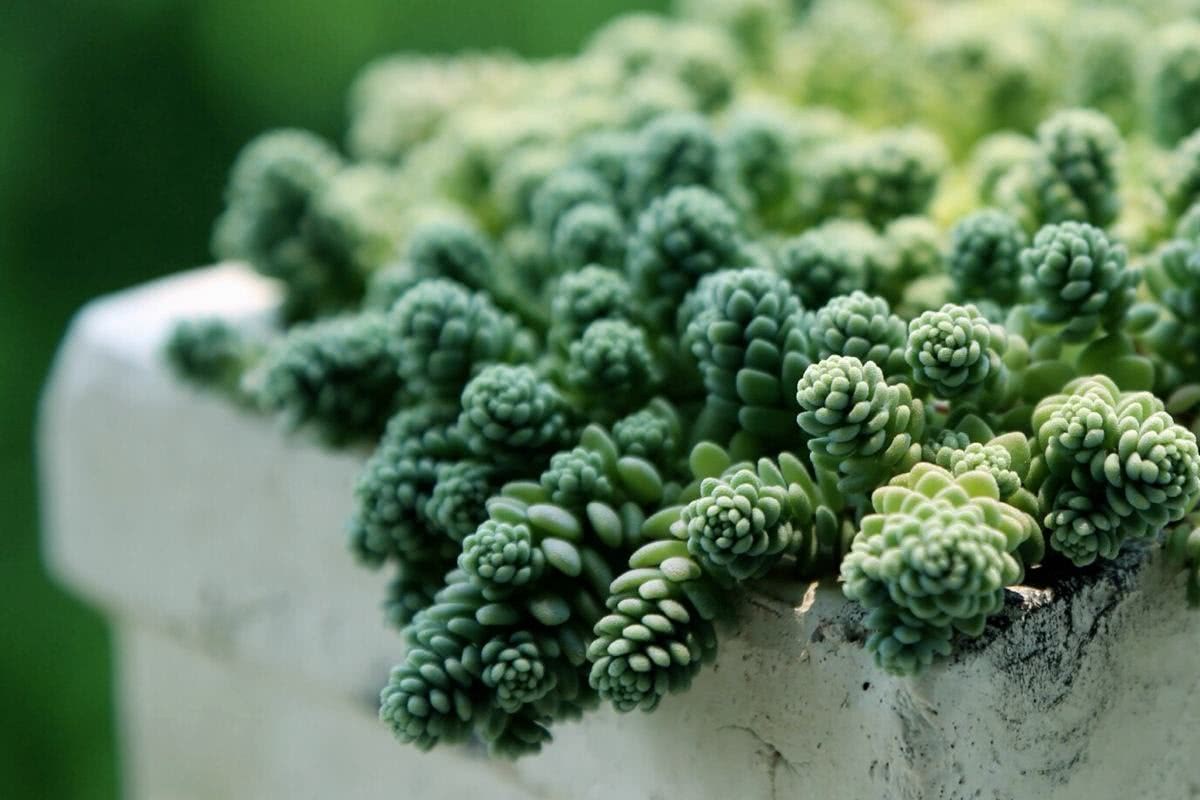
Sedum dasyphyllum is a succulent plant in the genus Sedum of the family Crassulaceae. It originates from the arid regions of West Asia and North Africa, mainly distributed in the southern, central, and southeastern parts of the Anatolian Peninsula. It prefers warm, dry, and sunny environments, and is very suitable for placement on sunny windowsills, balconies, and indoors as a decorative accent. In regions with dry climates, it also makes a distinctive groundcover plant.
Sedum dasyphyllum
Morphological Characteristics:
Sedum dasyphyllum is a perennial succulent plant, with a plant height of 5-10 cm. The stems are much branched, and the leaves are enlarged, alternate, obovate, 2 cm long, green. The leaves are fleshy and dark green, resembling jade. The dark green fleshy leaves are very bright and beautiful under sunlight. It blooms in spring, with pale pinkish-white flowers.
Growing Environment:
Sedum dasyphyllum originates from the arid regions of West Asia and North Africa. It prefers warm, dry, and sunny environments. It is relatively cold-tolerant, afraid of waterlogging, and drought-tolerant. It is suitable for fertile, loose, and well-drained sandy loam soil. The optimal growth temperature is 13-23°C, and the winter temperature should not be lower than 5°C. During high temperatures and strong light in summer, provide appropriate shading, but the shading time should not be too long, otherwise the stems and leaves will be tender and prone to lodging. In autumn, it can be placed in a sunny location. During the spring and autumn growing seasons, water according to "water thoroughly when dry," keeping the potting soil moderately dry between waterings. During the high-temperature dormancy periods in winter and summer, control watering, preferring dry over wet.
Sedum dasyphyllum
Main Value:
Sedum dasyphyllum is very suitable for placement on sunny windowsills, balconies, and indoors as a decorative accent. In regions with dry climates, it also makes a distinctive groundcover plant.
It should be noted that succulent plants in the family Crassulaceae do not have anti-radiation or formaldehyde-resistant functions.
Propagation Methods:
Commonly propagated by sowing, leaf cuttings, stem cuttings, and division.
Sowing: Conducted from February to May, using indoor pot sowing. The suitable germination temperature is 18-21°C, and germination occurs 12-15 days after sowing.
Cuttings: Can be done throughout the year, very easy to root, with spring and autumn being the best. Cut short branches with compact terminal leaves, 5-7 cm long, insert into a sand bed, keep the cutting medium slightly moist, and roots will form 10-12 days after insertion. Leaf cuttings can also be used: scatter mature, plump fleshy leaves on a sand bed, spray water several times, and after a few weeks roots will grow from the leaf base and young plants will emerge.
Sedum dasyphyllum
Cultivation Techniques:
Cultivation Management
When repotting in spring, add a mixture of fertile garden soil and coarse sand, along with a small amount of leaf mold and bone meal. At the same time, appropriately prune the stems and leaves. Just after potting, do not water too much. During the growing season, fertilize once a month, but control the application rate; too much nitrogen fertilizer will cause internode elongation, sparse leaves, and poor form.
During high temperatures and strong light in summer, provide appropriate shading; the fleshy leaves will appear bright green, but the shading time should not be too long, otherwise the stems and leaves will be tender and prone to lodging. In autumn, it can be placed in a sunny location. In winter, the room temperature is best maintained at 10°C, reduce watering, and keep the potting soil slightly dry. Sedum dasyphyllum will slow its growth, and the stems and leaves will be compact and ornamental. If the potting soil is too wet, the stems and leaves are prone to leggy growth, and when exposed to low temperatures, they may instead suffer frost damage and rot.
Pest and Disease Control
Leaf spot and rust diseases sometimes occur; spray with 50% captan 800-fold solution for control. Pests include aphids and scale insects; spray with 50% fenitrothion emulsifiable concentrate 1500-fold solution to kill them.