Detailed Guide to Growing Hoya lanceolata ssp. bella in Pots
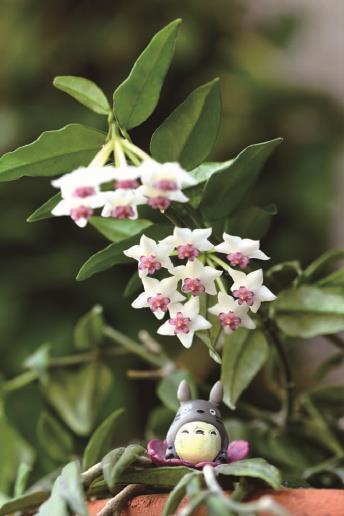
My Potted Hoya lanceolata ssp. bella Growing Technique
This year during the May Day holiday, my Hoya lanceolata ssp. bella bloomed right on schedule. This pot of Hoya lanceolata ssp. bella has been growing for 4 years, starting from 2 cuttings, with new branches increasing year by year, and now it has grown into a plant 50-60 cm long. When it is not blooming, it looks like a green waterfall cascading down. Looking back on previous years, every blooming season, watching the gradually enlarging buds turn yellow and drop was incredibly frustrating. Later I learned that Hoya lanceolata ssp. bella buds easily abort when lacking water, so during the bud stage I made sure to keep the soil and plant moist. Since last year it has bloomed continuously, and this May it successfully produced over twenty flower balls, while an estimated dozen or so buds aborted. "Aborts buds every day" is truly not an unearned reputation.
Now this pot of Hoya lanceolata ssp. bella has adapted to my home environment. Even though buds still turn yellow and drop (because Hoya lanceolata ssp. bella's inflorescences easily turn yellow and fall off, and are jokingly called yellow-drop hoya or drop-hoya by fellow growers), overall more bloom than drop, which is quite satisfying. Generally speaking, Hoya lanceolata ssp. bella is especially prone to bud abortion when buds are small, and less likely when buds are larger, so special attention should be paid to the period when buds first emerge - it is a bit like "protecting a pregnancy."
After a period of growth, Hoya lanceolata ssp. bella finally bloomed successfully. A single inflorescence blooms for about two weeks. When the buds are unopened they look like little five-pointed stars, when half-open they resemble teddy bear biscuits, and when fully open they have white petals and a red center, like exquisite pastries - and they are fragrant sweet treats.
The blooming process of Hoya lanceolata ssp. bella
I have always loved all kinds of hoyas. Unlike other hoyas I have grown, Hoya lanceolata ssp. bella's inflorescences do not open in a spherical shape but in an umbrella shape, so the hanging inflorescences look even more like exquisite little umbrellas, little umbrellas fallen in the forest, and paired with a Totoro they look even more like a scene from an anime.
Compared with other hoyas that readily open dozens of small flowers, Hoya lanceolata ssp. bella has only 7-9 small flowers per inflorescence. Combined with its tendency to abort buds, the number of flowers is often uneven - 4, 5, 6, 7, 8, 9 all together.
The morning after a rainstorm, the sunlight is brilliant, and the little bella forest still carries a touch of fresh post-rain fragrance. Although Hoya lanceolata ssp. bella is not suitable for cut flower arrangements, it is very suitable for floral art creation. I picked a few stems of bella little umbrellas and floated them in a cup, enjoying the visual pleasure brought by the little bella forest, and at the same time looking forward to the next bella blooming season.
Having read this far, you surely want to grow such a delicate and lovely Hoya lanceolata ssp. bella too. Now let me explain the key points for growing Hoya lanceolata ssp. bella:
Propagation: Hoya lanceolata ssp. bella is generally propagated by cuttings. In spring and autumn, cut some healthy branches. The branches do not need to be too long. Remove the leaves from the part to be inserted into the growing medium, and insert directly into the medium. The cutting medium can be prepared with bark, orchid stone, and perlite at a ratio of 3:1:1. This kind of medium is mainly for drainage and aeration, and does not easily rot. Hoya pots should be small rather than large; for cuttings you can use small pots 5-10 cm in diameter. If the local air is relatively dry, you can place the small cutting pot in a humidity box, then put it in a cool place, mist appropriately, and water when the medium is dry. Besides soil cuttings, Hoya lanceolata ssp. bella can also be propagated by water cuttings: insert the branches into water and wait for roots to form before transplanting into soil. This method also applies to some other hoya varieties.
Planting: Hoya lanceolata ssp. bella likes loose, well-draining and aerated soil rich in organic matter. Rooted cuttings can be planted in a medium mixed with peat soil, bark, and perlite. Because I was too lazy to repot, I directly used a 10 cm diameter pot with peat soil mixed with perlite for cutting and planting. Peat soil contains organic matter and has strong fertilizer and water retention; perlite has good drainage, contains no nutrients, and has low fertilizer and water retention. Hoya lanceolata ssp. bella's branches naturally droop and do not need a trellis to climb. You can use a hanging pot or place it on a flower stand to let the plant hang naturally. When the plant is larger, you can switch to a pot 10-18 cm in diameter. My bella is planted in a pot 18 cm in diameter.
Inflorescences of Hoya lanceolata ssp. bella (different numbers of flowers)
Inflorescences of Hoya lanceolata ssp. bella (different numbers of flowers)
Habits: Hoya lanceolata ssp. bella likes a humid and warm environment. During the bud growth period, keep the soil moist and increase air humidity. It likes plenty of scattered light; in summer avoid direct sunlight and scorching. The suitable growing temperature is 18-28°C. It is heat-tolerant but not cold-tolerant, suitable for growing in South China and Southwest China, and also suitable for indoor cultivation in northern areas with heating in winter.
Hoya lanceolata ssp. bella Mini Profile
Hoya lanceolata ssp. bella
[Family and Genus] Apocynaceae, Hoya genus
[Morphological Characteristics] Perennial twining shrub. Stems naturally drooping, leaves opposite, leaf blades rhombic-lanceolate, 3-4 cm long, 1-2 cm wide, leaf surface green, underside greenish-white, apex acuminate, base cuneate. Inflorescences terminal or in leaf axils, umbel with 7-9 flowers, flowers star-shaped, white, about 1 cm in diameter, corona purple-red, star-shaped. Fruit is a follicle.
[Blooming Period] Spring and autumn.
[Origin] India, Thailand, and Myanmar, etc.