Designing a semi-hydroponic moisture pot to promote better flower growth
Let's design a semi-hydroponic moisture pot that can promote better flower growth
Oxygen and water are the two major factors for healthy plant growth. Too much water causes root rot, too little causes wilting. Watering takes three years to master, and many beginners struggle to grasp watering techniques, ruining many flowers that should have bloomed. Oxygen and water seem to have a certain mutual exclusivity. Many experienced gardeners choose loose, moisture-retaining media and careful watering methods to balance oxygen and water. But is that the only way?
I have invented a new type of flower pot with an innovative spatial structure. Its core feature is a stable, open moist air layer constructed in the middle of the pot (hereafter referred to as the moisture layer), through which plant roots grow, thereby greatly satisfying the plant roots' needs for air and water. It can help beginners solve watering problems, and for experienced growers, it can further promote better flower growth.
The flower pot is divided into an inner pot and an outer pot. The outer edge of the inner pot is sized to rest on the outer pot, and the outer pot should be noticeably taller than the inner pot.
The bottom of the inner pot needs to have multiple holes, which can be drilled by yourself, to allow plant roots to extend through. Drill a small hole on the side of the outer pot at about four cm below the bottom of the inner pot for gas exchange and water level balancing. This position can be flexibly adjusted according to the pot's specifications.
Put some water in the outer pot, put soil in the inner pot, place it on top of the outer pot, and it is ready to use.
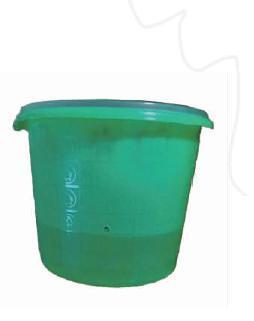
Many materials can be used. For ease of understanding, a bucket and a plastic basin were used here as raw materials to make the moisture pot, as shown in the figure:
The small hole limits the maximum height of the water so that it cannot contact the inner pot. In this way, a moist air layer forms between the bottom of the inner pot and the water surface of the outer pot.
With normal planting, plant roots will pass through the moisture layer, and the advantages of this design are as follows:
1. Structurally drought-resistant, but plant roots can obtain water from the moisture layer and the water layer in the outer pot, until the water in the outer pot dries up.
2. Structurally waterlogging-resistant. The roots extending from the inner pot pass through the moisture layer, and the moist air can provide sufficient oxygen, so the plant will not drown from too much water.
3. Fertilizer retention. If watering leaks through, nutrients will not be lost, but instead stored in the water of the outer pot.
Figure 1 Outer pot
Figure 2 Inner pot
Figure 3 Inner pot placed on top of the outer pot
Figure 4 The space between the inner pot and the outer pot
4. Easy transition from soil to water. Because the roots that grow to the water layer in the outer pot are water roots adapted to hydroponics, they can be transferred to hydroponic cultivation at any time.
5. Easy soil fertility testing. Directly take out the water in the outer pot, evaporate it to dryness and check the proportion of sediment, or directly measure the electrical conductivity to estimate fertilizer concentration.
6. High cleanliness. During transport, soil will not spill from the bottom, because the bottom of the outer pot has no holes; simply block the side ventilation hole with a finger.
7. Uses less soil, because roots can absorb water and nutrients from the water in the outer pot and obtain oxygen from the moisture layer, not relying solely on soil.
8. Soil stays consistently moist. When many roots pass through the pot and touch the water surface, capillary action occurs and feeds back to the soil in the inner pot. Also, the soil in the inner pot connects with the moisture layer and can obtain water, so even without watering, the soil will not become too dry.
9. Convenient root observation. Take out the inner pot and you can observe the growth of the plant roots. Compared with traditional planting, which requires digging them out, this causes no damage and is convenient.
10. Micro-convection inside the pot. Because the specific heat capacity of water is significantly greater than that of soil, there is a long-lasting temperature difference between the inner pot and the outer pot, forming a weak airflow that benefits root respiration.
11. Alleviates fertilizer burn on seedlings. The moisture in the moisture layer comes from the natural evaporation of water. As distilled water with the highest water potential, when plant roots lose water due to excessively high soil solution concentration, the root water potential decreases, and the relative water potential difference between the moist air layer and the roots increases accordingly. The existence of this huge water potential difference allows the moisture layer to significantly replenish the water lost by roots during fertilizer burn, thereby avoiding or significantly improving the phenomenon of fertilizer burn on seedlings, manifesting as a marked increase in the fertilizer tolerance of potted plants.
Based on the structural characteristics of the moisture pot, there are several stages when using this pot for planting. When the roots have not yet broken through the inner pot, management is basically the same as for ordinary potted plants. In addition, the outer pot should be filled with water. At this time, only advantages 3, 6, and 10 are present, so one should not be careless.
When the roots break through the inner pot and enter the air layer, advantages 2 and 11 are added.
When a large number of roots touch the water surface, advantages 1 to 11 can be fully demonstrated. If the water and fertilizer in the pot are sufficient, the plant can continue to grow even without care for a long time.