Key Integrated Control Technologies for Major Diseases and Pests of Early-Maturing Peaches in Southern China
Key Integrated Control Technologies for Major Diseases and Pests of Early-Maturing Peaches in Southern China
Peach is a perennial stone fruit deciduous fruit tree of the genus Prunus, subfamily Prunoideae, family Rosaceae. With the rise of leisure and sightseeing agriculture, peach has been increasingly planted because of its gorgeous blossoms, diverse fruit shapes, numerous cultivars and strong adaptability. According to statistics, in 2014 the peach cultivation area in Taizhou reached 3,400 hm2. Early-maturing peaches have large fruit, crisp texture, early maturity and high prices, giving them strong market competitiveness and making them very popular with producers and consumers. However, in recent years, affected by many factors such as mixed cultivars, uneven tree ages, extensive cultivation management and climatic conditions, diseases and pests occur commonly in Taizhou peach orchards. In particular, major diseases and pests such as peach gummosis, twig blight, brown rot, bacterial shot hole, aphids and lesser fruit borers occur severely in some areas, causing fruit drop and fruit rot. Peach growers are at a loss as to what to do, which has greatly dampened their enthusiasm for growing peaches and has become a major obstacle to the healthy and sustainable development of the current peach industry [1-2].
The survey revealed that peach growers currently commonly use pesticides such as mancozeb, thiophanate-methyl, tebuconazole and chlorpyrifos for disease and pest control. Because these have been used continuously for many years, not only has the dosage increased and the number of applications risen, but the efficacy is also poor, with considerable fruit rot during the picking period, non-smooth fruit surfaces and poor marketability [3-4]. For this reason, in 2016 several high-quality pesticide combinations were selected to explore key integrated control technologies for major diseases and pests during the key growth stages of peach, in order to clarify the comprehensive control effects of these pesticides on major peach diseases and pests under local production conditions, as well as the optimal application timing and safety, so as to provide a scientific basis for production application and to achieve the goals of reducing dosage and controlling harm, ensuring human and livestock safety, being environmentally friendly, and increasing efficiency and income. The experimental results are summarized and reported below.
1 Materials and Methods
1.1 Experimental Overview
The experiment was conducted at a peach orchard base in Yangpengtou Village, Xiage Town, Xianju County, where the peach planting area is more than 80 hm2. The cultivation management level of this grower is representative of the local area. The experimental plots were flat, with loam soil of medium fertility, and early-maturing honey peaches were planted all around. During the experiment, the peach trees grew well, and except for the different pesticide combinations, the daily field management measures of each treatment were basically the same. Before this experiment was carried out, peach gummosis, twig blight and bacterial shot hole occurred sporadically and evenly, and no other diseases or pests were observed.
1.2 Experimental Pesticides
Pesticides for the integrated control demonstration plot: 32.5% difenoconazole·azoxystrobin suspension concentrate (trade name Amistar Top), 30% difenoconazole·propiconazole emulsifiable concentrate (trade name Amisto), 22% thiamethoxam·lambda-cyhalothrin microcapsule suspension concentrate (trade name Alika), 11% amino acid-containing water-soluble fertilizer (trade name Yishibang), produced by Syngenta (China) Investment Co., Ltd., Switzerland, provided by Taizhou Agricultural Materials Co., Ltd.; 33.5% oxine-copper suspension concentrate (trade name Haizheng Bilu), Zhejiang Hisun Chemical Co., Ltd., provided by Taizhou Agricultural Materials Co., Ltd.
Pesticides for the grower self-control plot: 60% pyraclostrobin·metiram water-dispersible granules (trade name Baitai), produced by BASF, Germany; 70% thiophanate-methyl wettable powder (trade name Topsin-M), produced by Jiangsu Longdeng Chemical Co., Ltd.; 10% validamycin aqueous solution, produced by Tonglu Huifeng Biotechnology Co., Ltd.; 20% imazalil emulsion in water, produced by Yifan Biotechnology Group Co., Ltd.; 80% tebuconazole water-dispersible granules, produced by Shandong Bi'ao Biotechnology Co., Ltd.; 40% chlorpyrifos emulsifiable concentrate, produced by Jiangsu Huifeng Agrochemical Co., Ltd. All the above pesticides were commercially available.
1.3 Experimental Treatments and Implementation Overview
The experiment set up two sites: 3-4 a tree age (near the foot of the hill) and 6-7 a tree age (beside the road at the village edge). Each site had three treatments: the integrated control demonstration plot, the grower self-control plot and the blank control plot, with 90 peach trees in each treatment. Each application used a high-pressure sprayer to spray the peach trees evenly, with the water volume based on evenly wetting the whole peach tree (60-100 kg per 667 m2). The weather was fine at each application, and there was no rain within 24 h after application. There were no special climatic phenomena throughout the experiment.
The specific application details are as follows. Integrated control demonstration plot: March 2 (before bud break), apply 3-5 degrees Baume lime sulfur mixture; March 15 (flower bud stage), apply Amisto 3,000 times + Alika 1,200 times + Yishibang 600 times; April 1 (2/3 of petals fallen), apply Amistar Top 1,500 times + Alika 1,500 times + Haizheng Bilu 1,500 times + Yishibang 600 times; April 17 (young fruit stage), apply Amistar Top 1,500 times + Alika 1,500 times + Bilu 1,500 times + Yishibang 600 times; May 12 (expansion stage), apply Amistar Top 1,500 times + Alika 1,500 times + Haizheng Bilu 1,500 times + Yishibang 600 times. Grower self-control plot: March 2 (before bud break), apply 3-5 degrees Baume lime sulfur mixture; March 15 (flower bud stage), apply Baitai 1,000 times + 70% thiophanate-methyl wettable powder 800 times + 10% validamycin aqueous solution 1,000 times + 40% chlorpyrifos emulsifiable concentrate 1,000 times; April 1 (2/3 of petals fallen), apply 20% imazalil emulsion in water 1,000 times + 70% thiophanate-methyl wettable powder 800 times + 40% chlorpyrifos emulsifiable concentrate 1,000 times; April 17 (young fruit stage), apply 80% tebuconazole water-dispersible granules 3,000 times + 70% thiophanate-methyl wettable powder 800 times + 40% chlorpyrifos emulsifiable concentrate 1,000 times; May 12 (expansion stage), apply Baitai 1,000 times + 80% tebuconazole water-dispersible granules 3,000 times + 70% thiophanate-methyl wettable powder 800 times + 40% chlorpyrifos emulsifiable concentrate 1,000 times. The blank control plot received no pesticide during the experiment.
1.4 Safety Investigation
Throughout the experiment, observations were made as to whether each pesticide treatment had any adverse effects on peach leaves, branches, fruiting, etc. If phytotoxicity occurred, the type and severity of the phytotoxicity were recorded.
1.5 Investigation of Major Diseases and Pests
Because at the time of the first application peach gummosis, twig blight and bacterial shot hole occurred sporadically and evenly, while peach brown rot, aphids and lesser fruit borers had not yet occurred, the investigation was carried out once before the first batch of peach fruit was picked. Each treatment was divided into three equal parts as three replicates.
Peach gummosis and twig blight. The disease incidence of all peach trees (30 trees) in each plot was investigated, the degree of disease was recorded separately, and the disease index and control effect were calculated.
Peach brown rot and lesser fruit borer. In each plot, the middle 3 peach trees were investigated; around the canopy and in the middle-upper part of the inner canopy of each tree, 100 fruits were randomly examined, giving a total of 300 fruits per plot. The number of brown rot diseased fruits and the number of fruits damaged by lesser fruit borer were recorded, and the control effect was calculated.
Peach bacterial shot hole. In each plot, the middle 3 peach trees were investigated; around the canopy and in the middle-upper part of the inner canopy of each tree, 5 newly sprouted branches of the current year were randomly examined, and 20 leaves per branch were examined from top to bottom. The degree of disease was recorded separately, and the disease index and control effect were calculated.
Peach aphid. In each plot, the middle 3 peach trees were investigated; around the canopy and in the middle-upper part of the inner canopy of each tree, 5 newly sprouted branches of the current year were randomly examined. The number of surviving aphids was counted, and the control effect was calculated.
Grading standard for peach gummosis: grade 0, the whole plant is normal, with no gummosis and no disease spots; grade 1, 1-9 gummosis points on the whole tree, with diseased area below 5%; grade 2, 10-19 gummosis points on the whole tree, with diseased area 5%-10%; grade 3, 20-29 gummosis points on the whole tree, with diseased area 10%-20%; grade 4, more than 30 gummosis points on the whole tree, with diseased area above 20%.
Grading standard for peach twig blight: grade 0, the whole plant is normal, with no dead branches; grade 1, 1-2 dead branches on the whole tree; grade 2, 3-5 dead branches on the whole tree; grade 3, 6-10 dead branches on the whole tree; grade 4, more than 10 dead branches on the whole tree.
Grading standard for peach bacterial shot hole: grade 0, no disease spots; grade 1, 1-2 disease spots per leaf; grade 2, 3-5 disease spots per leaf; grade 3, 6-10 disease spots per leaf; grade 4, more than 10 disease spots per leaf [5].
1.6 Yield Measurement
Each treatment was first divided into three equal parts as three replicates. At the first fruit picking during the peach maturity period, 30 peaches were randomly taken from each plot to measure the soluble solids (TSS) content at the fruit stalk and fruit apex as well as the single fruit weight. At the same time, in the unpicked area, 3 peach trees with similar growth vigor were randomly selected in each plot, and the yield was calculated after all batches of fruit were picked.
1.7 Data Processing
All data were organized in Excel 2010, and analysis of variance was carried out using DPS software [Jishan Huayao].
2 Results and Analysis
2.1 Safety
Throughout the experiment, the treatments with each pesticide combination in the integrated control demonstration plot had no adverse effects on peach leaves, branches, fruiting, etc., indicating that the safety of each pesticide combination was good.
2.2 Control Effect
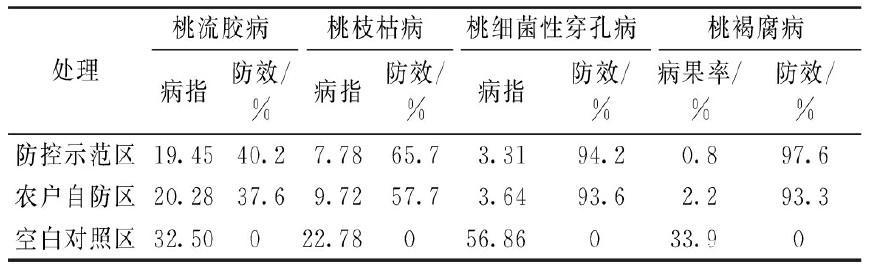
As can be seen from Table 1, the control effects of the integrated control demonstration plot on peach gummosis, twig blight, bacterial shot hole and brown rot were 40.2%, 65.7%, 94.2% and 97.6% respectively, which were 2.6, 8.0, 0.6 and 4.3 percentage points higher than those of the grower self-control plot, but the differences were not significant (P>0.05).
As can be seen from Table 2, the control effects of the integrated control demonstration plot on peach aphid and lesser fruit borer were 96.8% and 99.1% respectively, which were 2.6 and 1.6 percentage points higher than those of the grower self-control plot, and the differences were not significant (P>0.05).
Table 1 Control effects of each treatment on peach gummosis, twig blight, bacterial shot hole and brown rot
Table 2 Control effects of each treatment on peach aphid and lesser fruit borer
2.3 Effect on Yield
As can be seen from Table 3, at the first fruit picking during the peach maturity period, the single fruit weight in the integrated control demonstration plot was 156.3 g, and the average soluble solids (TSS) content was 10.43%, which were 46.2% and 3.87 percentage points higher than those of the blank control plot respectively, extremely significant (P<0.01)优于农户自防区。在桃全部批次采摘完毕后,防控示范区每3株产量为61.0 kg,极显著优于农户自防区和空白对照区,较之分别增加6.3%和125.1%。
Table 3 Effects of each treatment on peach fruit quality and yield
Note: Data in the same column followed by no common uppercase letter indicate an extremely significant difference (P<0.01)。
3 Summary and Discussion
The results of this experiment preliminarily show that in the integrated control demonstration plot, the use of pesticide combinations such as Amisto, Amistar Top, Alika and Haizheng Bilu for control at key growth stages such as the peach flower bud stage, after petal fall and the young fruit stage had very good control effects on peach bacterial shot hole, brown rot, peach aphid and lesser fruit borer, with control effects reaching 94.2%, 97.6%, 96.8% and 99.1% respectively, and also had a certain controlling effect on peach gummosis and twig blight, with control effects of 40.2% and 65.7% respectively. Through the combined formulation of pesticides with a nutrient solution (Yishibang), the integrated control demonstration plot played a good role in increasing the soluble solids content and single fruit weight of peach; at the first fruit picking, the soluble solids content and single fruit weight of the integrated control demonstration plot were 59.0% and 46.2% higher than those of the blank control plot, extremely significant (P<0.01)优于农户自防区。整个试验期间观察发现,防控示范区桃树叶片、果柄较农户自防区变绿、增厚、增粗,田间长势好、落果相对较少,且防控示范区桃成熟期比农户自防区提早2~3 d。综上,防控示范区对桃主要病虫控制效果理想,安全性好,具有提高桃果实可溶性固形物含量、增加单果重、提早成熟的效果。全部批次采摘完毕后实收测产,每3株平均产量为61.0 kg,极显著(P<0.01)优于农户自防区和空白对照区,具有显著的增产效益。