Literati tree bonsai appreciation: the spirit and charm are indescribably wonderful
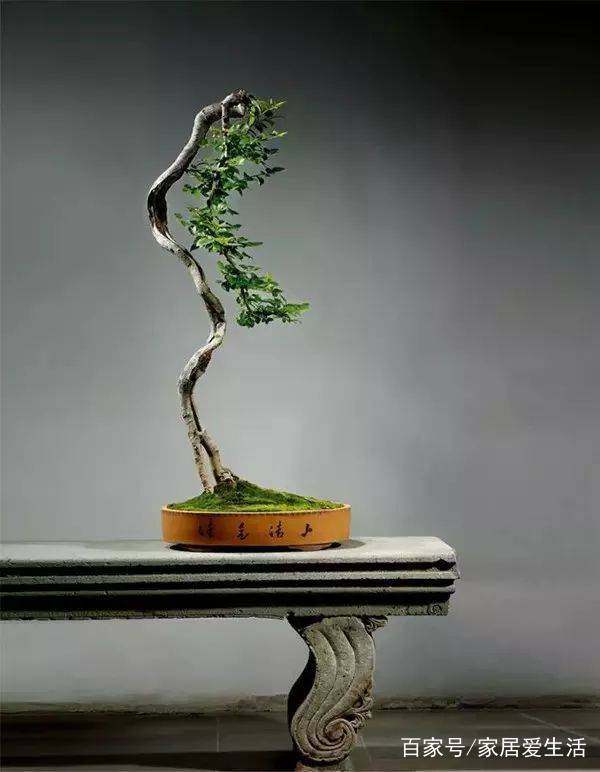
Literati bonsai originated in China. It can be traced back to the Tang Dynasty. To understand what literati painting is, one must start with literati painting.
Literati painting generally refers to the painting of scholar-officials in Chinese feudal society. In terms of subject matter, a large number of frustrated scholars were dissatisfied with the real society. They turned their attention to nature and expressed their aspirations through objects. Representative figures of literati painting include Wang Wei, Wen Tong, Su Shi, the four monks of the early Qing Dynasty, and the Wu School.
Song Dynasty, Ma Yuan, "Pine and Moon"
The concept of the literati tree in bonsai art emerged from the literati painting school, that is, the literati tree must have the characteristics of "literati painting." From the loftiness and transcendence of literati and literati, we can see that the main characteristics of the literati tree should be arrogance, delicacy, and incompleteness. A sturdy, upright, and full single-trunk bonsai can only be called a single-trunk tree or a tall-trunk tree. This kind of "healthy" tree lacks a "morbid" connotation and artistic conception. The literati tree must have an artistic conception, vent an emotion, and reveal an indignation.
Feng Bonne (Chinese juniper, tree height 115 cm, tree age about 30 years).
Therefore, in ancient Chinese literati painting, most trees are thin and lean, while Mieba Ro is short and sturdy, and the trees are full of trees. This was caused by the aesthetic orientation of Chinese literati.
"Ben Yue" (Chinese juniper, tree height 85 cm, tree age about 30 years).
The most artistically valuable literati trees are "morbid" trees, full of "tragic" artistic conception. This conclusion can be drawn from literati painting: literati painting reached its peak in the Qing Dynasty, and some top artists emerged, the most prominent being the "Four Monks," and among the "Four Monks," Bada Shanren and Shi Tao were the most outstanding. They were remnants of the Ming Dynasty, and in their painting and painting there was national suffering, unrestrained freedom, indulgence, conciseness, condensation, exaggerated forms, and a cold artistic conception. The trees they painted were all rotten.
"Into the Clouds" (Chinese juniper, tree height 132 cm, tree age 30 years)
Some people believe that a literati tree must be single-trunked, and otherwise it cannot be called a literati tree. In fact, the most important artistic feature of a literati tree should be whether it can speak with the tree, and whether it is full of the aesthetic characteristics of literati painting. If the requirements of the arrogant, thin, and incomplete literati painting are met, then two or more trees should not be harmful.
The character of the literati tree
With the form of form, it has the shape of meaning. This is an unintentional, accidental, everyday interest. This is an insight without or without traces of touch. It is the infusion, expression, and revelation of the literati's spiritual realm.
Flavor
That is, the flavor of the text. It is the morale of the literati's temperament, interest, and charm, and it is the literati's thin, detached, empty, and profound spiritual connotation.
Simplicity
Simple and clear. Some branches are sparse, the branches and leaves are sparse, and the number of leaves is large; there are many branches and few leaves. This is a simple and simple expression. It can be simplified without being simplified, and even simplified to "zero," which is concise to the point of almost abstraction.