How do you grow Chinese roses? Understand these 3 things first before you start
Click [Follow] in the top right corner to follow the Lanyao Garden Toutiao account, send a private message with "Encyclopedia of Flower Growing" and receive a free e-book that can solve 70&-80% of flower-growing problems (updated regularly)
This is day 883 of Lanyao's daily original articles
Article 81 in the Chinese rose growing series
For the past two months, Lanyao has been writing about Chinese rose care knowledge, but today a flower friend asked Lanyao this question:
Are Chinese roses perennial?
Previously, when flower friends bought Chinese rose seedlings from Lanyao, they also asked Lanyao:
Will it bloom this year?
These questions that seem like non-questions actually reflect how much we beginner flower friends know about Chinese roses, which can be said to be truly no understanding at all.
Perhaps this has a lot to do with modern people generally living in big cities and having less contact with the natural environment.
As the saying goes: if you have not eaten pork, have you not seen a pig run?
But the real situation now is: everyone has eaten pork, yet truly few people have seen a pig run! The progress of the times has made our cognition leap forward.
Just like many people buy fresh-cut Chinese roses at flower shops, but they do not clearly know when Chinese roses bloom, or whether they are perennial, in the same way.
Today Lanyao will briefly introduce the characteristics of Chinese roses.
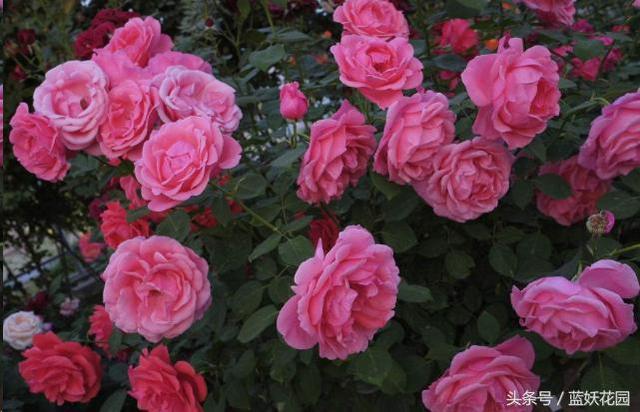
Most Chinese roses grown in modern households are European roses, abbreviated as European roses. The more common Chinese roses in rural areas before were our native Chinese roses, also called Yueyuehong.
Chinese roses are evergreen or semi-evergreen low shrubs. In warm places they can bloom in all four seasons; in areas with frost, they generally lose their leaves and rest in winter, and bloom in spring, summer and autumn.
How large does a Chinese rose seedling need to be to bloom?
Many flower friends who have just started growing Chinese roses do not know how large a Chinese rose seedling needs to be to bloom. Actually, this is a false proposition!
The characteristic of Chinese roses is that when fertilizer and water are sufficient, new shoots will produce flower buds. So even a young seedling that has just successfully rooted from cuttings, as long as fertilizer and water are sufficient, can bloom after growing new shoots.
Of course, the quality of the flowers produced is definitely different from that of a mature large plant. Here Lanyao is talking about a flowering characteristic of Chinese roses.
Generally speaking, no matter how large the seedling you buy is, as long as it is a variety that blooms in all four seasons, with normal care, it can bloom in the same year.
But if it is a single-season variety and you miss the spring flowering period, you will need to wait another year.
It should be noted that Chinese rose seedlings are not better the taller they are!
There are always flower friends who care more about the height of Chinese rose seedlings. Lanyao has said that Chinese roses really like being pruned, and they must be pruned constantly to bloom well, so generally after flowering and during the dormant period we prune Chinese roses to promote the production of new branches, and then produce flower buds and bloom.
It can be seen that choosing strong Chinese rose seedlings is more reliable than choosing tall Chinese rose seedlings!Follow Lanyao's WeChat public account: Lanyao Garden (ilanyao) to exchange flower-growing tips together
Welcome to follow the [Lanyao Garden] Toutiao account, accelerate your growth together, and become a flower-growing expert. If you like my articles, you might as well like, forward and bookmark them!