Concerns about GM crop contamination should not be underestimated; the experiences of Japan and South Korea are worth learning from
By Chen Ju-wei
At the "Taiwan, Japan and South Korea Food Moment—School Lunch and Anti-GM Action" workshop that just concluded two weeks ago, Oh Se-young, executive committee chair of South Korea's "National Anti-GMOAction," and teacher Tenshaku Keisuke, representing Japan's "We Don't Want GM Food! Movement," both spoke about cases of GM crop contamination of the environment in their own countries and the citizen actions launched by civil society.
Since Taiwan, Japan and South Korea currently do not cultivate any GM crops, the cases of GM crop contamination in South Korea and Japan are indeed worth serious consideration and learning from for Taiwan.
South Korea
Executive committee chair Oh Se-young stated that2017in May of that year, a GM rapeseed contamination incident broke out in South Korea. The "Taebaek Rapeseed Flower Festival," originally scheduled for June, was forced to be cancelled after official routine inspections found GM rapeseed in the festival grounds. Subsequent investigations indicated that the contamination source came from rapeseed imported from China that had been mixed with viable GM rapeseed seeds.2016In 1from that month onward, South Korea imported a total of79.6tons of rapeseed from China, of which32.5tons were suspected of being mixed with GM seeds, and of that,464kg flowed into small-scale trading markets(Note 1)。
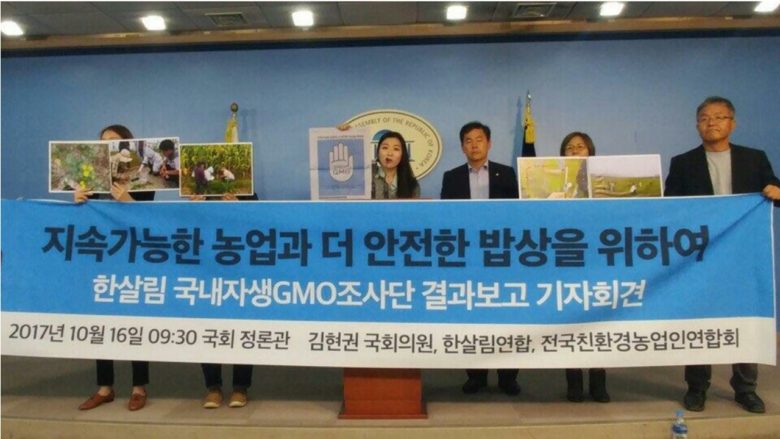
In August of the same year, South Korea'sHansalimcooperative alliance recruited members to form a "domestic spontaneousGMOinvestigation team"; in October,Hansalimtogether with members of the National Assembly, they held a press conference to announce the investigation results and put forward five demands, including information transparency, expanded investigation, strengthened review, provision of compensation, and complete labeling of GM ingredients, but officials have so far not responded actively.
These cases in Japan and South Korea repeatedly remind us that the GM issue concerns not only human health or food safety, but also involves important aspects such as environmental ecology and food autonomy.
Just as stated in the "2018Taiwan, Japan and South Korea Anti-GM Movement Joint Declaration" recently signed by civil anti-GM groups from Taiwan, Japan and South Korea, it has been more than twenty years since GM crops were first commercially marketed, and the four major GM crops and foods - soybeans, corn, cotton and rapeseed - are ubiquitous in people's daily lives, bringing far-reaching and complex impacts on environmental ecology, human health, food sovereignty and international trade. As multinational corporations that control GM seeds expand their monopoly through mergers, and as organisms using next-generation genetic technology may enter the market without regulation, for civil anti-GM movement organizations that are relatively short of manpower and funds, only through international alliances can they strengthen their power to stop GM from invading daily life.
Note 1: The data source is the presentation content given by Executive Committee Chair Oh Se-young at the workshop on May 8, 2018.
This article is adapted from the piece "The Environmental Crisis Brought by GM Crop Contamination"