What is variegation in succulents? A detailed explanation of the difference between true variegation and chemically induced variegation
Xiao Jingzhi Life mentioned succulent "variegation" in a previous article, and then many friends sent private messages asking how to avoid buying "chemically induced variegation". So, next Xiao Jingzhi Life will discuss with everyone what variegation in succulents is, as well as the difference between "true variegation" and "chemically induced variegation".
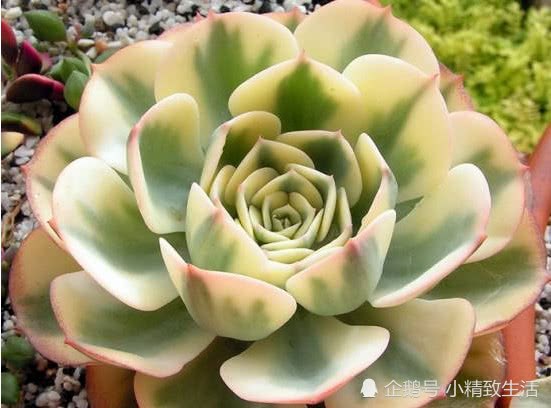
Variegated Echeveria 'Rainbow'
First, let's talk about what variegation in succulents is: variegation is also called chimeral variegation, and it is a state of succulents, strictly speaking a mutated state. The phenomenon of variegation is that parts such as the stems and leaves of succulents mutate into various colors such as white, yellow, and orange. Compared with the original color, variegated succulents have more colors and are more ornamental. Generally, variegated succulents simply have a "variegated" added to the end of their original name; for example, a variegated Pachyphytum 'Little Beauty' is called "variegated Pachyphytum 'Little Beauty'".
Variegated Pachyphytum 'Little Beauty' with marginal variegation
Variegation is not something humans can control. From the internal genetic factors of succulents to external mutation factors such as light, watering, climate, temperature, and chemicals, all may promote gene mutation or recombination in succulents, causing the chlorophyll in the cells of succulents to be disturbed or missing, thereby changing the original color and forming variegation. It can be said that variegation in succulents is something that can only be encountered by chance, not sought.
Variegated Echeveria 'Chihuahuaensis'
Precisely because variegation is uncontrollable, variegated succulents are rare, and compared with the original color, variegated succulents are even more stunning and beautiful, so the price of variegated succulents increases several times over. Thus, "chemically induced variegation" appeared.
Chemically induced variegation
Chemically induced variegation mainly uses so-called "variegation liquid" to stimulate succulents and form the appearance of variegation. Most of these so-called variegation liquids are agents harmful to plants such as herbicides. The "artificial fake variegation" made in this way is especially prone to root rot and black rot. Even if it survives by luck, after it grows normally, in order to carry out normal photosynthesis, the fake variegated patches will also fade. Therefore, it is better not to buy chemically induced variegation.
Chemically induced variegation
So, how do you distinguish true variegation from chemically induced variegation? First, the variegated patches of chemically induced variegation look very abrupt, with a feeling like a drop of ink falling on white paper, while true variegation has transitional colors between the colors, so it looks relatively natural and soft. Second, the variegated patches of chemically induced variegation are generally concentrated in the center of the succulent, and the oldest leaves at the bottom still have their original color because they did not touch the liquid. In contrast, the variegated patches on both new and old leaves of true variegation are relatively uniform, only the old leaves are lighter. Finally, chemically induced variegation is very difficult to keep alive, while true variegation is relatively much easier to care for.
Variegated Aeonium
The above is the difference between true variegation and chemically induced variegation. I hope it is helpful to everyone.
Compiled and published by Xiao Jingzhi Life.