Blue Apple is a succulent plant of the genus Echeveria in the Crassulaceae family.
Text
Images and text: This girl is a bit sweet
Blue Apple (xSedeveria 'Blue Elf') belongs to the genus Echeveria in the Crassulaceae family, and is also known as Blue Sprite and Blue Angel. The leaves of Blue Apple are slender and spoon-shaped, with slanted pointed tips that easily turn red.
Morphological characteristics
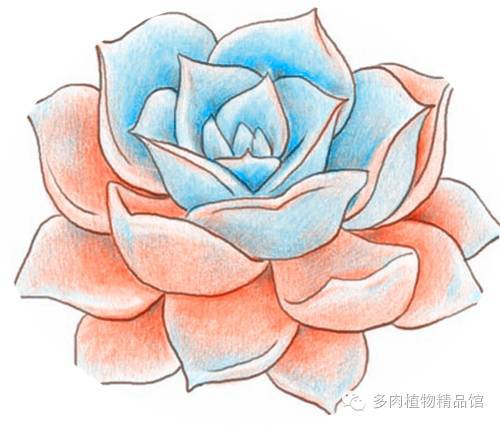
The Blue Apple succulent plant usually grows in a rosette form, and easily sends out new branches from the lower part of the stem, forming a clustered growth habit and gradually becoming an old stump. The leaves are spoon-shaped, whorled, and arranged in a rosette, plump and fleshy, slightly flattened, with some protrusion on the back of the leaf and a keel line, while the leaf surface is flat or slightly concave, and the leaf tip is slightly narrowed and pointed. The leaf color is relatively rich and changes with the seasons and temperature differences, including blue-green, purple, and beautiful jelly colors. The leaf tips have peach red, pink, or rose red color halos, and the surface and back of old leaves have large areas of red blush. When in show condition, the red becomes more intense and more intoxicating, and the leaf surface is covered with white powder.
In summer, the red color at the leaf tips of the Blue Apple succulent easily fades, and may even disappear completely, basically appearing blue-green. The flowering period is in spring, with scorpioid cymes borne in the leaf axils, and small bell-shaped flowers with 5 petals in a five-pointed star shape, lemon yellow in color.
Growth habits
Blue Apple is relatively vigorous by nature and relatively easy to cultivate. It is a summer-growing type, with an optimum growth temperature of 15-25°C. Like most plants in the same genus, it likes a warm, dry, and sunny environment, is drought-tolerant, not cold-tolerant, and slightly tolerant of semi-shade. Blue Apple is easy to care for and easy to cluster. The lower leaves are easily consumed, forming a stem, and side buds grow from the bottom to form clusters. During the spring and autumn growing seasons, give as much full sunlight as possible. With sufficient light, the form of Blue Apple can be more compact, and the leaf color becomes red and vivid, just like a mouth-watering red apple. But if the light is insufficient, Blue Apple is prone to leggy growth, the leaf centers turn white, and it becomes vegetable-colored.
Care methods
Blue Apple succulents can be cared for outdoors during the growing period. In the spring and autumn growing seasons, Blue Apple can be watered thoroughly, and when the potting soil is about 70-80% dry, it can be watered until it runs through. Avoid long-term complete drying out. During the rainy season, avoid prolonged rain exposure to prevent water accumulation and leaf rot. In winter, it can be moved indoors to a sunny place for care. Blue Apple still grows in summer, and water cannot be completely cut off during the summer. You can pour water along the edge of the pot, just enough to moisten it, to prevent it from being too wet. In midsummer, avoid exposure to strong sunlight and heavy rain, and pay attention to shading and ventilation. When the temperature is below 5°C in winter, watering should be controlled.
Propagation methods for Blue Apple
Blue Apple can be propagated using leaves, or its side buds can be selected for stem cuttings.
Soil mix
For planting Blue Apple, the soil mix can choose loose and breathable media, such as peat/coco coir and granular soil in a 1:1 ratio. The soil mix ratio can be configured differently according to the environment in different places and care habits.
The article was compiled by the Succulent Plant Boutique Pavilion, and the copyright belongs to the original author. For some articles, the source cannot be identified and they are marked as sourced from the internet. If there is any infringement, please contact us immediately, and we will handle it promptly.