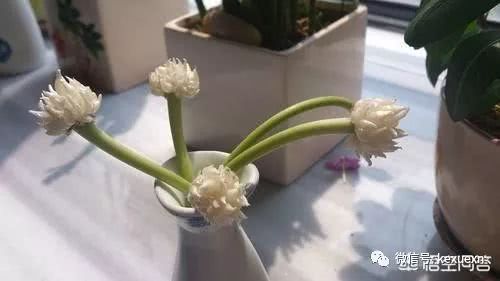
Garlic can flower and set seed, and the bulbils at the top can also be planted.
Why is garlic not grown from seed? To answer this question, we first need a basic understanding of how garlic reproduces. Garlic bulbils are the seeds of garlic; the meaning of "seed" in production differs from the botanical meaning of seed. In production, anything capable of developing into a plant can be called a seed.
In other words, garlic has two kinds of seeds. One is the clove currently used in production, which, in terms of the garlic's parts, is merely the garlic's vegetative body - an organ. The other is the so-called true seed, that is, the seed formed after garlic flowers! Never seen garlic flower? No need to be surprised; it should be said that most people have never seen it, though garlic farmers have, namely the tiny bulbils formed on the scape after flowering when the scape was forgotten and left unremoved in the garlic field - extremely, extremely small!
Do not think this kind of garlic lacks the ability to grow and develop; like garlic cloves, it too can develop into a garlic plant. But why is garlic from the scape not used for planting in current agricultural production? There must be a reason, and now Science Agriculture will explain it for you.
Anyone who has seen this kind of bulbil knows that it is very small. After sowing, the most intuitive response is that the seedlings grow weak and small, and even if the nutrient supply is very good later on, it is still difficult to harvest a larger garlic head at harvest time. In fact, when nutrients are insufficient, single-clove garlic can appear, which then becomes solo garlic. For farmers aiming to harvest garlic, this is clearly a losing proposition, and high production efficiency certainly cannot be achieved.
The underground garlic cloves thus become another option, that is, propagation by vegetative organs. Garlic cloves are rich in nutrients, including the bud core in the middle, which provides abundant nutrition for sprouting. Vegetative propagation also has another major advantage: the genes do not change, meaning that continuous planting will not lead to genetic segregation due to genetic variation, producing low-yield garlic. Factors affecting yield are thus shifted more toward environmental factors.
However, the situation is very different for propagation relying on the bulbils on the scape, because flowering and fruiting above mean that foreign pollen is received, and variation occurs due to chromosome recombination. This makes it impossible to guarantee garlic yield.
In summary, we can see that the bulbils at the top of garlic are not suitable for use as garlic seed.
This is Science Agriculture; you are welcome to follow, and together we will grow our knowledge.