What to do when succulents lose their color in summer? Try this trick to make them more and more beautiful as you grow them
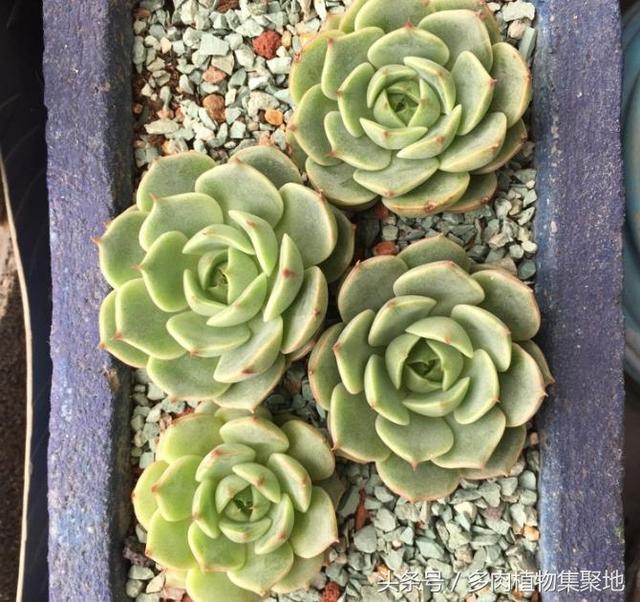
The general safe growing temperature range for succulents is 5-30°C. Within this range, the lower the temperature, the bigger the difference, and the easier it is for succulents to develop their best colors. The principle is simple: the combined effect of anthocyanins, chlorophyll, carotenoids and so on in the succulent's body affects how its external color appears. Generally, anthocyanins and chlorophyll are in a see-saw relationship. Within the succulent's growing range, the lower the temperature, the more favorable it is for anthocyanin synthesis, and the higher the temperature, the more favorable it is for chlorophyll synthesis. Around 30°C is the temperature most suitable for chlorophyll synthesis and anthocyanin degradation, which is also why succulents lose their colorful hues as soon as summer arrives.
Using light to change a succulent's color is the most common method and also the fastest to show results. You can do a simple experiment: move a succulent that has been kept indoors for a long time to a sunny windowsill, and within a few days you will see the leaf color begin to change. Of course, they will not necessarily all turn red, because there are so many succulent varieties, and each has its own characteristics, so the colors will differ as well. For example, Aeonium 'Zwartkop' (black mage) turns black as sunlight increases, Firecracker Plant (firecracker plant) turns fire red, Hongzhiyu Jin (Hongzhiyu Jin) turns pink, and Huangli (Huangli) turns yellow, and so on.
Temperature plays a considerable role in the color change of succulents. Succulents kept indoors are generally at a relatively constant temperature, so at this time the color change is slower, and because glass, window screens and so on block most of the ultraviolet rays, the color becomes very pale and elegant, or even stays evergreen without turning red. This is also the main reason why indoor-grown succulents are mostly green. So, everyone can try letting the plants slowly move outdoors; even a small windowsill is already sufficient space and environment for these mini succulents.
There are 3 elements to coloring succulents: water control, light, and temperature difference. These 3 points can be said to be indispensable. Water control is the easiest to manage. As for light, summer light is also very strong, and in summer everyone also controls water, so why is it not easy to color them? This shows that water control and light are not the most important factors for coloring. The reason succulents easily lose color in summer is that the temperature difference in summer is small. This also corresponds to why succulents color best only in spring and autumn, and also in early winter. So the conclusion is that temperature difference is the most critical issue determining coloring, while grow lights are only secondary support, which can let succulents grow better while also increasing the percentage probability of coloring.
Some gardening friends have asked, can you spray ice water on succulents in summer to create a temperature difference and make them color up? The answer is definitely no. The factors behind succulent color change are mainly: light, temperature and so on. Entering autumn, sunlight intensity will increase, and ultraviolet intensity will also rise together to its annual peak. The strength of ultraviolet rays in sunlight determines the degree of color change in succulents. Temperature also plays a considerable role in the color change of succulents. The reason low temperatures make them change color quickly is mainly the synthesis of new anthocyanins.
This is a gathering place for succulent lovers, sharing succulent care tips. Welcome to follow and exchange ideas.