Detailed Explanation of Key Techniques for Mulch Cultivation of Moso Bamboo Shoot-Production Forests
Research on Mulch Cultivation Techniques for Moso Bamboo Shoot-Production Forests
Bamboo Phyllostachys heterocycla (Carr.) Mitford 'Pubescens' is an important natural resource in Xianning. The city currently has 102,300 hm2 of bamboo forest, of which 100,400 hm2 is moso bamboo forest, with 260 million standing culms and an annual bamboo timber output of 25 million culms, all accounting for more than 80% of the province's total. At present, the management model for moso bamboo forests in the city is monotonous, and large-scale practices in shoot-production forest cultivation have not yet been seen. Affected by its own growth characteristics and market demand, the traditional bamboo forest management model focused on timber production makes it difficult to achieve major breakthroughs in yield and efficiency of moso bamboo forests. Therefore, it is imperative to explore a new production and management approach for moso bamboo forests to substantially enhance their comprehensive benefits. Mulch cultivation of moso bamboo shoot-production forests refers to a bamboo forest management model in which materials such as rice straw and rice husks are used to cover the forest floor, raising soil temperature through fermentation-generated heat, altering the natural growth and development patterns of moso bamboo shoots, achieving earlier shoot emergence, and increasing forest management benefits. Related research has been carried out in Zhejiang, Fujian, Hunan and other places, and research results have been applied to production in some areas. Hu Weibin[1], Wang Bo[2] and others advanced shoot emergence time by 54 d and 57 d respectively through mulching, and bamboo shoot yield was also significantly increased; Qiu Yonghua[3] and others significantly increased winter shoot yield through continuous mulching with rice husk + rice straw for 2 a. From 2015 to 2016, the Xianning Academy of Forestry conducted experimental research on moso bamboo forest mulch cultivation, exploring the role of mulch technology in increasing yield of shoot-production forests, providing technical reference for early emergence and high-yield cultivation of moso bamboo shoots.
1 Materials and Methods
1.1 Overview of the Experimental Site
The experimental site is located in Qianshan National Forest Park, Xianning City, Hubei Province, with geographical coordinates of 114°96'E, 29°48'N, an altitude of 200 m, and a northwest slope aspect. The forest soil is yellow-brown soil, with deep and fertile soil layers. The experimental site belongs to a subtropical monsoon climate zone, with an average annual temperature of 16.8 °C, an extreme maximum temperature of 41.4 °C, an extreme minimum temperature of -15.4 °C, an average annual precipitation of 1,700 mm, and an average annual sunshine duration of 1,234.6 h. The experimental moso bamboo forest is an on-year/off-year forest with shoots in even years, with a standing culm density of 165-183 culms/667 m2 and an average diameter at breast height of 10.7-11.1 cm.
1.2 Experimental Design
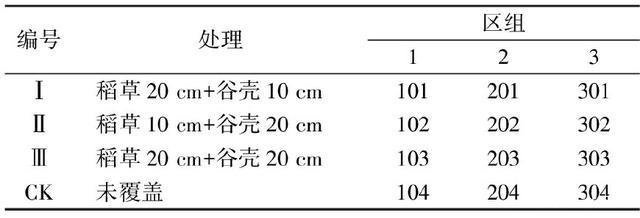
The experiment set up 3 treatments and 1 control (see Table 1), with 3 replicates per treatment, arranged in a completely randomized block design, totaling 12 plots, each with an area of 270 m2 (18 m x 15 m).
Table 1 Experimental Design
1.3 Data Processing
Continuous mulching was carried out for two years from 2015 to 2016, with mulching completed from mid-November to late November. Right-angle soil thermometers were used for continuous timed observation of surface (0 cm) temperature and underground (20 cm) soil temperature for each treatment. For mulched forest plots, bamboo shoots were harvested when cracks appeared in the rice husk and shoot tips pushed up the rice husk; for control forest plots, harvesting was based on bamboo shoots growing about 15 cm above the ground. Each shoot was weighed daily and yield was recorded. The average of two years of observation data was taken for statistical analysis, and Excel 2007 was used for data processing and analysis of variance.
2 Results and Analysis
2.1 Effects of Different Mulch Treatments on Soil Temperature
Observation of soil temperature in moso bamboo forests under different treatments showed that mulching can significantly increase forest soil temperature. The maximum surface temperatures of Treatments I-III were 16.0, 19.5, and 22.5 °C respectively, which were 4.7, 8.2, and 11.2 °C higher than the control maximum surface temperature (11.3 °C); the maximum soil temperatures at 20 cm underground were 16.0, 19.0, and 20.5 °C respectively, which were 4.5, 7.5, and 9.0 °C higher than the control maximum temperature (11.5 °C). The average surface temperatures of Treatments I-III were 12.4, 14.1, and 14.8 °C respectively, which were 6.8, 8.5, and 9.2 °C higher than the control (5.6 °C); the average soil temperatures at 20 cm underground were 12.5, 14.3, and 15.3 °C respectively, which were 5.5, 7.3, and 8.3 °C higher than the control (7.0 °C).
From Figures 1 and 2, it can be seen that forest floor mulching can to some extent increase and maintain soil temperature, and its temperature variation pattern is basically consistent with air temperature variation, but it is less affected by air temperature. The overall warming effect of each treatment was Treatment III > Treatment II > Treatment I > CK. Analysis of variance on soil temperature data for different mulch thicknesses and soil layers showed that all treatments were significantly different from the control (P<0.05),处理Ⅰ与处理Ⅲ差异显著(P<0.05),处理Ⅱ与处理Ⅰ、处理Ⅲ则无显著差异。
Figure 1 Soil temperature variation at the surface (0 cm)/°C
Figure 2 Soil temperature variation underground (20 cm)/°C
2.2 Effects of Different Mulch Treatments on Shoot Emergence Time
Continuous observation of shoot emergence time in bamboo forests under different treatments for two years found that compared with the control, the shoot emergence time of Treatments I-III in 2016 was advanced by 65, 51, and 55 d respectively compared with 2015, and in 2017 was advanced by 51, 42, and 44 d respectively compared with 2015, fully demonstrating that forest floor mulching can effectively promote earlier shoot emergence in moso bamboo forests. From the perspective of shoot period, the control bamboo forest began to produce shoots successively in spring each year, with the shoot period lasting only about one month; while all mulched treatments produced bamboo shoots in winter (Table 2), reaching a peak from late February to mid-to-late March, with the shoot period lasting up to 83 d, indicating that forest floor mulching has a significant effect on extending the shoot period.
Table 2 Statistics of Shoot Period Under Different Treatments
2.3 Effects of Different Treatments on Bamboo Shoot Yield
Based on the natural shoot emergence time of the control treatment, bamboo shoots harvested before that time are called early shoots. From Table 3, it can be seen that forest floor mulching has a considerable effect on increasing bamboo shoot yield, especially with an extremely significant (P<0.01)的效果。对两年平均产量进行分析可知,处理Ⅲ效果最佳,产量达1 547.68 kg/667 m2,且早期笋产量达780.93 kg/667 m2,平均单株笋重达2.02 kg;与对照相比,覆盖各处理分别增产53.27%(处理Ⅰ)、55.16%(处理Ⅱ)、66.40%(处理Ⅲ)。对不同覆盖厚度处理的早期笋产量及总产量进行方差分析和多重比较,结果表明,不同处理对早期笋产量及总产量均产生了显著影响(,且各处理的早期笋产量之间差异均达到显著水平,但处理Ⅰ、Ⅱ的竹笋总产量之间差异不显著,其余处理间竹笋总产量存在显著差异。
Table 3 Average Bamboo Shoot Yield Under Different Mulch Treatments
Note: a,b,c,d represent significant differences (P<0.05);A,B,C,D 代表极显著差异
3 Summary and Discussion
(1) Forest floor mulching can effectively increase soil temperature, and its later temperature variation pattern is basically consistent with air temperature variation, but it is less affected by air temperature changes. Compared with the control, mulch treatments significantly increased surface and 20 cm underground soil temperatures, and showed significant differences from the control (P<0.05),其中处理Ⅲ最高温度分别达到22.5 ℃(0 cm)、20.5 ℃(20 cm),但随着时间的推移,地表及地下20 cm土壤温度呈逐渐下降的趋势,这与王波[2]等研究结果相似。在竹笋采挖过程中发现部分稻草未完全腐烂,土壤松散干燥,说明水分不足,这可能是导致发热慢、增温时间短、温度下降快的主要原因。
(2) Mulching has obvious effects on promoting earlier shoot emergence, extending the shoot period, and increasing yield in moso bamboo forests. The experiment showed that Treatment III (rice straw 20 cm + rice husk 20 cm) had the best comprehensive effect, with shoot emergence advanced by 55 d and the shoot period extended by 41 d in 2016, and shoot emergence advanced by 44 d and the shoot period extended by 34 d in 2017; the total bamboo shoot yield was 1,547.68 kg/667 m2, a yield increase of 66.40% compared with the control, of which early shoot yield reached 780.93 kg/667 m2.
(3) To achieve ideal mulching effects, it is advisable to select shoot-production forests that have been well cultivated in the earlier period[2-4]. The 2014 preliminary experiment results showed that directly mulching without prior cultivation of the bamboo forest resulted in a yield of only 244 kg/667 m2, with poor mulching effects; while starting from 2015, using well-cultivated shoot-production forests for mulching, bamboo shoot yields under different treatments all increased significantly, averaging over 1,000 kg/667 m2, and the proportion of early shoot yield reached over 50%, which is conducive to improving bamboo forest management benefits.
(4) Mulch cultivation breaks the natural growth and development patterns of moso bamboo forests, causing certain negative impacts on the forest. Related research has proven that long-term mulching and intensive management can lead to severe degradation of bamboo forest soil, with forest productivity gradually declining[5]. Therefore, it is still necessary to further carry out research on the relationship between consecutive years of mulching and the on-year/off-year cycle of bamboo forests, the impact on underground rhizome systems, and the maintenance of bamboo forest productivity.