These steps are crucial in the process of making a Golden Larch bonsai
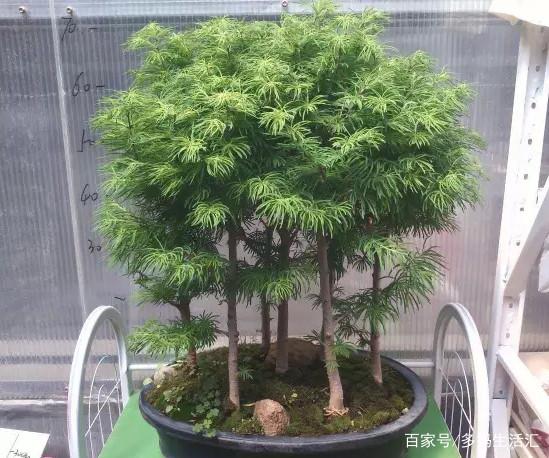
The Golden Larch has a distinctive form and is an excellent material for making bonsai. Its leaves are linear, slender and soft, and turn golden yellow after autumn, with a color like copper coins, which is why it is named Golden Larch. Today, the editor will share with everyone the making of Golden Larch.
First, seedling raising and material selection. Golden Larch is usually propagated by sowing. Collect ripe fruit in October, leave them for a period, then rub and thresh them to extract the seeds. Sow them again in spring. Before sowing, the seeds can be placed in naturally cooled water at a temperature of around 40 degrees, and they will sprout in about half a month. Generally, the seedlings can be potted after being grown for 2-3 years.
For Golden Larch, purple clay pots or glazed ceramic pots are quite suitable. The shape also varies depending on whether it is planted in a group or as a single specimen. For group planting, a rectangular or oval shallow pot can be used. For single planting, a rectangular, square, round or oval medium-deep pot is all acceptable.
Second, the requirements for the environment. Golden Larch's requirement for soil is best met by fertile, well-drained acidic soil. If poor saline-alkali soil is used, phenomena such as leaf drop and crown dieback will occur. In summer, it must not be exposed to harsh sunlight during maintenance and can be placed in a shaded area. The optimal temperature for Golden Larch is 15 to 25 degrees. During maintenance, attention should be paid to water control for the potted plant. Too much water easily leads to root rot, so generally the state of watering when dry and stopping when wet is sufficient. When the weather is relatively dry, water can be sprayed onto the branches and leaves.
Third, key points of layout. When planting Golden Larch, it is generally chosen in spring in March or April, or after leaf fall in autumn. This is especially true for group-planted bonsai, where the layout must be well chosen. For group-planted bonsai, seedlings of different thickness and height can be selected for planting. An overall layout with height and density, and clear layers, is also a very good landscape. Group planting usually uses an odd number, such as three or five plants, and the layout must have a clear primary-secondary relationship and appropriate density.
Finally, there is the pruning and branch training of Golden Larch, which also depends on the situation. Generally, for single planting, a larger seedling can be selected and only the trunk needs to be bent and shaped. For group-planted bonsai, the trunk does not need to be processed; only the side branches need to be pruned. The bending and shaping work must be carried out before sprouting in spring.
That is all the editor will share about making Golden Larch bonsai. I hope it is helpful to you. Golden Larch bonsai can be made into a forest bonsai, elegant and graceful, and can also be paired with a few stones and figures to highlight a natural landscape, fresh and refined. Do you like Golden Larch bonsai?