What potted plant can even a lazy person not kill? Its leaves take root as soon as they fall to the ground, and the more you grow it, the more it fills the pot.
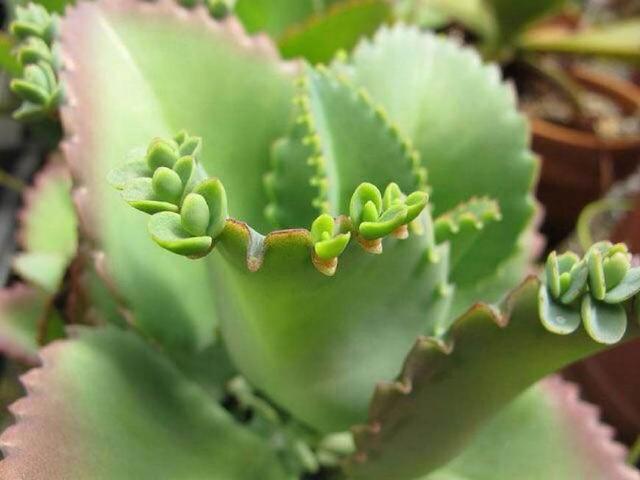
Kalanchoe daigremontiana, also called "never-die bird," is the most common succulent plant. From a distance it looks like a flock of dancing little butterflies, quite whimsical. Families often grow it in pots, placing it on windowsills and desks as an accent - small and elegant.
The never-die bird is truly the undisputed champion of over-breeding. Every leaf has countless growth points. Plant one in a pot, and you can just sit back and wait for never-die birds to overrun your home!
Kalanchoe daigremontiana is also known as leaf-rooting, unkillable, sun-proof, leaf-bud-bursting, flower butterfly, foreign peony, Mexican hat, lantern flower, and compound-leaf kalanchoe. Kalanchoe daigremontiana is a perennial succulent herb in the Crassulaceae family, Kalanchoe genus, with a plant height of 50-100cm. The stem is single, branched, upright, and brown. In early spring, a hard flower stalk emerges from the center of the plant. The never-die bird is also known as kalanchoe daigremontiana and brocade butterfly - the kind that grows long dangling parts, grows bulbs beside bulbs, grows bulbs on top of bulbs, grows spores on leaves, grows seeds inside leaves, and grows roots from a single inserted leaf. The flowering period is January to March.
The never-die bird is a perennial succulent herb. As its name suggests, it has very strong vitality, and can take root and survive wherever there is soil. Its leaves are long and spindle-shaped, thick and fleshy, opposite, dark green with beautiful brown markings. Especially distinctive is that the leaf margins are serrated, and adventitious buds grow along the toothed edges, just like two neat rows of little "butterflies" resting on both sides of the leaf. These adventitious buds fall off easily, and once they land on soil they grow into new seedlings. Once planted, it can reproduce on its own, growing more and more. In winter it produces red bell-shaped flowers in umbel-like inflorescences, and the flowers last a relatively long time.
The never-die bird has a vigorous constitution and is quite easy to grow. It is not strict about potting soil, and the container for potting is relatively flexible. It likes a sunny, warm, and humid environment, is relatively tolerant, and is very cold-tolerant. It is suitable for growing in well-drained acidic soil. It is drought-tolerant. It likes well-drained, fertile sandy loam. The optimum growth temperature is 13-19°C. In winter it can withstand short periods of freezing temperatures. During severe freezing and snowy weather, it should be moved indoors promptly, and when the temperature rises it can still be put back in its original place. If placed indoors for too long, the plant will become leggy and weak, grow poorly, and lose its ornamental effect.