How do you care for a cedar bonsai? Master the method and it will thrive even in harsh environments
Near the Himalayas there exist many, many of a kind of large tree whose vitality is very tenacious; after all, at such a high altitude, there is almost no life that can carry on there.
But they are the exception; not only can they survive in such harsh conditions, they can also grow very lushly, with no sign of withering at all.
Do you want to know their name? Their name is cedar (Cedrus). What I am introducing to you next is not the cedar itself, but at the same time it is inextricably linked to the cedar; its name is the cedar bonsai.
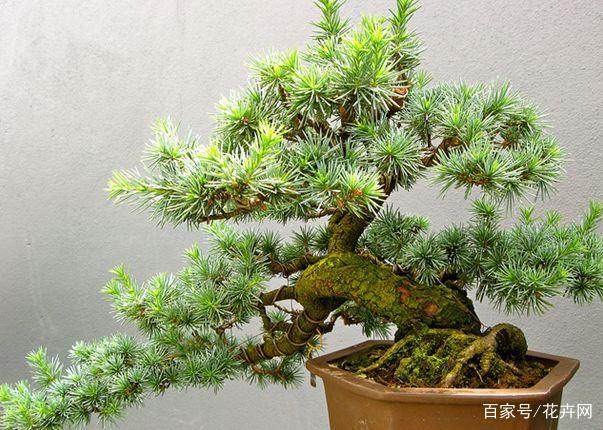
Many people wonder what a cedar bonsai is. In fact, a cedar bonsai is a mini version of the cedar. Through especially professional techniques, people shape the cedar into a relatively small plant that can be placed in a pot; this kind of bonsai is grown in household after household, letting people grow it and admire it both at home and in daily life.
Cedar bonsai generally lives in mild, humid air, and this kind of environment lets it flourish even more. It grows into a small cedar; although that is the case, this does not mean it cannot adapt to severe cold winters. In fact, the cedar bonsai very much likes sunlight, and the environment that lets it grow most vigorously is one bathed in sunlight with very humid air as well.
Usually, the cedar bonsai is most suited to being distributed along the middle and lower reaches of the Yangtze River, that is, in the more southern locations.
The cedar bonsai has a very tall and upright appearance; its branches and trunk feel like the hands of a dancer, stretching out freely. Different cedar bonsai have different postures, and all kinds of postures make cedar bonsai become endlessly varied, but what they have in common is that they are all very elegant.
In daily life, the cedar bonsai is also very important. For example, if summer comes, there will be many mosquitoes, especially at night, keeping you awake all night. But if you grow a cedar bonsai at home, because of it there will be fewer mosquitoes, and it will even make mosquitoes die out in your home. In ancient times, ancient people processed cedar into an insect repellent to use. The effect was very good.
People today have extracted essential oils from cedar; through chemical production and manufacturing, these essential oils have been made into all kinds of items convenient for people to use, to make people's lives easier and achieve the effects of sterilization and insect prevention.
You should place the cedar in a sunny and relatively humid space; when the weather is very hot, the cedar can not only block sunlight, but in winter it can also withstand severe cold, though it is still best to place it indoors. In fact, like the cactus, the cedar can withstand days without water, and even quite a long time without water. For the cedar, the best situation is still to water it regularly. If you want to fertilize the cedar, the best is human excrement or nutrient-rich fertilizer.
The best time to fertilize is in April or May each year. As for the amount, do not use too much; an appropriate amount is enough. As for frequency, two to three times a year is best. Precisely because the cedar grows very fast and very lushly, you should also prune the cedar regularly. Prune away the withered branches, trunk and leaves of the cedar; in this way, not only will the withered and decayed branches, trunk and leaves not absorb new nutrients, but the new branches, trunk and leaves can also absorb sufficient nutrients even more, ultimately growing full of vitality.
Does anyone have the idea of growing a cedar? Go buy one right away!