How do you make a pomegranate bonsai? Grow it as a potted plant at home like this, and the flowers and fruit will be a feast for the eyes
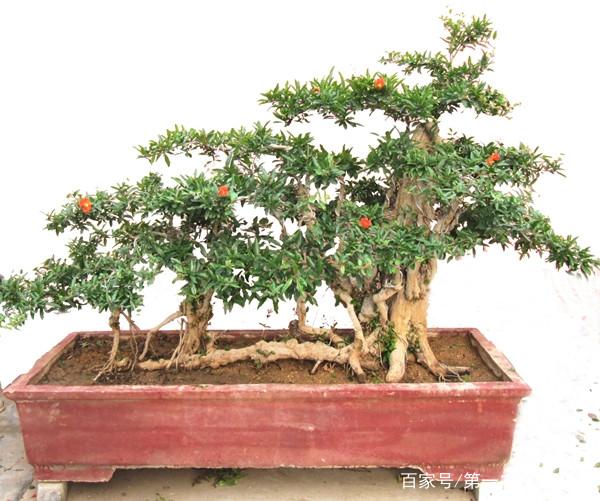
There are many kinds of pomegranate. As a symbol of "a hundred sons and a thousand grandsons," the pomegranate has been beloved since ancient times, and many bonsai enthusiasts turn it into a bonsai, finding great delight in both its flowers and its fruit. However, the pomegranate trees used for making bonsai generally cannot be orchard varieties, because these pomegranate trees grow too fast and too large and are not suited to potting. The ornamental flowering pomegranates mainly include flower pomegranates and fruit pomegranates. Flower pomegranates generally bloom without setting fruit, while fruit pomegranates flower first and bear fruit afterward, but their flower color is not as showy as that of flower pomegranates, though their fruit display is excellent.
Making a pomegranate tree into a bonsai is an art, and producing a top-grade bonsai is extremely difficult. But the pomegranate genus has very strong sprouting ability and is easy to shape. With a little patience, generally old multi-year stumps can develop gnarled, twisted branches and lush foliage with abundant blooms. If you can get it to expose its roots and reveal its claws, that is even rarer. This is a living "artistic carving," of limitless value.
So, how should you grow a potted pomegranate flower at home to turn it into a pomegranate bonsai whose flowers and fruit are a feast for the eyes?
Generally speaking, this is a long-term task. Turning a potted pomegranate flower into a bonsai requires stages such as raising the stump, building up branches, and taking shape, and throughout these processes, how to prune and shape it is very important.
Stump-raising stage: To make a pomegranate bonsai, you generally should choose tree species that are short in form and have smaller leaves and fruit, such as fire pomegranate, agate pomegranate, four-season pomegranate and other varieties. After a few years of cultivation, the seedlings can be cut back at the trunk and have branches built up to develop into small to medium-sized bonsai.
Branch-building stage: This is a very important process. Making a pot of pomegranate bonsai with ornamental value is not a simple matter. In the early care, according to the tree form, the pomegranate trunk should be cut off at an appropriate height to create various tree forms such as the straight-trunk style, curved-trunk style, and slanting-trunk style, with proper pruning and adjustment carried out every year.
Shaping stage: After raising the stump and building up branches, plant it into an ornamental pot of suitable size and carry out careful care. After several years of cultivation and pruning, it generally can take shape. At this stage, the pomegranate bonsai already has initial ornamental value.
Finally, the pomegranate tree is cold-resistant, and as long as it is not in an extremely cold place, it can generally be grown outdoors. During cultivation, appropriate fertilization is needed to promote growth and better achieve the shaping goal. In addition, small and medium-sized pomegranate bonsai should not keep too much fruit. A small bonsai should keep 1-2 fruits, and a medium bonsai should keep 3-5 fruits. Too many will put pressure on the tree's growth and affect the next year's fruiting.