What plant is wild oat? A detailed explanation of its morphological characteristics and growth habits
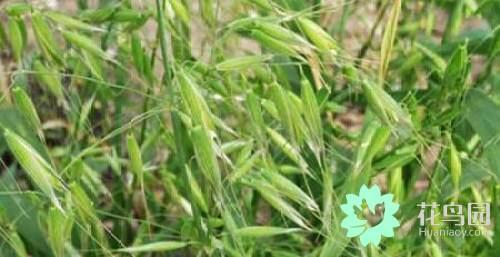
Wild oat, also known as black oat, bell oat, oat grass, etc., is an annual plant of the genus Avena in the grass family. It is usually a weed harming crops such as wheat and barley, mostly growing in abandoned fields or farmland, widely distributed across all provinces north and south in China, and also distributed in the temperate and cold zones of Europe, Asia and Africa, and has also been introduced to North America, where the indigenous peoples used its seeds for food.
The annual fibrous roots of wild oat are relatively tough. The culms are erect, smooth and hairless, 60-120 cm tall, with 2-4 nodes. The leaf sheaths are loose, smooth or the basal ones slightly hairy. The ligule is transparent and membranous, 1-5 mm long. The leaf blades are flat, 10-30 cm long, 4-12 mm wide, slightly rough, or sparsely pubescent on the upper surface and margins.
The panicle of wild oat is open, pyramidal, 10-25 cm long, with angular, rough branches. The spikelets are 18-25 mm long, containing 2-3 florets, their stalks curved and drooping, enlarged at the tip. The rachilla is densely covered with light brown or white stiff hairs, its nodes brittle and easily broken off, the first internode about 3 mm long. The glumes are herbaceous, nearly equal, usually with 9 veins. The lemma is hard in texture, the first lemma 15-20 mm long, with light brown or white stiff hairs on the back below the middle; the awn extends from slightly below the middle of the lemma, 2-4 cm long, geniculate, the awn column brown, twisted. The caryopsis is covered with light brown pubescence, with a longitudinal groove on the ventral side, 6-8 mm long. Flowering and fruiting period is April to September.
Wild oat poses a serious threat to cereal crop production. In the United States and Canada, the affected area is hundreds of millions of acres, with annual losses amounting to 150 million US dollars. Damage is also relatively serious in Australia, the United Kingdom, the Soviet Union, North Africa and the Middle East. In China, wild oat is also widely distributed, mainly in the Northeast, Northwest and Qinghai-Tibet regions. Wild oat prefers cool conditions, has strong adaptability, occurs commonly, reproduces in large quantities, and easily spreads into a disaster. Combined with human factors over the past 10-plus years, the damage from wild oat has expanded and worsened year by year.
Wild oat is sweet in taste and warm in nature, entering the liver and lung meridians. It has the effects of tonifying deficiency, suppressing sweating and stopping bleeding, and is used for conditions such as spontaneous sweating, night sweating, incessant weak sweating, hematemesis and metrorrhagia, with a usual dosage of 15-30 grams. The whole plant of wild oat has effects basically the same as the fruit, used for hematemesis, metrorrhagia, leukorrhea, hemafecia, spontaneous sweating, night sweating and other conditions, with a usual dosage of 15-60 grams.
When oat grass is used for grazing, because of its high sugar content, good palatability, tall plants, fine stems and relatively abundant leaves, it is suitable for making hay after harvesting. It contains moderate crude protein and abundant nitrogen-free extract. Compared with other plant fiber sources, the crude fiber content is moderate, the neutral detergent fiber content of the hay is lower, and it is more palatable than other hays containing higher neutral detergent fiber.