A Detailed Guide to Selecting and Managing Wild-Collected Orchids
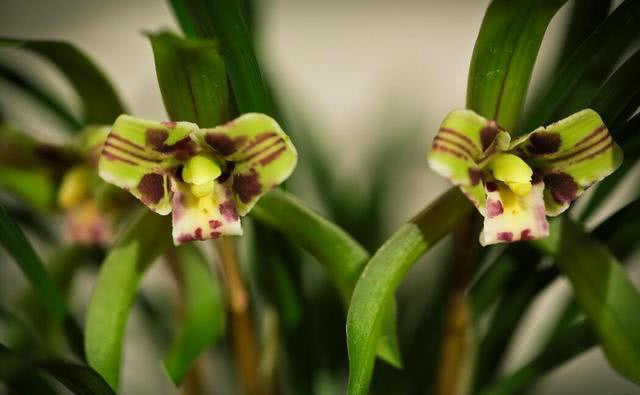
1. Common characteristics of the leaves and sheaths of lotus-petal orchids:
The sheath leaves are broad, thick and stiff, with tightly cupped tips; the leaf shape is well-proportioned in the middle, the leaf texture is broad and thick, the grain is moist, and the veins are fine and contained; the leaf tips are round and blunt, symmetrical, or spoon-shaped and slightly upturned, the leaf serrations are fine and dense, and the leaf surface is glossy and has running ridges. These are all the characteristics of traditional lotus-petal orchids, so among this type of wild-collected plant the probability of producing a lotus-petal flower is relatively greater.
2. Common characteristics of the leaves and sheaths of plum-petal orchids:
The sheath leaves are thick and moist, tightly gathered, with scattered bracts, and one leaf sheath twists forward, with a white head at the sheath; the leaves are relatively evenly proportioned in the middle, the leaf ends gradually taper, the leaf sheaths are rather pointed, and the majority have medium-fine leaf width, with the middle leaves mostly semi-erect; the side leaves are mostly bow-drooping or sickle-drooping in shape. The leaf serrations are fine and dense but not very regular, and both the leaf surface and the leaf back are relatively smooth and lubricated, showing firmness within softness; the middle of the lower leaves is widened, shaped like a boat, and the tips of the side leaves form a cup. These are all the characteristics of traditional plum-petal orchids, so among this type of wild-collected plant the probability of producing a plum-petal flower is relatively greater.
3. Common characteristics of the leaves and sheaths of dish-petal orchids:
The outer dish has tall bracts, forming an inverted "eight" shape, and the midrib is slightly off-center, so the leaf sheaths also often have curved or slightly slanting tips. The leaf sheaths of the inner dish are slightly slender, with pointed sheath tips. The leaf shape of lotus-form outer dishes is generally slightly more slender than the leaf stalks of lotus-petal plants, and the leaf texture may be thick or thin, but they all share one common trait: poor symmetry of the leaf blade, with most midribs slightly off-center (each leaf deviating in a different direction). Within the same leaf, the veins vary in thickness, the spacing between veins is uneven, the grooves on the leaf surface vary in depth and width, and the arrangement of leaf serrations varies in thickness. Sometimes the single side of the rear half of the leaf shows no serrations or intermittent serration rows, but by the time it reaches the leaf tip area the serrations on both sides become noticeably thicker. The greater the difference in serration shape between the front end and the rear half of the side leaves, the greater the proportion of lip-transformed areas of the outer dish. The leaf shape of the inner dish is mostly slightly slender; the leaves of the inner dish are more symmetrical than those of the outer dish, but the leaf serrations likewise vary in thickness, and the more prominent the midrib of the side leaves of the inner dish, the larger the tongue shape; the more prominent the two veins on either side near the midrib, the broader the spread of the outer three petals. If there is dish transformation on the leaf blade, it will mostly produce a side-petal dish, while dish transformation of the heart leaf will produce a stamen dish. These are all the common characteristics of traditional dish-petal orchids, so among this type of wild-collected plant the probability of producing a dish-petal flower is relatively greater.
4. How to select lotus-petal orchids:
The bud sheaths of lotus-petal flowers are broad, and the bracts of the ovary must have heavy sand-like mottling, with the bud sheaths short and broad, fully wrapping the flower bud. The plants of lotus-petal flowers generally have two leaf postures, semi-drooping and slanting-erect; the leaf width is relatively broad, the leaf tips are relatively blunt, the vein pattern is relatively fine, and the leaf sheaths are broad and thick and tightly clasp the leaf stalk. If the leaf sheaths do not tightly clasp the leaf stalk but are loose, it will certainly not produce a true lotus-petal flower, and a coarse, hard, oily and astringent leaf texture cannot produce a lotus-petal flower. A lotus-petal flower must possess the following conditions:
1. The middle lobe of the lip must be short, round and broad. Generally, lotus-petal orchids have four types of lip: the large round tongue, the large round dragon-swallowing tongue, the large ruyi tongue, and the large liuhai tongue. If it does not have one of these four tongues, then no matter how broad the outer three petals are, it cannot be counted as a true lotus-petal flower.
2. The clasping petals must be short, round and broad. The clasping petals of lotus-petal orchids are generally the clam-shell clasp, the short round clasp, the xinkou clasp, and so on. The clasping petals and the tongue petal together are called the "central palace," and the "central palace" must be round and broad. If the clasping petals are long and pointed, it cannot be counted as a true lotus-petal flower, but can only be counted as a "lotus-form" flower.
3. The outer three petals are short, round and broad, with contracted bases and flared corners. The tight contraction of the base of the outer three petals of a lotus-petal orchid is crucial; if the base does not contract, the breadth cannot be shown, and if the corners do not flare, the shortness and roundness cannot be shown. Some flowers have relatively short and round outer three petals when they first open, but after full bloom the outer three petals elongate; this type of flower cannot be counted as a lotus-petal orchid. A good lotus-petal orchid's outer three petals contract extremely tightly at the base, are short, round and broad, with flared corners at the petal tips, and the edges curl slightly inward, closely resembling the petals of a "lotus," and the petal tips have a sense of thickening. Only this is a top-grade lotus-petal orchid.
5. How orchid enthusiasts select buds and identify leaf buds.
In this selection process, examining new buds to identify varieties is an extremely important method. From early April to the end of June each year, new buds emerge from the soil one after another, and this is a very good time of year for identifying orchids. When examining new buds to identify orchids, it is best if the new buds are at a height of about 2 gongfen; at this height the characteristics of the new buds are relatively obvious and stable. If the height is too low, their essential characteristics have not yet appeared; if too high, their essential characteristics gradually fade.
1. The new buds of male-ized petal-form flowers are relatively short and round when they first emerge from the soil, with more foot sheaths; the bud body is thick and solid, shaped like a fish's back, and by the time it reaches a height of about 2 gongfen, the bud tip generally carries a very obvious white head. This white head has a very strong fleshy texture, like a piece of superior white jade, with inner-gathered radiance, and is different from the tender white bud tip of an ordinary common flower's new bud. Moreover, the veins on the foot sheath are thick and even, soft and moist through to the top, with heavy sand-like mottling. However, there are also a small number of cupped flowers whose new buds do not show the above characteristics clearly.
2. The new buds of bizarre-flower types generally come in two kinds, greenish-brown and reddish-brown. The bud tips of these two types of new buds also often carry fleshy white heads, but the veins on the foot sheath are dense with heavy sand-like mottling, and besides the fleshy white head, the bud tip also carries a differently colored cap. The first sheath from bottom to top on the foot sheath often has veins so fine and dense they are like silk threads, each one reaching the top; the second sheath often has a thick midrib and rich color, but the midrib generally breaks off at 1/3 of the way to the top or changes from thick to thin, and the top 1/3 often carries a differently colored cap, either a deep green colored cap or a red colored cap.
3. Besides possessing some of the above characteristics, the new buds of butterfly types have foot sheath edges that are more translucent than ordinary plants, and the translucent areas are covered with a layer of relatively heavy sand-like mottling. The vast majority of butterflies are like this. The new buds of stamen-butterfly types are generally purple-red, rarely blue-green. The veins on the foot sheath are thick and reach the top, with sand-like mottling wrapping the body, and the bud tip carries white; in particular, the higher the degree of tongue transformation, the more obvious the white head. After the new buds open into leaves, the leaf tips often carry a bit of red color, which is very beautiful. The new bud forms of colored flowers vary greatly, and it is relatively difficult to distinguish specifically which type of color they are. The new buds of this type of flower are often very richly and vividly colored, with layer upon layer of mottling, fine, long and dense veins, a thick and sturdy central vein reaching the top, and gorgeous luster. When the bud is at a height of about 2 gongfen, the characteristics of the bud tip are most obvious, often carrying a colored cap, whether white, deep red, deep green, and so on. Viewed as a whole, the new bud colors of this type of flower are relatively monotone, with the color at the very base of the foot sheath on the pale side, gradually becoming richer upward, and richest at the tip, forming colored caps of different colors. When the new bud is at a height of 2 gongfen, besides the obvious color of the midrib, the above characteristics are very obvious: pale yellow foot with a large white tip, white-yellow foot with a green tip, green foot with a red-brown tip, green foot with an oily green tip, and so on.
4. The new buds of plain-color flowers generally refer to the new buds of white and green plain-heart flowers. The new bud characteristics of this type of flower are relatively stable, either white or tender green, without the slightest impurity, the bud body crystal clear and transparent, with soft sand-like mottling, inner-gathered radiance, soft and moist with slight translucence, and the bud tip appearing white-jade in color. When you encounter this type of bud, it is unquestionably a plain-color flower.
6. How to make the flower scape taller:
1. Preparing the nutrient growing medium required by orchids is the most basic way to increase flower scape height. The budding and flowering of Cymbidium goeringii consumes a large amount of nutrients, and it is impossible to produce good flowers with insufficient innate nutrition. Therefore, whether the orchid-growing medium has complete nutrition has a direct impact on the height of the Cymbidium goeringii flower scape. This determines that when preparing the orchid-growing medium we should, on the principle of overall coordination, strive to work hard on breathability, drainage, and complete nutrition. Practice has proven that the best preparation of orchid-growing medium is a combination of traditional and modern, and that mixing sieved orchid mud with granular medium to grow orchids gives the best results. In this way the advantages complement each other, the nutrition is complete, and it provides a sufficient power source for the Cymbidium goeringii flower scape to grow taller and bloom.
2. Sufficient vernalization and creating an appropriate temperature difference are necessary conditions for promoting the height of the Cymbidium goeringii flower scape. Cymbidium goeringii generally undergoes nearly half a year from budding after autumn to flowering after spring. Through long-term natural evolution, Cymbidium goeringii has developed the characteristic that only by undergoing the low-temperature vernalization of winter can the flower bud expand and the flower scape grow taller. During the reproductive growth period, if the temperature is on the high side, it is very easy for the phenomenon of "borrowing spring to bloom" to occur, with the flowers lying on the pot surface, greatly reducing the flower quality and seriously affecting its ornamental value. In this regard, orchid masters of past generations have all attached great importance to the issue of sufficient vernalization of Cymbidium goeringii, advocating that in winter, especially during the period from Major Snow to Major Cold, the orchid should be kept at a low temperature of 0~10°C, with the day-night temperature difference maintained at around 10°C, so as to accumulate sufficient nutrients for the need of the flower scape to grow taller and open after spring. Sufficient vernalization and an appropriate temperature difference are necessary conditions for promoting the Cymbidium goeringii flower scape to grow taller and for the flower quality to be in place, and should not be treated lightly.
3. High humidity at flowering time is the catalyst that ensures the height of the Cymbidium goeringii flower scape. Practice has proven that maintaining a relatively high air humidity when Cymbidium goeringii is in bloom is very conducive to the height of the flower scape. Orchid enthusiasts can adopt various measures such as humidifiers, spraying the pot surface, spraying the ground, and humidifying with water trays to strive to create an air humidity of no less than 50%, which can effectively increase the flower scape height of Cymbidium goeringii, and the effect is even more obvious for lotus-petal Cymbidium goeringii. For example, when the famous Cymbidium goeringii variety Dafugui is in bloom in an air humidity of around 60~80%, the flower scape can reach 12~15 cm, greatly enhancing its ornamental value. Relatively high air humidity is the catalyst that promotes the height of the Cymbidium goeringii flower scape. I publish orchid knowledge and pictures every day, taking you to understand orchids in depth and teaching you to grow orchids easily. If there is anything you do not understand about orchids, you can ask me at any time or leave a comment below. If my knowledge has been of help to you, I hope you can help me by giving a like or sharing it to help more people!